Creative Uniqueization in 2026: Why Spy Tools and Cosmetic Edits No Longer Work — and What to Do Instead
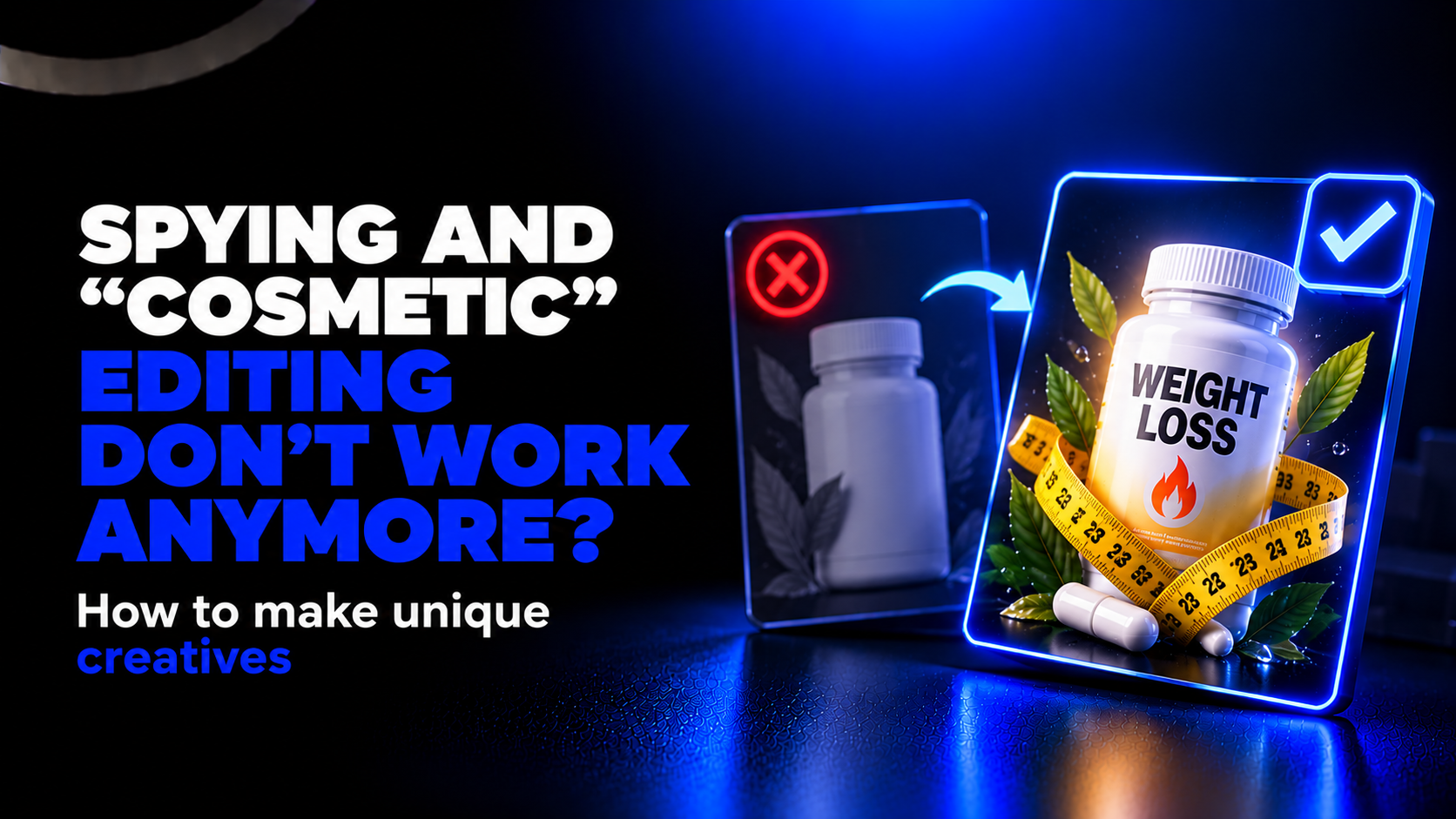
If you've been buying traffic for more than a year, you've watched the old way of uniqueizing creatives die in front of you. Two or three years ago you could "refresh" a winning creative by swapping its metadata, nudging the speed, changing the font, flipping it horizontally — and get roughly the same conversion. That window is closed. The platforms have learned to read the meaning of a video rather than the file itself, and to them a technically "different" file is still the same creative.
Below is a deep dive into how FB and TikTok ad systems analyze creatives in 2026, why the old tricks return less and less, where the line actually sits between a new creative and a variation, how to use spy tools now, and how to build a creative system that doesn't collapse the moment a single winner burns out.
Article structure
- What changed: from file to meaning
- What the ad system actually recognizes in 2026
- Which "classic" uniqueization still works — and which doesn't
- The top 12 buyer mistakes in uniqueization
- Where the line sits between a new creative and a variation
- Cheat sheet: what to keep vs. what to change
- Why you still need spy tools — and the new launch logic
- The difference between FB and TikTok
- The role of AI generation and UGC in 2026
- How to build a creative system instead of living winner-to-winner
- Pre-launch checklist
- Takeaway
1. What changed: from file to meaning
The core shift of recent years is simple: algorithms stopped comparing files and started comparing meaning. Uniqueization used to work because the system keyed off technical signals — the file hash, resolution, bitrate, metadata. Change those, and you'd register as a "new" object in the eyes of moderation and the auction.
Today the platforms parse a video at the level of content: who's on screen, what they're doing, what the scene is, what text appears, what the voice says, what the music is, how it's edited, what emotion it carries, and how audiences have already reacted to similar content. To a system like this, "speed it up 3%, change the font, flip it" isn't a new creative — it's the same video wearing makeup.
The impact on buying shows up in the numbers. Where a careful variation of a working creative used to deliver around 70–90% of the original's result, a typical variation today often lands at 20–40% — and sometimes doesn't catch at all. Similar creatives burn out faster, clear moderation worse, enter the auction more expensively, and more often fail to learn properly, because the algorithm sees the repeat across scene, face, structure, sound, text, editing, and audience response.
The point to internalize before your conversion drops: crude uniqueization — flipping, filters, speed changes, a couple of reworded lines — has, since late 2024, stopped being a scaling tool in most verticals. At best it's a way to lightly freshen a creative that's still alive.
2. What the ad system actually recognizes in 2026
Ad systems have looked past metadata for a long time. It helps to keep the full list of signals in mind — the things a platform reads to decide a video is "derivative":
- Faces and character types — not a specific individual, but a recognizable type and facial expression.
- Objects in frame — props, the product, set dressing.
- App interfaces — product screenshots and screen recordings.
- Logos and brand elements.
- On-screen text — subtitles, captions, overlays.
- Voice and audio track — timbre, intonation, the voiceover script.
- Music and sound effects.
- Edit structure — the rhythm of cuts, shot length.
- Similar scenes and locations.
- Visual style — color, lighting, grading.
- Shot sequence — the dramaturgy of the video.
- The semantic pattern — the narrative itself: pain → promise → proof → call to action.
- Audience reaction to similar content — watch-through, clicks, skips on creatives that have already been run.
This is exactly why precise work on composition (splitting a creative into layers, enlarging individual elements, flipping it, changing the background) helps but never gets you to a full result: the meaning layer stays the same, and the system recognizes it.
3. Which "classic" uniqueization still works — and which doesn't
Sort the familiar techniques into "still worth doing" and "barely moves the needle," and here's how 2026 looks:
May still be worth it:
- adapting to the format and logic of the source;
- replacing the first 2–3 seconds (the hook);
- a new voiceover;
- a different protagonist/character type;
- a different script;
- a different scene context;
- a new delivery logic;
- deep localization to the country, language, culture, and audience pain points.
Barely moves the needle:
- just flipping it;
- changing the font;
- speeding the video up slightly;
- adding a filter;
- swapping a couple of words;
- reuploading the same UGC with a different intro.
There is, however, a working "light-touch" approach: a small change to the background or to the person on screen. In today's reality, uniqueization increasingly becomes a refresh — updating minor elements to extend the life of a creative that hasn't burned out yet. Just be clear on the distinction: a refresh extends the life of what exists, while scaling requires genuine novelty (see Section 5).
4. The top 12 buyer mistakes in uniqueization
The old approach didn't die in a single day — it's been fading gradually. The thousands of cookie-cutter creatives that were mass-produced across every vertical played their part too: the networks essentially trained on all that sameness. Here are the mistakes most likely to burn budget today:
- Duplicating the winner too aggressively — multiplying one video instead of developing its mechanic.
- Making 10 identical variations and being surprised they all burn out at once.
- Changing only technical parameters, not the idea.
- Scaling CTR instead of money — chasing click-through rate instead of funnel depth.
- Not watching the full funnel down to deposit/purchase.
- Breaking a working ad set by editing it — touching something that has already learned.
- Raising the budget too fast and knocking out the learning phase.
- Not separating the creative hypothesis from the media-buying one — being unable to tell whether results dropped because of the creative or the settings.
- Taking the video from spy, not the mechanic — copying the form instead of the reason for success.
- Not building a creative system, but living from one winner to the next.
- Launching creatives without tagging the hypothesis — making it impossible afterward to tell what actually worked.
- Ignoring the traffic-quality signal — optimizing on top-of-funnel events and getting cheap registrations with no deposits.
None of these mistakes are new in themselves, but in 2026 they bite harder: the system used to forgive sameness, now it penalizes it.
5. Where the line sits between a new creative and a variation
The most common question: a test finds a winning creative, it performs beautifully — but if you uniqueize it as deeply as 2026 demands, will any of the result survive? After all, you have to change almost everything.
The answer is to separate form from perception.
A variation is when you change the form. Same protagonist, same hook, same scene, same logic, same call to action — that's a variation, even if the file is technically different. The algorithm (and the human) reads it as a repeat.
A new creative is when you change perception. It begins the moment at least a few key things change:
- a different first frame;
- a different protagonist;
- a different situation;
- a different angle;
- a different conflict or pain;
- a different reason to believe;
- a different emotion;
- a different delivery structure.
The goal isn't to fool the algorithm — it's to make both the human and the system experience the video as a new advertising experience. That's a fundamentally different way of working: you're not hiding an old creative, you're building a new one around a proven mechanic.
A practical tip: if a creative stops performing after a deep refresh, don't throw it away — try to work out which vital element you removed, and put it back. Results often hang on one specific detail (a particular hook, a particular emotion in the first frame), and lose it and you lose the whole conversion.
6. Cheat sheet: what to keep vs. what to change
So uniqueization doesn't turn into throwing away a working mechanic, keep a simple split on hand.
Keep (this is the value of the winner):
- the type of pain;
- the persuasion structure;
- the trust format;
- the emotional trigger;
- the logic of the transition to the product;
- a strong CTA;
- the pacing.
Change (this is what creates novelty):
- the protagonist;
- the first 2–3 seconds;
- the scene;
- the wording;
- the visual context;
- the voiceover;
- the examples;
- the localization;
- the editing patterns.
The logic is simple: keep what drives the result (why a person believes and buys) and change what the system uses to recognize a repeat (how it looks and sounds).
7. Why you still need spy tools — and the new launch logic
If adapting your own winners takes work, spy tools take even more. But it's too early to cancel the subscriptions: the approach changed, yet the need to see working meanings remains. You now go into spy not for the video, but for the market.
What the full offer-work cycle looks like in 2026:
- Take an offer and a country (e.g. FR).
- Break down the product: registration, deposit, bonus, payment methods, restrictions, strengths.
- Go into spy not for a video but for the market: which angles are running, which hooks keep recurring, which formats live longest.
- Analyze not "what to steal" but "why it works": the pain, the promise, the visual pattern, the first frame, the CTA, the social context.
- Form 3–5 fundamentally different hypotheses.
- Build a separate creative package for each hypothesis: several videos, different opening seconds, different protagonists, different deliveries.
- Adapt to the source: Meta wants cleaner logic and a strong first frame; TikTok wants more nativeness and the feel of "content."
- Test not a single creative but the whole bundle: offer → prelander/PWA → creative → audience → pixel → event.
- Watch not just CTR but the full funnel: click → install/reg → deposit → CPA → quality.
- Don't scale winners by crude copying — break them down into their mechanic and build new versions around it.
A separate working tactic is to pull your own source material from similar countries. For a new geo you can take a creative from a culturally and economically close country (for Colombia, say, your Argentina material) and add finds from spy on top. Everything that performs goes to the designers for a refresh.
Spy services are still needed for another reason too: there are always innovators who find something non-obvious — an unconventional mechanic, a fresh visual device, a new approach to trust. Without spy you might simply never think of it yourself. So the best strategy is to observe, test, and rework for yourself — not copy one-to-one. Many buyers also prefer the platform's own ad library to spy: it shows what's actually running right now.
8. The difference between FB and TikTok
One platform can wave a creative through and give you a good conversion while another cuts it to almost nothing. The era of one-size-fits-all approaches and simple size adaptation is over. But the platforms work on different logic, and that's usable.
Meta is tougher on repetition, patterns, and the quality of the ad signal. Simple variations die faster here, especially once the account, pixel, and vertical are already "sensitive." Meta reacts more to the structure of the video and the cleanliness of the funnel — here the advertising mechanic decides.
TikTok leans more on nativeness: pace, trends, the feel of live content. Here variations of a single approach sometimes live longer — if they look like different organic videos: a different person, a different delivery, a different sound, a different context. But TikTok, too, stopped being about "reupload someone else's video" long ago: the platform is good at sensing derivativeness and weak retention.
Short version:
- Meta demands a stronger structure and a cleaner funnel;
- TikTok demands more nativeness and a content feel;
- on Meta, the advertising mechanic matters more;
- on TikTok, the "this is content, not an ad" feeling matters more.
The practical conclusion: the same creative almost never ports between the two platforms "as is." For Meta, strengthen the first frame and the logic; for TikTok, strengthen the organic feel and the sense that a regular person shot it.
9. The role of AI generation and UGC in 2026
It's worth addressing separately the thing that has visibly reshaped the picture over the past couple of years — mass AI generation.
Generative tools (video, voice, avatars, lip-sync) have driven the cost of producing a creative down to nearly zero. That's an opportunity and a trap at the same time.
The opportunity: AI lets you quickly assemble genuinely different hypotheses — different protagonists, different scenes, different voiceovers and localizations — which is precisely the kind of substantive novelty 2026 demands. For deep localization to language and culture, it's especially valuable.
The trap: if AI is used for the same thing flipping used to be used for — stamping out 50 near-identical videos — the result will be the same as old uniqueization. The algorithm sees the same semantic pattern whether a human or a neural network made the video. On top of that, platforms are getting better at spotting "empty" AI content with no retention.
The rule is simple: AI is an accelerator for producing hypotheses, not a replacement for hypotheses. It helps you cheaply test many different ideas, but the ideas themselves (angle, pain, reason to believe) are still the buyer's job.
The same goes for UGC: the value of a live video isn't that it's "real," it's that it carries a new perception. A reuploaded piece of someone else's UGC with a different intro is, to the system, still a repeat.
10. How to build a creative system instead of living winner-to-winner
The central idea of this whole piece: in 2026 the winner isn't whoever has one brilliant video, it's whoever has a system for producing hypotheses. A winner will burn out either way — the question is whether you have a conveyor belt producing the next one.
What that looks like in practice:
- An angle bank. Keep a list of proven angles (pain, promise, protagonist type, trust context) for each vertical and geo. This is your real asset — not the specific files.
- Decomposing winners. Break every video that fires into its components: what hook, what pain, what reason to believe, what CTA. These elements get reused; the videos themselves don't.
- Batch testing. Test packages of 3–5 different hypotheses rather than individual videos, so you quickly learn which angle lives and which doesn't.
- Tagging. Record each creative's hypothesis (angle, hook, protagonist), otherwise after the test you can't tell what actually worked — and you won't be able to repeat it.
- Separating layers. Always separate the creative hypothesis from the media buying. If results drop, first determine whether it's the creative or the settings, or you'll be fixing the wrong thing.
- An update rhythm. Don't wait for the conversion to drop. Prepare the next wave of hypotheses while the current one is still in the green.
11. Pre-launch checklist
Before you start buying, run quickly through the list:
- Is this a new creative (different perception) or a variation (different form)? Scaling needs the former.
- Is the working mechanic preserved (pain, persuasion structure, emotional trigger, CTA)?
- Has what the system uses to recognize a repeat been changed (protagonist, opening seconds, scene, voiceover, editing)?
- Is the creative adapted to the specific source (Meta — structure, TikTok — nativeness)?
- Does the hypothesis have tagging (angle, hook, protagonist) so you can dissect the result later?
- Are you testing the whole bundle, not just the video?
- Are you watching the full funnel to deposit/purchase, not just CTR?
- Is the next wave of hypotheses ready in case of burnout?
12. Takeaway
The move from form to meaning will most likely continue, and small technical edits will keep buying afloat for ever-shorter stretches. If you have a polished uniqueization routine with a good conversion right now, there's no guarantee it performs the same tomorrow.
So the smarter move is not to wait for the conversion to fall but to rebuild your process ahead of time: think in meanings, not files; build a bank of hypotheses and a creative system; and treat uniqueization as creating a new advertising experience rather than disguising an old one. Those who adopt the new rules earlier gain their advantage at exactly the moment everyone else's numbers start to slide.
Share this article
Send it to your audience or copy an AI-ready prompt.