Halloween 2026 for Media Buyers: How to Work Q4's First Big Spike
Halloween is one of the few occasions you never have to explain to an audience. Pumpkins, ghosts, witches and vampires register in a split second, and the holiday gives a natural reason for limited-time offers, themed promos and promo codes. In 2026 it has one more advantage: October 31 falls on a Saturday. Peak activity stretches across a long weekend from October 30 to November 1, when users have more free time for gaming, shopping and entertainment.
There is a flip side. Halloween opens Q4, the most expensive stretch of the year for buying traffic. By late October, e-commerce advertisers are already warming audiences up for Black Friday, and the auction gets pricier for everyone. The winners are the teams that find working setups before the market floods with seasonal creatives. Below is a practical breakdown: when to start, which GEOs and verticals to focus on, how to build creatives, what to test, and how not to burn budget at the peak.
The 2026 calendar: dates to keep in view
Halloween doesn't exist in a vacuum. Several events around it shape user behavior and traffic costs.
| Date | Event | What it means for buying |
|---|---|---|
| Early October | Seasonal releases and promos begin | Window for cheap tests while competition is low |
| Oct 25 (Sun) | Clocks go back in the EU and UK | Dayparting schedules and hourly reports shift |
| Oct 30 – Nov 1 | Long holiday weekend | Main peak in traffic and deposits |
| Oct 31 (Sat) | Halloween | Day of maximum auction competition |
| Nov 1 (Sun) | Clocks go back in the US and Canada | Check ad schedules and hourly attribution |
| Nov 1–2 | Día de Muertos (Mexico and LatAm) | Extends the seasonal theme for LatAm GEOs |
| Nov 27 (Fri) | Black Friday | Sharp CPM increase; wrap up the Halloween tail early |
The holiday also lands in the middle of a busy sports season: NFL and NBA regular seasons, European club competitions and the top football leagues. For betting, this is a chance to pair a sports hook with a Halloween angle, such as "spooky" odds boosts or themed free bets on weekend games.
Prep timeline: don't build everything around October 31
The most common mistake is launching a Halloween campaign a couple of days before the holiday. By then the auction is crowded, competitors' creatives all look alike, and there's no time left to find a setup that works. Start dates vary: some teams begin five or six weeks out, others two. The logic is nearly always the same.
- Late September – first week of October: prep. Build a pool of offers with Halloween promos, confirm promo dates with networks and advertisers, and prepare 3–5 creative groups with different angles.
- Second week of October: tests. Small budgets, one hypothesis per variable. The goal is to see which hooks drive deposits or purchases, not just CTR.
- Mid-October: scaling. Cut losing setups, raise budgets on winners, and make variations of your best creatives to delay fatigue.
- October 24–31: peak. Most of the budget goes here, with a focus on time-limited offers and countdowns.
- November 1–8: tail and reactivation. Short "last chance" promos, retargeting people who clicked but didn't convert, and a smooth handoff to November and holiday-season campaigns.
The key point: by the time competitors flood the market with Halloween creatives, you should already have data and proven setups.
GEOs: where Halloween sells and where it just decorates
The holiday's pull varies a lot by market. In some countries Halloween is a mass event with costumes and parties; in others it's more of a trendy aesthetic with little real effect on behavior.
| GEO group | Holiday strength | How to use it |
|---|---|---|
| US, Canada, UK, Ireland, Australia | Very strong, part of the culture | Full seasonal campaigns, costumes, themed promos, Trick or Treat |
| Mexico and Latin America | Strong, plus Día de Muertos on Nov 1–2 | Extend the theme into early November, adapt visuals to local tradition |
| Brazil | Moderate (Dia das Bruxas) | Halloween as a style, focus on promos and bonuses |
| Germany, Poland, Czechia, Nordics | Moderate, growing among younger users | Seasonal styling without overloading on symbols |
| Tier-3 and low-engagement regions | Weak | Use dark autumn visuals as a hook, not as the main offer |
In India, Diwali falls in early November and matters far more than Halloween, so seasonal budget is better spent there. Either way, check not only how popular the holiday is but also the ad rules in each jurisdiction: for gambling and betting, they can override any creative idea.
Verticals: who gets the most out of Halloween
Seasonal campaigns are usually discussed in the context of iGaming, but Halloween works across other verticals too.
- iGaming. The obvious one. Every October, providers release or re-promote themed slots full of mysticism, monsters and potions, while operators run tournaments, drops and seasonal bonuses. You don't need to invent a Halloween story from scratch; it's already been built for you.
- Betting. Pair the holiday with the sports calendar: weekend games on October 30 – November 1, themed free bets, "spooky" accumulators.
- Sweepstakes and social casino. Mystery prizes and giveaways fit the theme of the unknown perfectly.
- E-commerce and dropshipping. Costumes, decor, lighting, party supplies. Demand peaks earlier here: many people buy 2–3 weeks ahead, so the final days underperform unless you offer fast shipping.
- Mobile apps and games. Horror and casual games with seasonal events, photo editors with Halloween filters, AI apps that generate costumes and avatars.
- Dating. Parties and themed meetups are a natural hook for "find someone to go out with on Halloween" creatives.
- Nutra. Use with caution: a "scary" angle combined with health claims is almost guaranteed to cause moderation and trust problems.
Creatives in 2026: recognizable, but diverse
A Halloween creative's strength is its recognizable visual code. Even major brands don't reinvent the wheel: an orange-and-black palette, pumpkins, ghosts, the moon, fog, dark backgrounds with contrasting accents. This isn't laziness; it's psychology that works. The audience instantly links familiar symbols to the season and expects a limited-time offer.
What has changed by 2026 is what ad algorithms demand. Major platforms, Meta above all, lean ever more on automated audience matching, and creative diversity now matters more than precise targeting. Ten near-identical banners with the same pumpkin look like one creative to the algorithm. You need genuinely different concepts: different formats, different hooks, different emotions.
The core building blocks of a Halloween creative:
- recognizable characters and symbols: pumpkins, ghosts, witches, vampires, skeletons;
- dark backgrounds, neon or orange accents, high contrast;
- visuals of the themed product itself: a slot, a costume, an app;
- a countdown to the end of the promo;
- a Trick or Treat or "mystery reward" mechanic;
- a promo code tied to the holiday.
A few rules that save budget:
- Don't overload the first screen. If one banner shows a themed slot, a promo code, a tournament, free spins and a button, the main hook gets lost. One idea per creative.
- Go vertical video. 9:16 for Reels, TikTok and Shorts, with your strongest visual hook in the first 1–2 seconds.
- Use AI for volume, not for the idea. Generative tools let you produce dozens of background, character and animation variations in a day. But a human sets the concept and the hook; otherwise you get the same "generated Halloween" as everyone else.
- Localize. Halloween looks different in Mexico, the US and Germany. Language, local symbols and the right currency in the promo code noticeably lift conversion.
- Keep a reserve. Creatives fatigue faster than usual during peak week. Hold back 30–50% of your variations so you can refresh campaigns without losing the learning phase.
Mechanics and funnels: one story from click to conversion
Halloween sells scarcity and the unknown. The mechanics that work best are the ones where users don't know in advance what they'll get, or know the offer is about to disappear.
Themed promo code. A short word tied directly to the holiday: PUMPKIN, GHOST, ZOMBIE, VAMPIRE, MONSTER, SPOOKY. It's easy to remember and easier to track by channel, since you can create a separate variation for each traffic source.
End-to-end funnel. The strongest campaigns tell one story along the entire user journey:
Halloween creative → themed pre-lander → promo code → short validity window → themed game or product category.
If the creative is about witches and the landing page is a standard operator page without a single seasonal element, the user's expectation breaks and conversion drops.
Several activations instead of one bonus. Don't stop at a single offer. A mix that works well:
- free spins on themed slots;
- reload bonuses on repeat deposits;
- tournaments and leaderboards, including series of short tournaments;
- freeroll tournaments for new players;
- Drops & Wins and random prize drops;
- Mystery Bonus and Mystery Drop;
- daily missions and points accumulation;
- time-limited reward multipliers.
Make some promos short, for example just 2–3 days from October 28 to 31. Extend others into early November. This creates a sense of exclusivity and scarcity and gives users a reason to come back. Trick or Treat mechanics and mystery rewards fit especially well: not knowing the outcome is the whole point of the holiday.
Test matrix: test hypotheses, not banners
In media buying there's no rule that says "pumpkin + free spins" or a mystery bonus will automatically deliver the best CTR. There's only a proven principle: seasonal content works when the launch is built on data. And data comes from tests.
Instead of five near-identical banners, test genuinely different hypotheses:
| Creative | Hypothesis | What it tests |
|---|---|---|
| A | Halloween visuals + themed product (slot, costume, app) | Whether the product sells itself |
| B | Halloween visuals + promo code | Whether the offer works as the main hook |
| C | Trick or Treat / mystery reward | Whether curiosity drives action |
| D | Tournament + leaderboard + seasonal palette | Response from a competitive audience |
| E | Countdown + offer valid until October 31 | The pull of scarcity and urgency |
| F | UGC video or a "reaction" to a win or purchase | Trust and native feel |
Test rules: one variable per hypothesis, matching audiences and budgets, and enough data before drawing conclusions. Don't kill a creative after the first few hundred impressions; algorithms need time to learn.
Metrics: a high CTR proves nothing on its own
Seasonal creatives often post excellent CTRs because holiday imagery sparks curiosity. But curiosity isn't purchasing power. A high CTR with weak Reg2Dep usually means the creative is pulling in idle clickers rather than your target audience.
Evaluate the whole chain:
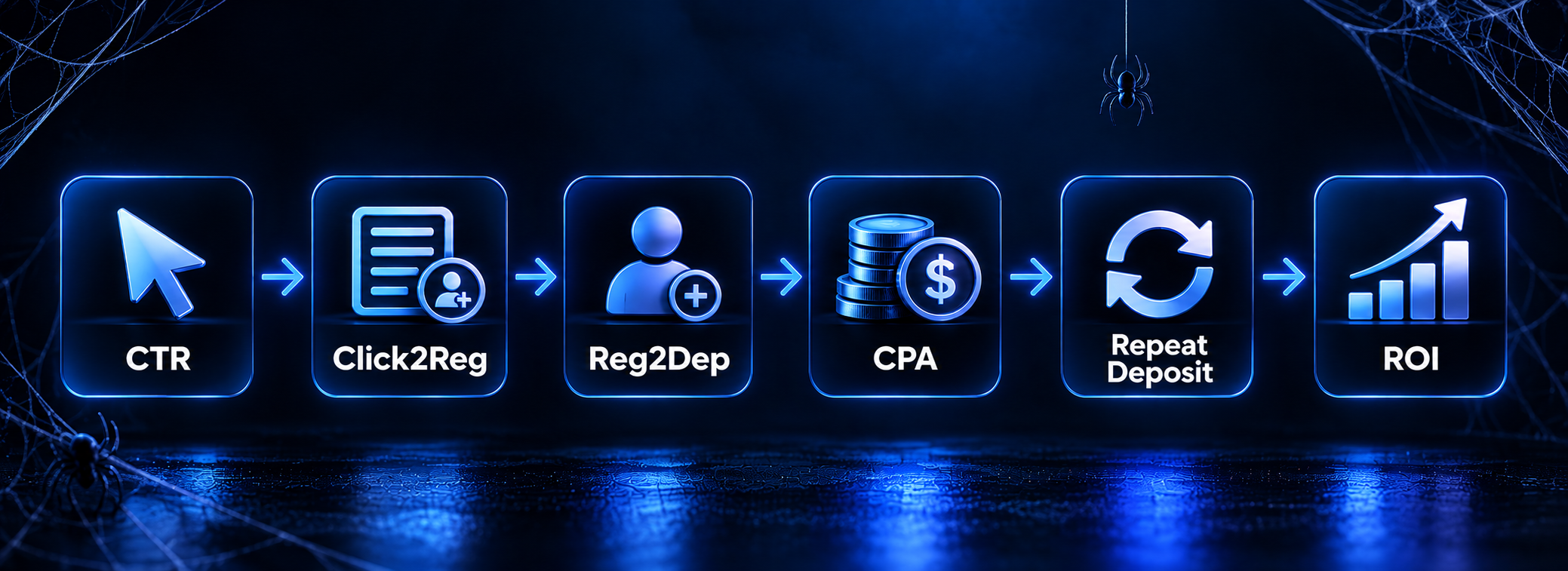
For e-commerce, the equivalent is CTR → add to cart → purchase → average order value → ROAS. Look at cohorts separately: users who came in on a Halloween promo may convert well to a first deposit but retain worse. Compare their LTV with regular traffic at day 7 and day 30; that tells you whether this setup is worth scaling again next year. And make sure postbacks and attribution are set up before the peak, not during it.
Auction and budget: how not to overpay at the peak
Q4 is when big advertisers with big budgets enter the auction, and CPMs climb week after week. Halloween is the first step up; Black Friday on November 27 is the summit. A few practical points:
- Record baselines early. Note your CPM, CPC and CPA for September and early October so you can see how much traffic costs are rising and don't mistake a seasonal increase for a creative problem.
- Factor in the Saturday. With October 31 on a weekend, Friday evening and Saturday will be the most competitive slots. It can pay to shift some budget to Thursday and Friday morning, before the auction overheats.
- Recheck dayparting after the clock change. Clocks go back in the EU on October 25 and in the US on November 1. Schedules tied to the account's time zone can drift by an hour, and hour-by-hour comparisons in reports will be off.
- Scale gradually. Sharp budget jumps reset a campaign's learning. Increase in 20–30% steps, or duplicate winning setups into new campaigns.
- Set stop-losses. On peak days, expensive traffic can eat your margin in a few hours. Configure spend caps and auto-pause rules based on CPA.
Moderation and compliance: where Halloween gets ads rejected
Seasonal aesthetics are a risk as well as an advantage. A few things to check before launch:
- Blood, violence and frightening imagery. Overly realistic zombies, wounds, weapons and shock content are often rejected or see reach throttled. Stay in "cute-creepy" territory, not "genuinely scary."
- Child-appealing visuals in gambling. Cartoon pumpkins and cute ghosts look harmless, but in many jurisdictions, such as the UK, gambling ads must not strongly appeal to under-18s. A cartoon style can draw regulator complaints, so go for a more grown-up look.
- Platform rules for gambling and betting. On major platforms these ads require certification or authorization and are allowed only in certain countries. Check this before you spend time on production.
- Honest mechanics. If you promise a mystery prize, it must exist and the terms must be clear. Misleading promos hurt both moderation and retention.
After October 31: the campaign doesn't end at midnight
Halloween gives you not just a peak but an audience you can keep working with:
- The November 1–3 tail. Short "last chance" promos and extended offers often run cheaper than the peak, because competitors have already switched off their seasonal creatives.
- Día de Muertos. For Mexico and LatAm, the theme naturally continues on November 1–2.
- Retargeting and reactivation. Users who clicked or registered but didn't deposit or buy are a warm audience for November offers.
- Bridge to Black Friday. Carry winning mechanics (countdowns, mystery rewards, limited promo codes) into November campaigns, changing only the visual code.
- Review the results. Write down which hooks, GEOs and mechanics worked. A year from now, that saves weeks of testing.
October 2026 checklist
- Compile a list of offers with Halloween promos and confirm promo dates
- Choose GEOs based on holiday strength and ad restrictions
- Prepare 5–6 creative groups with different hypotheses
- Build themed promo codes and pre-landers
- Check postbacks, attribution and dayparting around the clock changes
- Record baseline CPM and CPA from September
- Launch tests by mid-October at the latest
- Scale winners by October 24
- Prepare tail promos and retargeting for November 1–8
- Write up lessons for next season
Conclusion
Halloween is one of the most predictable occasions of the year: the date is known in advance, providers and advertisers prepare themed promos, and the audience is already expecting holiday offers. In 2026, a Saturday Halloween and the closeness of Black Friday make it even more important, and even more expensive. The winners will be those who start testing in early October, judge setups by the full funnel rather than CTR, and turn holiday traffic into an audience for the rest of Q4.
Share this article
Send it to your audience or copy an AI-ready prompt.