Instagram Comments Are Turning Into a CRM: What Meta's "Reply to Keywords" Means for Media Buyers in 2026
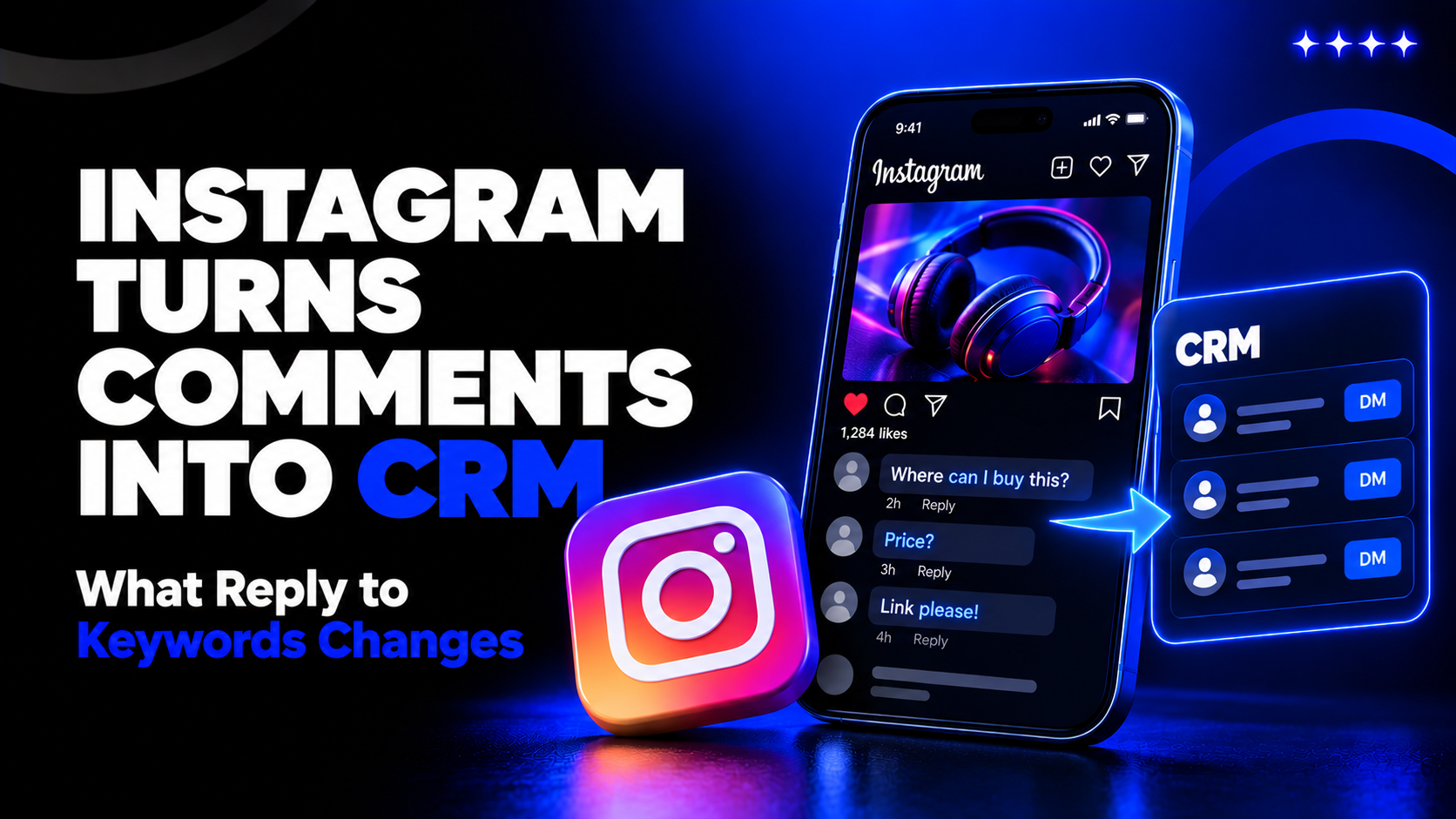
In late August 2026, a slice of advertisers opened Ads Manager and found a new option waiting in the ad-creation flow: Reply to Keywords. The premise is simple — a user comments a specific word under your Instagram ad, and the system fires back a pre-written direct message automatically, no human in the loop.
For anyone who runs paid traffic for a living, this is worth more than a passing glance. Meta is quietly pulling a workflow that used to require third-party software directly inside the ad account. Below we break down how the feature actually works, where its hard limits are, whether it can replace ManyChat-style tools, and — most importantly — how to fold it into a funnel without torching your leads.
What Reply to Keywords actually does
Meta has spent the last couple of years migrating automation tooling into Ads Manager, and comment interactions are the latest piece to move in. The mechanic is exactly what it sounds like: the system watches the comments on your promoted post, and when someone drops one of your chosen keywords, it sends that person a private message.
Here's the setup as it stands in the test build:
- Up to five keywords or phrases. You define the trigger words. When a user comments any of them on your ad, the DM goes out.
- One pre-written message. You write the text that gets sent. Meta says it can carry a link, a phone number, or an email address.
- Live previews. Ads Manager shows you a preview of both the comment and the outgoing DM, so you can eyeball the customer experience before the ad goes live.
- A dedicated "Conversations" section. Advertisers with access toggle the feature on inside a new block in the ad builder, rather than bolting it on afterward.
One caveat that matters a lot for funnel design: all five keywords currently point to the same message template. There's no branching. You can't have "PRICE" open a price list while "DEMO" books a call. That makes today's version a single-path tool, not a full funnel builder — a point we'll come back to.
None of this is conceptually new inside Meta's ecosystem. Keyword-triggered auto-replies have existed for a while through Inbox Automation and the Meta Business Agent in Business Suite. What's genuinely new is the placement: Meta is testing the mechanic inside the ad-creation flow itself, tying it to the container you're already building rather than to a separate messaging surface.
The limitations you need to know before you rely on it
This is a test feature, and it behaves like one. A few constraints are worth internalizing before you build anything around it.
Instagram only. Every report so far — and Jon Loomer, who first surfaced the feature, confirmed this — shows it running on Instagram placements. Facebook placements aren't supported. Meta hasn't clarified which GEOs or ad accounts are in the test either, so availability is a lottery right now.
The API messaging window is not a blank check. This is the piece the hype cycle keeps skipping. Instagram's existing private-reply rules cap a business to one private reply within seven days of the comment, unless the recipient replies first. Once they do reply, you get a 24-hour window for follow-up messages. For Instagram Live, the window shrinks to the duration of the stream. In plain terms: the auto-DM is not a license to camp in someone's inbox for a week. It's a short, one-shot opening. Design the first message as if it's the only guaranteed message you'll ever send — because it might be.
It might never ship broadly. Meta has a track record of testing comment-adjacent features and quietly dropping them. Back in 2024 the company trialed Comment Controls — a setting to restrict or fully disable comments under ads — and it never graduated into a standard Ads Manager tool. Reply to Keywords could follow the same path, so don't rebuild your entire acquisition model around it just yet.
Simple actions inflate vanity metrics, not conversions. The easier you make the trigger, the more comments and DMs you'll collect — but volume isn't quality. A flood of "PROMO" comments from people who'll never convert is just noise with a nicer dashboard.
Why this matters for affiliates and performance buyers
Strip away the novelty and here's the real story: Meta is embedding a mechanic natively that used to demand an external service and an API connection.
For a straight "keyword → automated message" play, a third-party tool genuinely may become unnecessary. The comment-to-DM pattern — user comments a word, gets a DM, enters a conversation — is a staple in lead gen, e-commerce, dating, and any vertical where the goal is to capture a contact or continue the conversation without pushing the user off-platform to a landing page.
And there's a structural advantage most buyers underrate: the algorithm tends to be friendlier when you use the platform's own native features. Wiring up an external tool over the API has always carried a tax. You launch, connect the software, and catch a checkpoint out of nowhere for "suspicious activity." The API has a habit of dropping. The middleware has a habit of
falling over at the worst possible moment — traffic's flowing, budget's spending, the auto-replies have silently died, and you're bleeding warm leads in real time. Every extra technical link is a new point of failure.
Moving that link inside Ads Manager removes it. Less integration overhead, no monthly fee for a messaging service, more native trust, fewer triggers. For a buyer, that's close to an ideal trade.
The honest counterpoint: for anything more complex than one keyword and one message, you still need the external platforms. Multi-step sequences, conditional logic, per-keyword scenarios, CRM sync, cross-channel nurture — none of that lives in the test build. Reply to Keywords covers the shallow end. The deep end still belongs to the dedicated tools.
How to use it well: a practical playbook for 2026
If the option shows up in your account, here's how to get real value out of it instead of just inflating comment counts.
Pick distinctive keywords, not generic ones. A word like "price" or "yes" can appear naturally in a comment and fire a DM nobody asked for. A distinctive, purpose-built trigger — "GUIDE," "MENU," "AUDIT," "SIMULATOR" — tied to a clearly stated action creates a stronger sense of consent and cleaner data.
Match the keyword to the vertical. In niche offers, a topic-relevant trigger ("audit," "size," "recipe," "schedule") often pulls less volume but far more intent. Fewer comments, better leads is usually the trade you want.
Tell people exactly what will happen. Your creative or caption should spell it out: "Comment PROMO and we'll DM you the offer." Clear expectation up front means the DM lands as something the user asked for, not an ambush.
Front-load the value. Because of the seven-day / single-reply cap, your first message is effectively your only guaranteed shot. Deliver the promised thing immediately — the link, the code, the resource — and give exactly one obvious next step. Don't save the payoff for message two that may never be allowed to send.
Make it easy to reach a human. The moment the conversation gets more complex than the script handles, the user needs a clear path to a real person. Automation that dead-ends kills trust fast.
Measure the right things. Comment volume is a vanity metric. Track replies, qualified conversations, and actual conversions.
The bigger picture: Meta is turning DMs into the front door
Zoom out and Reply to Keywords is one move in a much larger strategy. Users increasingly live in private messages rather than the feed, and Meta is methodically converting every public interaction into a private-conversation opportunity. Comments become a CRM entry point; the distance between seeing an ad, expressing interest, and entering a conversion flow keeps shrinking.
For buyers, that direction of travel is the real signal — bigger than any single test feature. The interface here looks almost trivially simple, arguably too simple in an era where conversational AI can seed genuinely human-feeling exchanges. But the strategic shift underneath it is not small: Meta wants the conversation to start inside its own walls, on its own tooling, and it's building the on-ramps to make that the default.
Bottom line
Reply to Keywords can close out the basic jobs people currently rent third-party DM services for — the simple comment-to-DM handoff, done natively, with less overhead and more algorithmic goodwill. What it can't do yet is replace the complex funnels: no branching, no per-keyword scenarios, no multi-step logic. Layer on the fact that it's still a limited Instagram-only test with a real chance of never rolling out broadly, and the sensible stance is clear: if it's in your account, test it, measure conversions rather than comments, and keep your heavier automation stack ready for everything the native tool can't touch.
Share this article
Send it to your audience or copy an AI-ready prompt.