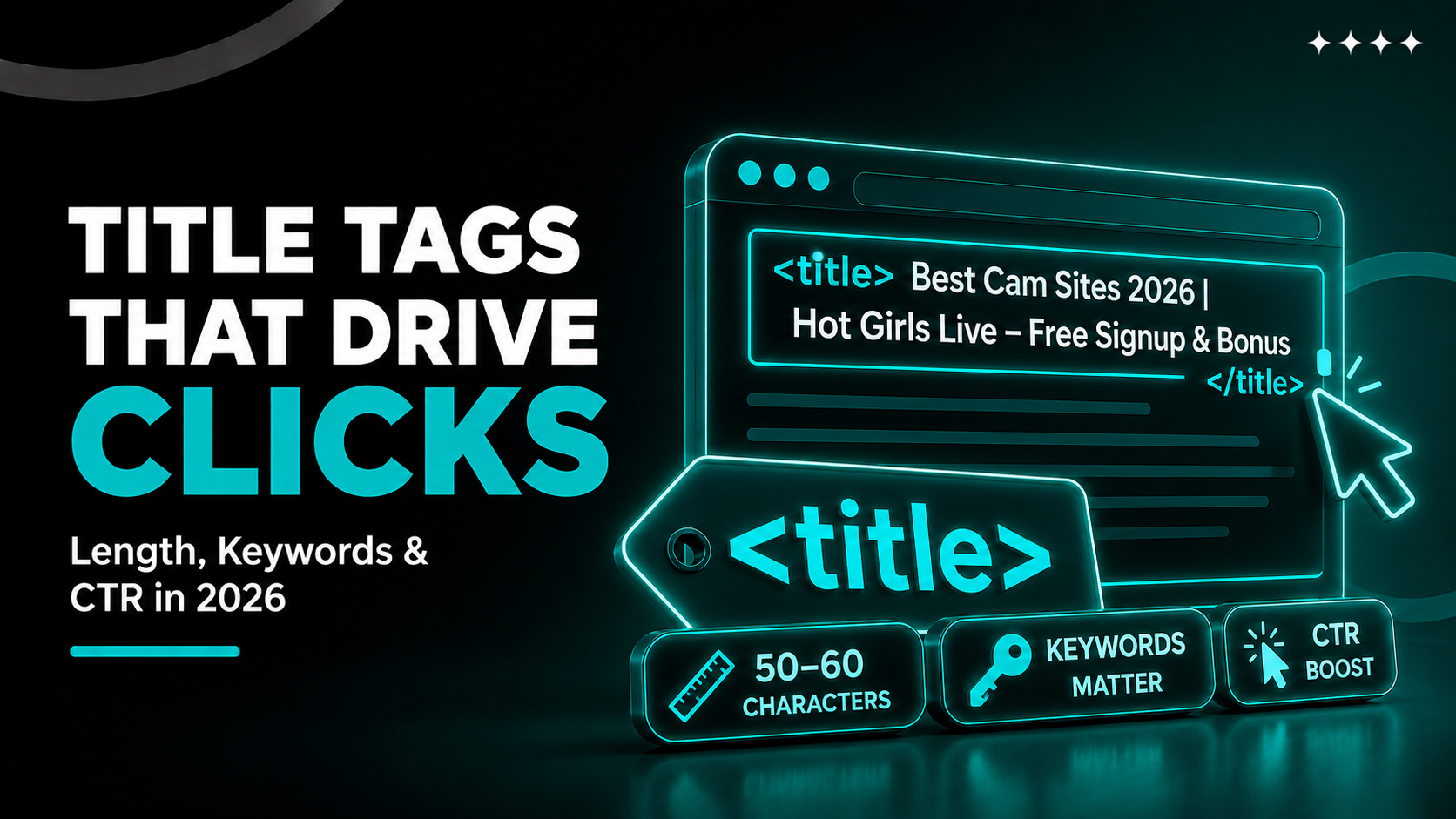
Title Tags That Win Clicks: The 2026 Length, Pixel & Keyword Playbook for Adult Sites
On-page SEO field guide · Updated 2026 · Reading time ~18 min
Your homepage <title> is still the highest-ROI line of code on your site. In 2026 it matters more than ever — Google now rewrites most titles, AI answers are eating the clicks that remain, and regulation is thinning adult traffic worldwide. This is how to write titles that survive the rewrite, rank for the terms that pay, and earn the tap.
The short version
- Aim for ~51–55 characters and stay under ~600px on desktop — but write mobile-first, because that's where Google now judges truncation.
- Put your primary keyword in the first 3–5 words. Early position carries the most ranking weight.
- Keep titles accurate and un-stuffed so Google doesn't overwrite them — rewrite rates have climbed to roughly 76%.
- Sentence case beats ALL CAPS: caps are 30–40% wider and read as spam.
- Brand goes last unless you're already a household name searchers look up by name.
- In 2026 every organic impression is worth more. Age-verification laws and SafeSearch are shrinking the adult traffic pool — the title is your cheapest lever on what's left.
01 — What a title tag is, and its new job in 2026
The title tag is the clickable headline of your page. It shows up as the blue link in search results, as the label on the browser tab, and as the headline when someone shares your URL on messengers or forums. It tells search engines and humans, in one line, what the page is about — which makes it the most visible on-page element you fully control.
Title tag vs. H1 heading
These are two different things and they don't have to match. The title tag (<title>) lives in the page's <head> and appears in search results. The H1 is the visible heading on the page itself. On an adult homepage the title usually leans on broad, high-volume keywords for search visibility, while the H1 can be shorter, punchier, or more brand-forward for the visitor who already landed.
There's a practical reason to keep the H1 clean and descriptive: when Google decides to rewrite your title, it very often pulls the replacement straight from your H1. A tidy H1 is your insurance policy — more on that in Section 03.
The third audience: machines that answer instead of link
Until recently a title spoke to two audiences: searchers and Google's ranking systems. In 2026 there's a third. AI Overviews sit at the top of a growing share of search results, and standalone AI answer engines (the search modes inside ChatGPT, Perplexity, Gemini and others) increasingly parse title links to decide which page to cite as the source behind an answer. Your title has become an attribution anchor — a compact statement of "this page, this brand, this topic" that a machine can quote and credit. Write it so a system that never sends a click can still register you as the authority.
By the numbers: searchers spend roughly 3 seconds deciding whether a result is worth clicking; the title is the #1 on-page CTR lever for the effort; and Google now rewrites ~76% of titles before showing them.
02 — Why the homepage title is your foundation
Your homepage almost always collects the most backlinks and the strongest authority signals on the domain. A well-built homepage title does double duty: it competes for your most valuable head terms, and it passes relevance and ranking power down through internal links to the categories and pages beneath it.
It's also the result most people see when they search your brand directly — the "brand SERP" — so it shapes first impressions for returning visitors, partners, and advertisers evaluating you. Getting this one line right influences how the whole site is perceived and, through internal linking, how well the rest of it ranks. It earns the most attention because it does the most work.
03 — The 2026 reality: Google rewrites most titles
Here's the uncomfortable truth that reshapes every rule below: the title you write is often not the title Google shows. Independent studies since 2020 have tracked the rewrite rate climbing from around 61% to roughly 76%, and it keeps rising. Google now treats your <title> as a strong suggestion, not a command.
What triggers a rewrite
- It's too long. Titles that overflow the pixel budget get truncated — or swapped for something shorter. Research on live results found untouched titles averaged roughly 44 characters, while rewritten ones averaged closer to 63. Shorter and tighter survives.
- It's stuffed. Repeated keywords ("Free Porn Videos Porn Sex Porn Movies") trip the spam heuristics and get rewritten wholesale.
- It's boilerplate. "Home", "Welcome to SiteName", or a bare brand name gives Google nothing useful, so it builds its own from your H1 or page text.
- It doesn't match the page. If the title promises more than the content delivers, Google substitutes a headline it trusts more — usually your H1 or a prominent on-page phrase.
- Brand handling. Google frequently appends your brand when it helps searchers, and strips it when it doesn't.
The rewrite loophole worth knowing. Even when Google shows a different headline, it still reads your original <title> for ranking. Google's own engineers have confirmed that every keyword in the tag is indexed even if it's truncated or replaced on screen. So a keyword that gets cut off still counts toward relevance — it just won't be doing persuasion work in the SERP.
The practical move: write the tag for both jobs. Front-load the keywords that must count for ranking, and make the visible portion read as a clean promise. Then give Google a clean, descriptive H1 as its fallback — because that's what it reaches for when it decides to rewrite.
Everything in the rest of this guide is aimed at one outcome: writing a title so accurate, so tightly sized, and so well-matched to the page that Google has no reason to touch it. A title you control is a title that converts.
04 — Ideal length: characters are a proxy, pixels are the truth
The old advice — "keep it under 60 characters" — still works as a rough guardrail, but it hides what's actually happening. Google doesn't count letters; it measures pixel width. Desktop results show roughly 600 pixels of title before cutting to an ellipsis. Some live-SERP research finds truncation starting even earlier, around 525–535px, so treat 600 as a ceiling, not a target.
Character guidance, with the caveats
- Minimum ~30 characters. Shorter than this and you waste SERP real estate and miss keyword coverage. Google also tends to lengthen very short titles on its own.
- Sweet spot 51–55 characters. This band has the lowest observed rewrite rate — long enough to carry your keywords, short enough to display in full on most devices.
- Ceiling ~60 characters. Past this you're gambling on truncation, and you raise the odds Google rewrites the whole thing.
Roughly how often a title displays in full, by length
| Title length | Shown in full | What it means |
|---|---|---|
| Under 50 chars | ~99% | Safe everywhere, but may leave keyword room on the table |
| 50–55 chars | ~95% | The reliable zone for most homepages |
| 55–60 chars | ~82% | Fine if the words are narrow; risky if wide |
| 60–70 chars | ~45% | Expect truncation; put nothing critical past ~55 |
| Over 70 chars | ~15% | Almost always cut and often rewritten |
Write mobile-first. Over 60% of adult search traffic is on phones, and Google's index is mobile-first — it evaluates and truncates your title against the mobile result, where context is tighter and scanning is faster. A title that reads perfectly on a desktop preview can still fall flat on the small screen. Preview both, but optimize for the phone.
05 — Pixel width, in detail
Because Google renders titles in a proportional font, every character eats a different amount of your pixel budget. Wide letters like W, M, Q and the @ sign consume 12–15px each; narrow ones like i, l, t, f use just 3–5px. That's why one 55-character title truncates while another sails through at 62.
Approximate pixel width by character type
| Character type | Examples | Pixel width |
|---|---|---|
| Wide uppercase | W M Q O | 12–15px |
| Standard uppercase | A B C D E | 9–11px |
| Wide lowercase | w m o | 9–11px |
| Standard lowercase | a b c d e | 7–9px |
| Narrow characters | i l t f j | 3–5px |
| Space | ( ) | ~4px |
Same character count, very different footprint:
| Sample | Approx. width |
|---|---|
| MILF VIDEOS | ~120px |
| milf videos | ~92px |
| hot little | ~68px |
The takeaway: don't trust the character counter alone. Paste your title into a SERP preview tool — options like Mangools' simulator, Moz's Title Tag Preview, ToTheWeb's snippet optimizer, or any of the free pixel-width checkers — and read the actual measured width and the exact point where it will cut. Do it for both desktop and mobile before you publish.
06 — Case strategy: sentence case wins
Capital letters are physically wider than lowercase ones. A capital "M" runs about 15px; a lowercase "m" is closer to 11px. Multiply that four-pixel gap across a whole line and an ALL-CAPS title can burn 30–40% more of your pixel budget than the same words in sentence case — enough to push a title that would have fit into truncation.
✅ Recommended — sentence case: Free Porn Videos & HD Sex Movies — SiteName Fits the pixel budget with room to spare, and reads as trustworthy.
❌ Avoid — all caps: FREE PORN VIDEOS & HD SEX MOVIES — SITENAME 30–40% wider, more likely to truncate, and reads as aggressive spam.
| Case style | Pixel impact | Verdict |
|---|---|---|
| Sentence case | Baseline | Best choice |
| Title Case | +10–15% | Acceptable |
| ALL CAPS | +30–40% | Avoid |
| all lowercase | −5–10% | Reads as careless |
Case has no direct effect on ranking — Google reads "PORN" and "porn" identically for indexing. The cost of all-caps is entirely human: lower click-through and a spammier first impression. Sentence case is the efficient, professional default.
07 — Keywords for adult homepages
A homepage title should carry 2–3 high-volume keywords that describe your core content and niche — no more. The single most important one belongs in the first 3–5 words, because early position gets the most ranking weight and is the part least likely to be cut.
The three keyword slots
- Primary content descriptor. "Porn Videos", "Sex Movies", "XXX Clips", "Adult Videos" — pick the one that matches your dominant format and how people actually search for it.
- Quality or format modifier. "HD", "4K", "Free", "Premium". These capture specific queries and set expectations before the click.
- Niche identifier (only if you specialize). "Amateur", "MILF", "Asian", "Lesbian". Add this only when your site genuinely centers on that niche; otherwise it narrows you for no reason.
Illustrative US monthly search volume (order of magnitude)
| Query | Approx. searches/mo |
|---|---|
| free porn | ~12M |
| porn videos | ~9M |
| sex videos | ~7M |
| hd porn | ~4M |
| xxx videos | ~3M |
Placement priority
- Words 1–3: primary keyword. "Free Porn Videos …" will out-rank "SiteName — Free Porn Videos" for porn videos, because Google weights early words most heavily.
- Words 4–7: secondary keyword. Add a complementary term that captures a different query variation — not a repeat of the first.
- End: brand. Park the site name last unless it already pulls its own search volume.
Match intent, not just volume. If searchers for your head term want free tube content and your title signals a paywall, you'll win the impression and lose the click — which, over time, hurts the ranking you were chasing. And remember the rewrite loophole: a keyword still counts for relevance even if it's truncated, so you can safely place a must-rank term slightly deeper as long as the visible portion still reads well.
Don't stuff. More than three keywords produces an unreadable, spammy line that both suppresses clicks and invites a rewrite. "Free Porn Videos HD Sex Movies XXX Clips Adult" will lose to a focused, human title every time. Use synonyms and related terms instead of repeating the same word.
08 — Where the brand goes, and which separator to use
For most adult sites the formula is simple: keywords first, brand last. That maximizes ranking for competitive terms while still keeping your name visible. The exception is an established brand with real search demand — a name people type into the box on purpose.
✅ New / growing site — keywords first: Free Porn Videos & HD Sex Movies — SiteName Nobody searches your name yet, so relevance drives the click.
✅ Established brand — brand can lead: SiteName — Free Porn Videos, Sex Movies & XXX Only works when the name has its own search volume.
❌ Unknown brand first — don't: NewSiteName | Free Videos and Movies Online Wastes prime real estate on a name no one is looking for.
Pipe or hyphen?
Both a pipe (|) and a hyphen/dash (–) work for SEO. The pipe saves a character versus " – " with spaces; the hyphen tends to read a touch more naturally, and some 2026 style guidance leans that way. Whichever you pick, be consistent across the site — and don't over-think it, because Google frequently normalizes separators in the displayed result anyway.
Keep brand names under ~15 characters inside the title so they don't crowd out keywords. If your name is longer, use a shorter form or acronym in the tag while keeping the full name elsewhere on the page.
09 — Proven title formulas
These patterns combine a modifier, a primary keyword, a secondary keyword, and a brand in orders that consistently hold up across tube sites and adult platforms. Treat them as scaffolding — fill them with your real keywords and check the pixel width.
Formula 1 — Classic structure
[Modifier] [Primary] & [Secondary] — [Brand]
Free Porn Videos & HD Sex Movies — SiteName 43 characters · ~430px · fits
The workhorse for general tube sites: high-volume terms up front, readable, comfortably inside the budget.
Formula 2 — Niche focus
[Niche] [Primary] — [Modifier] [Secondary] — [Brand]
Amateur Porn Videos — Free Homemade Sex — SiteName 49 characters · ~490px · fits
Leads with the niche so you capture specialized searches instead of drowning in general competition.
Formula 3 — Quality focus
[Quality] [Primary], [Content Type] & More — [Brand]
HD Porn Videos, Full-Length Movies & More — SiteName 52 characters · ~520px · near limit
Emphasizes a quality differentiator — HD, 4K, full-length — for premium positioning.
| Example title | Chars | Use case |
|---|---|---|
| Free Porn Videos & Sex Movies — Site | 38 | General tube |
| HD Porn Videos — Free XXX Movies — Site | 41 | Quality focus |
| ILF Porn Videos & Mature Sex — Site | 38 | Niche site |
| Free Porn, Sex Videos & XXX Movies — Site | 43 | Multi-keyword |
10 — Titles at scale: categories, tags & pagination
Big tube sites don't hand-write a title for every one of a million pages — they template. Done well, templating gives each page a unique, keyword-relevant, correctly-sized title automatically. Done badly, it produces duplicate boilerplate that makes your pages compete against each other.
Template patterns that hold up
- Category:
[Category] Porn Videos — Free [Category] Sex — Brand - Tag / model:
[Tag] Videos — [count] Free Clips — Brand - Dynamic modifiers: inject a live count ("2,140 videos"), the current year, or "HD" to keep titles fresh and specific without manual edits.
Watch-outs when templating
- Uniqueness. The same title on the homepage and a category page creates cannibalization — the pages fight over the same term and both lose. Every important page needs a distinct, targeted title.
- Variable length. A template that fits for "MILF" may overflow for "Amateur Interracial Gangbang". Cap the variable portion, or truncate category names gracefully so the whole title stays in the pixel budget.
- Pagination. Append a clear "— Page 2" (and make sure page 2 isn't trying to rank for the exact head term page 1 owns). Keep paginated titles distinct but not keyword-diluted.
- Localization. If you run multiple languages, translate the template per locale and wire up
hreflangso the right-language title shows to the right audience — a machine-translated English title on a Spanish page kills both trust and CTR.
Audit templated titles the way you'd audit code: pull a sample across the length spectrum, run them through a pixel checker, and confirm none collapse into duplicates.
11 — The 2026 adult-search reality: why every click counts
Title optimization has always mattered for adult sites. In 2026 it's closer to survival, because the pool of organic adult traffic is being squeezed from several directions at once — and organic is the channel adult operators can't afford to lose.
Why organic is the lifeline
Mainstream paid channels are mostly closed to adult content: Google Ads won't accept most of it, the major social platforms restrict or ban explicit promotion outright, and mainstream sites rarely link to adult pages, so link-building opportunities are thin. On top of that, SafeSearch is enabled by default on new Chrome installs and across managed/enterprise devices, quietly filtering explicit results out for a large slice of users. What's left is organic search and direct/type-in traffic — which is exactly why the title, the one thing that governs your appearance in the results you do show up in, punches so far above its weight.
Regulation is thinning the pool
Age-verification law went from fringe to mainstream fast. In the US, the Supreme Court upheld state age-verification requirements in mid-2025, and by August 2026 around 27 states had laws in effect, with roughly ten more in progress. The effect on traffic is blunt: after Louisiana's early law, one large platform reported traffic from the state falling roughly 80%. Internationally, the UK's Online Safety Act pushed a major operator to pull new UK registrations in early 2026 after reporting a ~77% drop in UK traffic; regulators there issued their first penalties; the EU rolled out a privacy-preserving age-verification blueprint in spring 2026; and Australia's checks expanded to websites the same year.
What this means for your titles. The organic slice is smaller and each impression is worth more. That raises the payoff on three things: squeezing maximum CTR from every result you appear in, owning your brand SERP so returning users find you cleanly, and diversifying beyond Google — Bing (often a lighter SafeSearch touch), adult-specific search engines, and direct/type-in all deserve title attention too, and they don't all truncate at the same point. A sharp title is the cheapest, fastest lever you have on all three.
12 — Title tags and AI search
The second force reshaping the results page is AI. AI Overviews now sit above the classic links on a growing share of queries, and they compress click-through on informational searches — the answer is right there, so fewer people scroll. That's the "zero-click reality," and it changes what a title is for.
- Titles as citation anchors. When an AI Overview or an LLM search engine (ChatGPT, Perplexity, Gemini) builds an answer, it leans on title links and headings to decide which pages to name as sources. A clear, self-contained, entity-rich title — brand + niche + content type — makes you easier to cite.
- Authority without a click. Even a searcher who never clicks can register your result as the source behind the answer they read. A vague or truncated title forfeits that recognition.
- Write for humans and machines at once. The same discipline serves both: accurate, un-stuffed, clearly scoped, and matched to the page. There's no separate "AI title" — there's just a good one that machines can also parse.
None of this replaces the fundamentals. It raises the stakes on them. In a results page where fewer links get clicked, the title that does the clearest job of stating what you are wins the attention that remains — human or otherwise.
13 — Mistakes to avoid
Avoiding these is as valuable as doing everything else right. Each one quietly bleeds rankings, clicks, or both.
| Mistake | Impact |
|---|---|
| Keyword stuffing | Lower CTR, spam risk, likely rewrite |
| Too long (70+ chars) | Truncation, lost keywords, rewrite |
| Too short (under 30) | Missed keywords, Google lengthens it for you |
| No keywords ("Home") | Ranks for nothing but your brand |
| ALL CAPS | Wider, lower CTR, spammy feel |
| Duplicate / boilerplate | Cannibalization across pages |
| Emoji & special characters | Often stripped or garbled; unreliable |
| Intent mismatch | Overpromise → clicks bounce → ranking slips |
| Changing titles too often | Resets Google's evaluation each time |
Mistake
Two that deserve a word. Emoji and special characters feel like an easy way to stand out, but Google strips or mangles them unpredictably and they eat pixel budget — not worth the gamble on a homepage. And restlessness: every title change makes Google re-evaluate the page, so churning your title weekly keeps you permanently in the "testing" penalty box. Change with intent, then leave it alone long enough to measure.
14 — Testing and optimization
Titles aren't set-and-forget. Preview before you publish, then let real data tell you whether it worked. Systematic testing can lift click-through meaningfully over a lazy baseline — but only if you change one thing at a time.
Before you publish
Run the title through a SERP simulator that shows pixel-accurate truncation, on both desktop and mobile. Confirm the visible portion still makes sense once anything past the cut is gone.
After you publish
- Watch Search Console. Track impressions, clicks, CTR and average position for the page. The signal you care about most is CTR at a stable position — if position holds but CTR moves, the title did it.
- Spot Google's rewrites. Search
site:yourdomain.comand compare the displayed titles to what you wrote. Where they differ, Google is telling you it trusts your H1 or on-page text more — fix the source, don't fight the symptom. - Give it time. Wait 2–4 weeks before judging. Results fluctuate and Google may A/B its own variations during that window.
- One variable at a time. Change the keyword or the length or the brand position — never all three — or you'll never know what moved the needle.
A workable toolset
| Tool | Job | Cost |
|---|---|---|
| Google Search Console | CTR & position tracking | Free |
| SERP simulator / pixel checker | Pre-publish preview | Free–freemium |
| Mangools / Moz | Preview & title analysis | Freemium–paid |
| Ahrefs / Semrush | Competitor titles & volumes | Paid |
| Server-side / CDN analytics | Traffic truth without cookie gaps | Varies |
15 — The checklist
Everything above, compressed into what to actually do.
- ✅ Target ~51–55 characters and keep the whole title under ~600px on desktop — verify with a pixel checker, and preview mobile too.
- ✅ Front-load your primary keyword in the first 3–5 words.
- ✅ Carry 2–3 keywords max: content descriptor, quality modifier, and niche only if you specialize.
- ✅ Use sentence case; skip ALL CAPS, emoji, and special characters.
- ✅ Put the brand last unless it has real search demand of its own; keep it under ~15 characters.
- ✅ Match the page — no overpromising — and give Google a clean, descriptive H1 as its rewrite fallback.
- ✅ Template category, tag and paginated titles for uniqueness; audit them for duplicates and overflow.
- ✅ Write for the AI layer too: clear, self-contained, entity-rich so machines can cite you.
- ✅ Test one variable at a time, wait 2–4 weeks, and read CTR at a stable position.
- ✅ Remember: every organic impression is worth more in 2026 — the title is your cheapest lever on all of it.
Your homepage title is the foundation of your organic presence. Get this one line right and it lifts rankings, click-through, and how both people and machines understand your site — a return on effort almost no other on-page change can match.
Figures for search volume, CTR and rewrite rates are directional industry estimates drawn from public SERP research and vary by query, device and region. Brand names in examples are placeholders. Regulatory details change quickly — verify current age-verification rules for the markets you serve.
Share this article
Send it to your audience or copy an AI-ready prompt.