llms.txt for Adult Websites in 2026: A Realistic Guide to AI Crawler Optimization
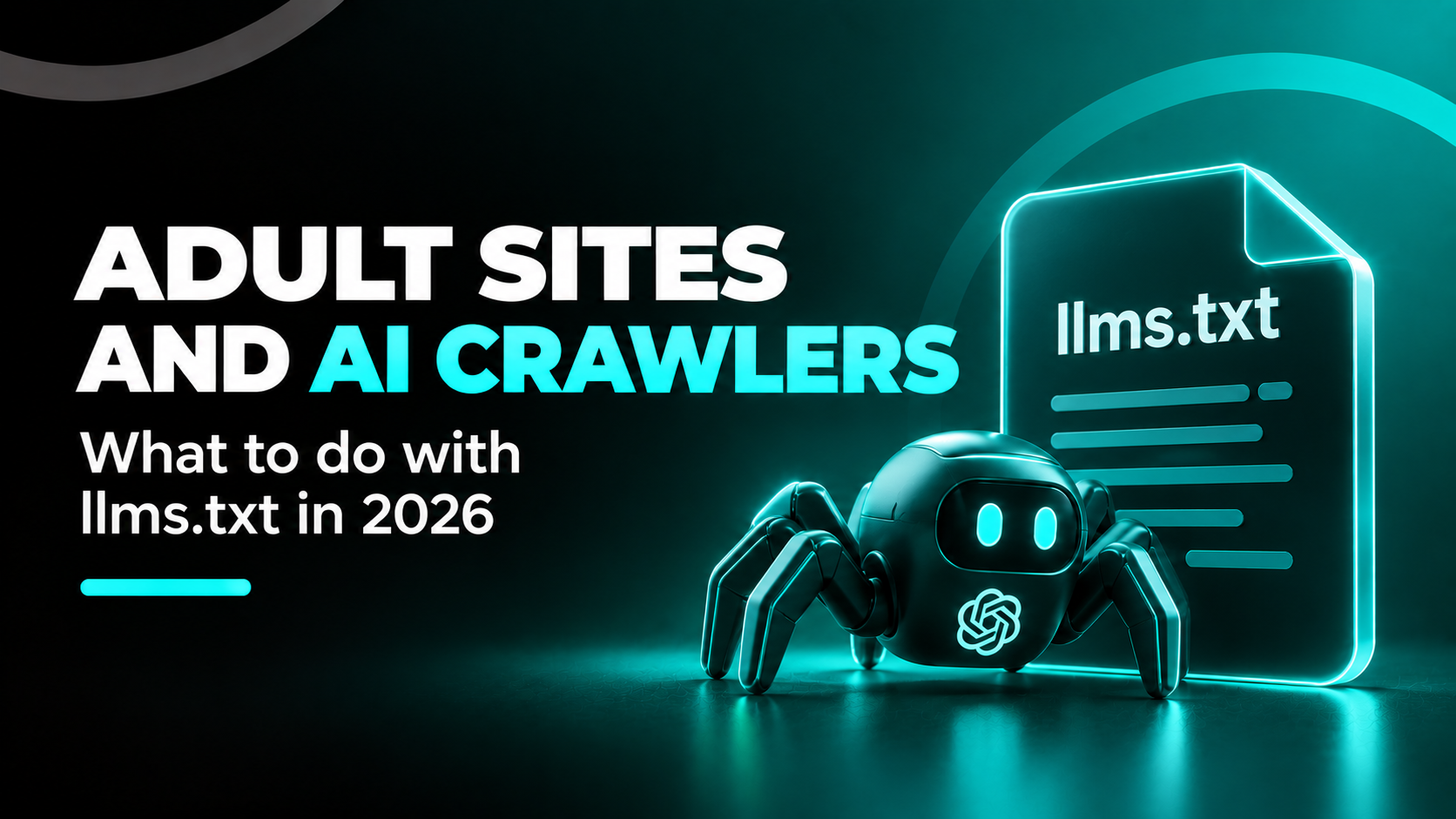
llms.txt for Adult Websites in 2026: A Realistic Guide to AI Crawler Optimization
The short version. llms.txt is a plain text file you place at your domain root to hand large language models (ChatGPT, Claude, Perplexity, Gemini and others) a short, machine-readable summary of your site. In 2026 it is still not a magic traffic button and still not a formal standard. But it's worth shipping: it takes fifteen minutes, breaks nothing, and may pay off as AI agents increasingly read the web on users' behalf. Here's the honest breakdown, without the inflated promises.
What llms.txt is — and what it isn't
llms.txt is a community convention (not a ratified W3C or IETF standard) proposed by Jeremy Howard of Answer.AI in September 2024. The idea is simple: sites have a human-readable interface — HTML stuffed with navigation, ads and scripts — but no short "summary for machines." llms.txt fills that gap by giving a model a clean description of who you are, what you specialize in, and which pages matter most.
Don't confuse the three root-level files, because people mix them up constantly:
- robots.txt controls access — it tells crawlers what they may and may not fetch. This is where you actually allow or block AI bots (GPTBot, ClaudeBot, PerplexityBot and so on).
- sitemap.xml helps search engines find and index all your pages.
- llms.txt neither controls access nor indexes. It provides context: "here's who we are, here's what's important." It complements robots.txt; it doesn't replace it.
The format is ordinary Markdown, readable by both humans and machines. A model that supports the convention can consult the file to grasp your site quickly instead of parsing mountains of HTML.
The honest 2026 picture: ignore the "+200% growth" claims
There's a lot of marketing noise around llms.txt, so let's stick to facts.
- Adoption is low. Depending on the study, the file exists on roughly one site in ten at the generous end — and just a few percent by stricter counts, with a notable share of those files being unconfigured plugin stubs.
- Google said no. In summer 2025, Google confirmed publicly that its search does not use llms.txt and has no plans to, comparing the file to the long-discredited keywords meta tag.
- Major AI providers haven't committed. None of the leading players (OpenAI, Anthropic, Google, Meta, Mistral) has officially stated it uses llms.txt as a production signal for ranking or citation.
- Bots rarely read it. In independent measurements across tens and hundreds of millions of AI crawler visits, requests to llms.txt specifically hovered around 0.1% of traffic. The bots overwhelmingly crawl plain HTML.
The takeaway isn't "the file is useless." It's this: treat llms.txt as a cheap bet on the future, not a traffic channel for tomorrow. Anyone selling it as "the new SEO hack that will explode your visits" is measuring the wrong thing.
Why it still makes sense for a site owner
If the payoff is uncertain, why bother? A few practical reasons.
The cost of entry is near zero. One text file, fifteen minutes, no risk to your existing SEO. The effort-to-potential-upside ratio is excellent even at low odds.
A bet on the agentic web. The real 2026 story isn't "AI search" but AI agents that traverse sites on the user's behalf — comparing, choosing, booking, checking out. llms.txt is the first standardized way to publish a machine-readable "storefront" for your brand that such an agent can route on. Think of it as business-to-agent (B2A) more than classic SEO.
Control over the facts about you. When a model does read the file, it takes facts about your project from your words rather than guessing. For a site surrounded by myths and moderation filters — and the adult niche is exactly that — the ability to set a clear, level-headed self-description is worth a lot.
Early positioning. Conventions like this either die or become infrastructure. If llms.txt follows the path of sitemap.xml, those who implemented it cleanly and early win without a scramble.
The special case: why adult sites are different
For 18+ sites the AI story is harder than for ordinary businesses — which is precisely why context matters more.
Model content restrictions. Many AI systems avoid adult domains entirely by default, out of caution. A clear description of your project as a legitimate business — reviews, analysis, safety guides, age verification — helps the system understand it's looking at a lawful platform, not spam or malware. This is transparency, not "filter evasion."
The 2026 legal context has shifted dramatically. Age verification has moved from theory to hard reality, and that directly shapes how both AI systems and regulators assess trust:
- In the US, by mid-2026 age-verification laws are active in roughly 26 states; in June 2025 the Supreme Court upheld states' authority to require them, applying intermediate scrutiny rather than the stricter review platforms had relied on. The "wait out the legal uncertainty" strategy is over.
- The UK's Online Safety Act came fully into force on July 25, 2025: sites serving pornographic content must use "highly effective" age assurance, and self-declaration ("I'm 18") is no longer enough. Ofcom has already issued penalties, with fines reaching up to £18 million or 10% of global turnover.
- The EU is rolling out its age-verification blueprint and Digital Identity Wallet, and Australia has its own codes. The global trend is consistent: tighter enforcement and privacy-preserving methods (facial age estimation, digital wallets, zero-knowledge proofs) over stored ID documents.
The point for a webmaster: legitimacy and compliance signals are part of your trust profile in 2026. Noting that you meet requirements (age gate, 18 U.S.C. § 2257, privacy-preserving verification) in your site description isn't about field-level parsing — it's about making sure both models and human editors see a responsible operator.
The correct file format (not the one floating around online)
Here's where nearly every guide gets it wrong: the official llmstxt.org spec does not use YAML-style fields like age_restriction: or citation_format:. Nothing parses those. The real format is clean Markdown structured like this:
- An H1 heading — the site/project name (required).
- A blockquote summary — one short sentence on what the project is (recommended).
- Free-form text — optionally a couple of paragraphs of important context.
##sections — thematic blocks, each containing a list of links as - [Name](URL): short note.- An
## Optional section— lower-priority links that can be skipped under length constraints.
There's also an llms-full.txt variant — same principle, but with the full text of key pages inlined. It's worth making if you want to hand a model ready content rather than just links, but it's heavier and needs more frequent updates.
Example llms.txt for an 18+ directory site
markdown
# Adult Directory (example)
> A curated directory of legal adult platforms: reviews,
> comparisons, and safety and privacy information.
This project publishes independent reviews and industry analysis
for the adult sector. All access to 18+ material is protected by
age verification, and the site operates in line with applicable
requirements (age gate, 2257 record-keeping).
## Reviews and comparisons
- [Premium platform reviews](https://example.com/premium/): subscription services
- [Free site reviews](https://example.com/free/): tube-site comparisons
- [Rankings and roundups](https://example.com/best/): themed top lists
## Safety and privacy
- [Safety guide](https://example.com/safety/): protecting your data
- [Age verification](https://example.com/age-check/): methods and privacy
## About
- [About the project](https://example.com/about/): methodology and policy
- [Contact](https://example.com/contact/): for verification and inquiries
## Optional
- [Industry blog](https://example.com/blog/): news and analysis
- [FAQ](https://example.com/faq/): common questions
Notice the restrained, businesslike tone. Models and editors judge tone. "The best porn on the internet" reads as spam; "curated reviews of adult entertainment platforms" reads as an authoritative source.
How to create and place the file: step by step
- Create the file. In any text editor — name it exactly
llms.txt, lowercase, no spaces. Encoding: UTF-8. - Write the content using the structure above: heading, summary, link sections.
- Upload to the domain root — the same place as robots.txt (
public_html on typical hosting; via FTP for WordPress; into the build output for static generators). - Check accessibility — open
yoursite.com/llms.txtin a browser: it should be publicly served with no authentication. - Check delivery — MIME type text/plain or
text/markdown, ideally under ~50 KB. - Keep it updated when your site's focus changes — at least quarterly.
Best practices
- Be honest about expertise. List only topics where you're genuinely authoritative. Inflated claims backfire the moment a model cites you and a user finds an inaccuracy.
- State the age status plainly. A brief mention of age verification and content nature in the summary is a legitimacy signal, not a "field to parse."
- Flag your "safe" pages. Your blog, about page, FAQ and educational material carry no explicit content — models with restrictions cite those more freely. It helps to group them in their own section.
- Reference compliance carefully. Meeting 2257, GDPR and age-verification requirements is part of your 2026 trust profile.
- Write naturally. No keyword stuffing: manipulation gets detected and works against you.
Common mistakes
| Mistake | Why it hurts | Do this instead |
|---|---|---|
| Keyword stuffing | Reads as manipulation | Write naturally; accuracy over density |
| YAML fields instead of the spec | Nothing parses them | Use H1 + summary + link sections |
| No age status mentioned | Model may not cite you at all | Briefly note 18+ and verification |
| Overstated expertise | Trust collapses on mismatch | Claim only what's provable |
| Wrong location | The file isn't found | Domain root only |
| Stale content | Undercuts credibility | Review quarterly |
How to measure impact: read your logs
The only honest way to know whether AI bots read you is server log analysis. Look for hits on /llms.txt and track AI crawler user-agents generally: GPTBot, OAI-SearchBot, ChatGPT-User (OpenAI), ClaudeBot, Claude-User (Anthropic), PerplexityBot, Perplexity-User, Google-Extended, plus CCBot, Bytespider, Amazonbot, Meta-ExternalAgent. That shows you reality rather than promises from someone else's case study. If you want to block any of them from taking your content, that's done in robots.txt — not llms.txt.
Fitting this into a monetization strategy
llms.txt makes no money on its own — traffic and its quality do. The logic is that referrals from AI assistants tend to come from high-intent users: someone has already framed a query, gotten a recommendation, and clicked deliberately. For monetization (affiliate programs, subscriptions, advertising) that traffic is worth more than random visits. But to earn it, the file is just the tip: beneath it you need genuinely indexable, current, canonical pages with strong content. llms.txt won't fix thin pages, broken links, or content rendered only through JavaScript. Site quality and technical hygiene come first; the storefront file comes second.
Takeaways and checklist
- llms.txt gives AI context, but it's a community convention, not a standard, and not yet a traffic channel.
- In 2026 adoption is low, Google doesn't use it, and bots rarely read it — expect no miracle.
- Ship it anyway: cheap, safe, and a sensible bet on the agentic web.
- Adult sites especially benefit from legitimacy and compliance signals — the 2026 legal landscape only sharpened that.
- Use the real format: H1 + summary + link sections, not invented YAML fields.
- Put the file at the domain root, UTF-8, ≤50 KB, review quarterly.
- Measure with logs, not other people's case studies.
- The foundation is a quality site; llms.txt just points to it cleanly.
Share this article
Send it to your audience or copy an AI-ready prompt.