YouTube Now Counts a View From Frame One: Your Counter Inflates, Your Payout Doesn't
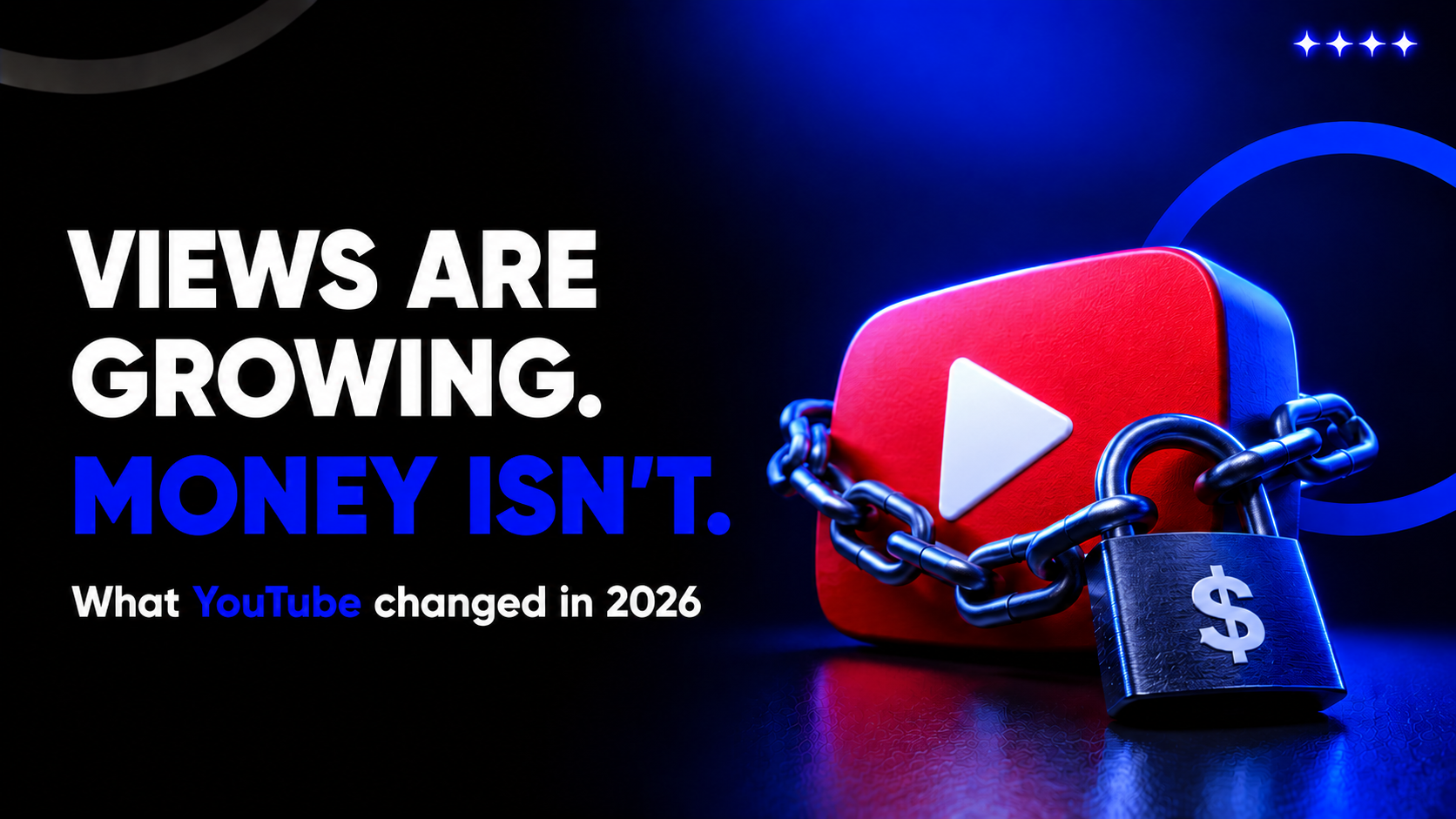
As of August 24, 2026, YouTube pulled a lever that made the numbers under every video on the platform jump at once — and changed absolutely nothing about what lands in the bank. A view is now registered from the very first frame: across all formats, with no minimum watch time, worldwide. Shorts, long-form uploads, podcasts, and live streams all run on the same rulebook. Meanwhile the money still rides on engaged views, Partner Program entry still rides on qualified watch hours, and — depending on which YouTube document you trust — average view duration and retention are about to slide. Here's what actually changed, what's about to break in your analytics, and why any year-over-year comparison that crosses August 24 is now worthless.
What flipped on August 24: a view now equals the first frame
The announcement landed on August 17, 2026 in the YouTube Help Community, posted by TeamYouTube. The wording was blunt: from 8/24/2026, a view is counted the moment a video begins to play — from the very first frame — and the standard now applies globally across every format.
The same thing is written into the Help Center article on the Views metric: starting August 24, 2026, views are counted the instant a video starts to play across all formats, including Shorts, long-form (VOD), and live streams.
The platform's stated reason is simple: each format used to have its own counting logic, and creators kept getting confused. YouTube framed it as a response to creators who wanted to kill the "metric confusion" and understand their true exposure. That word — exposure — is the tell. YouTube is deliberately moving the public counter away from "how many people watched" toward "how many times the player fired up."
Nail these four points down immediately:
- There is no minimum watch time anymore. The first frame plays, the counter ticks up by one. That's the whole rule.
- Nothing is recalculated retroactively. Videos uploaded before August 24 keep their accumulated numbers; the new method only applies to plays that happen after the date.
- For Shorts this is old news. Short-form has counted from the first frame since March 2025. Now long-form, podcasts, and live are being moved onto the same track.
- The old long-form threshold was never officially published. The "30 seconds" figure floated around the community for years, but it was never in the Help docs — so YouTube isn't naming the exact size of the bump either.
The platform is refreshingly honest about the outcome: creators will likely see their total view counts climb faster from now on. And it says why out loud — so creators can "confidently express their true scale and value to brand partners and sponsors." Translation: the new number is a sales tool aimed at advertisers.
Two numbers now live in Studio: view vs engaged view
The old definition of a view wasn't deleted — it was renamed. It's now the engaged view, and that's the metric the money is still counted against. YouTube's own explainer draws the line clearly: a view now counts from the very first frame — whether that's a Short surfacing in the feed or a long-form video autoplaying on the Home page — while an engaged view means watching past that initial frame, or clicking to watch.
Here's how the scenarios break down:
- Saw the thumbnail, scrolled past — that's a thumbnail impression. No view, no engaged view.
- Hovered on the thumbnail and autopreview kicked in — view counted from the first frame; engaged view only if the person keeps watching a few seconds.
- A Short started playing in the feed — view from the moment it launched; engaged view only if they don't swipe away instantly.
- Clicked or tapped the thumbnail — both a view and an engaged view at once.
The practical takeaway: the public counter under your video is now much closer to "player launches" than to "humans who actually watched something." Desktop hovers and Shorts-feed autoplay are now views.
Why the payouts won't grow: engaged views and qualified watch hours
YouTube left zero room for wishful thinking here. Earnings in the Partner Program are still calculated on engaged Shorts views and engaged watch hours, and YPP entry is still gated on qualified Shorts views and qualified watch hours. The public counter plays no part in that arithmetic whatsoever. The labels also shifted: what the requirements used to call "valid public" Shorts views and watch hours are now called "qualified."
What counts toward qualified watch hours:
- Counts: hours from public long-form videos, including podcasts, and from archived live streams.
- Doesn't count: private, unlisted, or deleted videos; plays of a video as an ad; Shorts hours; live streams with no archive.
What counts toward qualified Shorts views:
- Counts: public Shorts, and only engaged views — loops don't count.
- Doesn't count: private, unlisted, or deleted Shorts; Shorts shown as ads; long-form plays; image posts in the Shorts feed.
Now overlay this on the Partner Program overhaul announced in August 2026. From February 1, 2027, new channels need 8,000 qualified watch hours over 365 days or 20 million qualified Shorts views over 90 days — double the previous 4,000 and 10 million. The 1,000-subscriber requirement stays put, existing Partner Program members are grandfathered in and untouched, and to draw a share from the Shorts Creator Pool a channel has to maintain 10 million qualified Shorts views every rolling 90 days.
So here's the funny shape of it. From August 24, the public storefront of a channel inflates — while six months later the bar to reach the money doubles, and it's measured against an entirely different number. For anyone farming networks of channels aimed at the pool, that's two pieces of news, and neither of them is about more revenue.
The long tail: AVD, retention, and where the Help Center contradicts the Blog
This is the part worth knowing before you find yourself explaining a graph crash to a client.
The Blog version: the way clicks and taps are counted hasn't changed, the vast majority of analytics stay anchored on engaged views, and so CTR, average view duration (AVD), and retention are calculated the same way as before — nothing moves.
Now open the metrics glossary in the Help Center. On engaged views it says, in effect: this counts how many times viewers stayed past the initial seconds, loops excluded — and this metric only applies to Shorts. For Videos and Live streams, engaged views are available but identical to views. A line down, on average view duration: it's calculated from engaged views and their corresponding watch time. Same story for percentage viewed.
Stack those two statements together. For long-form and live, engaged views equal views. Views are now counted from the first frame. AVD and percentage-viewed are calculated from engaged views. Therefore, for long-form and live, the denominator in both metrics balloons, and the metrics themselves drop — and they drop harder the more Home-page autoplay a channel gets. For Shorts, where engaged views are a separate metric, nothing budges.
So by one official document nothing changes, and by another, AVD and retention on long-form are obliged to sag. YouTube hadn't reconciled that gap at the time of writing. The safe bet is that the Help Center is right: it describes the formula, while the Blog describes the intention.
Regardless of which wording wins, any ratio you calculate yourself off the public counter falls. Simple example: a video pulls 100,000 engaged views and 4,000 likes — that's 4% engagement. After August 24 the same video shows 160,000 views, still 4,000 likes — and engagement on paper drops to 2.5%. The video didn't get worse; the denominator changed.
The same thing happens to your internal "watch hours ÷ views" metric, to your view-to-link-click conversion in the description, to your CPV math on integrations, and to any dashboard that pulls viewCount from the API and divides it by anything at all.
Year-over-year is broken: August 24 is a seam in your data
History doesn't get recalculated. That means any report spanning the period before and after August 24 has two different methodologies sitting back to back — with no note about it anywhere in the export.
September 2026 versus September 2025 is a comparison of two different definitions of "view." Even August 2026 is cut in half internally. For long-form the break happens now; for Shorts the same break already happened in spring 2025 — so if your data series stretches back to 2024, it now has two seams in it.
There's a separate trap for anyone pulling stats automatically. In the YouTube Analytics API docs, the views metric is still described vaguely — it "represents different numbers in different types of reports" — while engagedViews is defined as the number of times a channel's videos were watched past the initial seconds. At time of writing, neither the Data API nor the Analytics API revision history said a word about August 24. In other words, the meaning of the field changed while the version and description did not.
What to do about it:
- Move your year-over-year comparisons onto engaged views and engaged watch hours — they preserve the old definition.
- Drop a vertical annotation on August 24, 2026 and on spring 2025 in every dashboard.
- Warn clients in advance that the jump up is methodology, not performance. Otherwise, a month later you'll be explaining the drop instead, once the comparison baseline catches up.
What this means for affiliates and media buyers
Buying integrations from creators just got more expensive in real terms. Most sellers price against views. From August 24, the same money buys you a more inflated number. Demand a screenshot from YouTube Studio showing engaged views, not the public counter on the video page — the gap between those two numbers is exactly what you're overpaying for.
Media kits are about to re-price all at once. A channel that sold yesterday as "80,000 views per video" will show six-figure numbers in September without a single new unit of audience. CPV and CPM forecasts built on historical data stop working the same day. Remember: YouTube itself named the conversation with brands as one of the reasons for the update.
Judge your own placement channels on engaged views and clicks. The public counter is now social proof and nothing more. The real funnel starts at the engaged view, continues with the click to the description link, and ends on the landing page. If your setup runs through a YouTube channel with an affiliate link, optimize on click and landing-page revenue, not the number under the video. For short-form this was already true.
Bot views get cheaper — and more useless. Spinning up a first frame is technically easier than holding a session. But YouTube explicitly reserves the right to "temporarily slow down, freeze, or change your metric count, and discard low-quality playbacks," and money plus program entry are measured on engaged and qualified. An inflated public counter pays out exactly zero cents — it buys a pretty screenshot for a media kit. Which, to be fair, is precisely what some people are after.
Ads are counted separately, and the old way. If you're buying traffic through Google Ads, your billable views are TrueView views, not the public counter. Per YouTube's rules, they register like this: skippable in-stream — 30 seconds or to the end of the video, whichever comes first, or a click on an ad element; in-feed video ads — at least 10 seconds of inline autoplay or a click on the thumbnail; YouTube Shorts ads — 10 seconds or to the end, or interaction with interactive elements. Nobody's going to bill you for a first frame in Google Ads.
API tracking has to be flagged by hand. The views metric changes meaning in reports while the docs don't reflect it. If viewCount feeds into your BI or a competitor-monitoring script, put a flag on the date — otherwise a quarter from now you'll be dissecting phantom growth on other people's channels and drawing wrong conclusions about the market from it.
The wider 2026 picture: YouTube just joined the TikTok/Instagram counting club
There's a strategic layer the news write-ups mostly skip. TikTok and Instagram Reels have both counted a view from the moment playback starts for years. By moving to first-frame counting, YouTube didn't just simplify its own house — it aligned its headline metric with its two biggest short-form rivals. For a media buyer running cross-platform campaigns, that has real consequences:
- Cross-platform view numbers are now roughly comparable at the top of the funnel. Before August 24, a "YouTube view" was a meaningfully stricter unit than a "TikTok view" or an "Instagram view." That asymmetry is gone. When a creator's media kit lists views across three platforms, you're now comparing three similarly loose numbers — which is more honest in one sense and more inflated across the board in another.
- Blended CPV models need a reset. If you've been running a single CPV benchmark across YouTube, TikTok, and Reels, your YouTube line was artificially favorable because its view was harder to earn. Post-change, YouTube's CPV on paper will look cheaper simply because the denominator grew. Rebuild the benchmark on engaged views for YouTube if you want an apples-to-apples read.
- The "quality gap" argument shifts to engagement. With top-of-funnel view counts converging across platforms, the differentiator you sell — and the one you should buy on — moves down the funnel: engaged views, watch time, click-through to the offer, and on-site conversion. The platform whose "view" is loosest is no longer automatically the weakest buy; you have to look one layer deeper on all three.
- Attribution windows and creative hooks matter more. When a view is free at frame one, the first second of creative is doing all the work of separating a scroll-past from an actual watch. For performance creatives especially, front-loading the hook and the offer is now non-negotiable — the metric that used to reward a 30-second watch no longer exists on the public side.
None of this is a reason to spend more or less on YouTube. It's a reason to stop treating the public view count as a currency and start pricing every platform on the engaged layer, where the numbers still mean the same thing they meant in July.
Checklist: what to do around August 24
- Export your channel history from before August 24 — public views, engaged views, and watch hours as separate columns.
- Rewrite the formulas in your internal reports to run on engaged views.
- Freeze current seller rate cards and their Studio screenshots — before the numbers drift apart.
- Add an "engaged views as the acceptance metric" clause to your integration contracts.
- Put an annotation on August 24, 2026 across every dashboard and BI tool.
- Recalculate your model against the February 2027 thresholds if your channel isn't in the Partner Program yet.
The storefront got louder; the cash register stayed the same. For anyone working with traffic, exactly one thing actually changed: you now have to keep two numbers in your head instead of one, and make sure your counterparties count on the one that means something.
Share this article
Send it to your audience or copy an AI-ready prompt.