The Trading Vertical in Africa: A 2026 Playbook for Media Buyers and Affiliates
A few years ago, almost nobody in affiliate marketing took Africa seriously. "No money, no internet, an audience nobody understands" — the usual list of objections. In 2026, those arguments sound less like analysis and more like an excuse from people who never bothered to study the region. Africa has become a genuine traffic frontier: cheap clicks, low competition in narrow niches, and tens of millions of young people looking for a way to make money from a smartphone. For the trading vertical, that's close to an ideal setup.
Let's break it down properly: why trading works on Africa, which GEOs actually turn a profit, how regulation has shifted going into 2026, where to source traffic, which funnels and creatives convert, and where budgets most often get burned.
What the trading vertical is and how you get paid
Trading — the "investment" side of the finance vertical — means running traffic to broker and trading-platform offers: forex, CFDs, binary options, crypto trading, auto-trading bots, and educational products. The user signs up, funds an account, and starts trading — and the affiliate gets paid for the target action.
The core payout models:
- CPA per FTD (First Time Deposit): a fixed payout for the first deposit. The clearest model for testing and quickly reading the economics of a funnel.
- RevShare: a percentage of what the trader loses to the platform over time. It pays off long-term but needs volume and patience.
- Hybrid: a combination — a small CPA per deposit plus revenue share. A compromise between recovering your budget fast and earning over the long run.
One detail matters for African GEOs: deposits here are smaller than in Tier-1, but the cost per lead is a fraction of what you'd pay elsewhere. The math isn't built on the size of a single deposit — it's built on volume and on click-to-deposit conversion.
Why Africa: the 2026 macro picture
Behind the slogan "Africa is promising" sit concrete numbers, and in 2026 they look more convincing than ever.
Mobile money as infrastructure. By the end of 2024, the continent had more than 1.1 billion registered mobile-money wallets, processing over $1 trillion in value a year — more than half of the global mobile-money volume. M-Pesa, MTN MoMo, and Airtel Money have effectively replaced banks: traders fund and withdraw directly from their phones, bypassing traditional banking entirely. For a trading offer, that removes the single biggest technical barrier — "how do I even get money in?"
A young population hunting for income. In Kenya, roughly 75% of the population is under 35; hundreds of thousands of graduates enter the labour market every year, and formal employment absorbs fewer than a third of them. Nigeria — the continent's most populous country at over 220 million people — tells a similar story with a huge youth bulge. For this audience, trading isn't a rich person's hobby; it's a side hustle, a real attempt to get ahead using nothing but a phone and a data plan.
Explosive growth in retail trading. By various estimates, around 1.3 million retail forex traders are active in Africa. The leaders are South Africa, Nigeria, and Kenya. Nigeria is cited at 200,000–300,000 active traders, South Africa at roughly 190,000, and retail forex in Kenya has grown more than 30% since 2023. And those are just the "active" ones — the number of accounts opened is several times higher.
Fintech and crypto. Nigeria, with Opay, Palmpay, and Flutterwave, is one of the most dynamic fintech markets in the world. In Africa, crypto isn't only speculation — it's a hedge against inflation, and the number of crypto users in the region has passed 50 million. That's a ready-made, warm audience for crypto-trading offers.
Bottom line: the payment rails exist, the demand exists, the audience is young and motivated, and competition in trading is still noticeably lower than in LatAm or Asia.
The key GEOs for trading
Africa isn't one country — it's 50-plus markets with different spending power, languages, and levels of traffic maturity. For trading, these are the GEOs worth your attention.
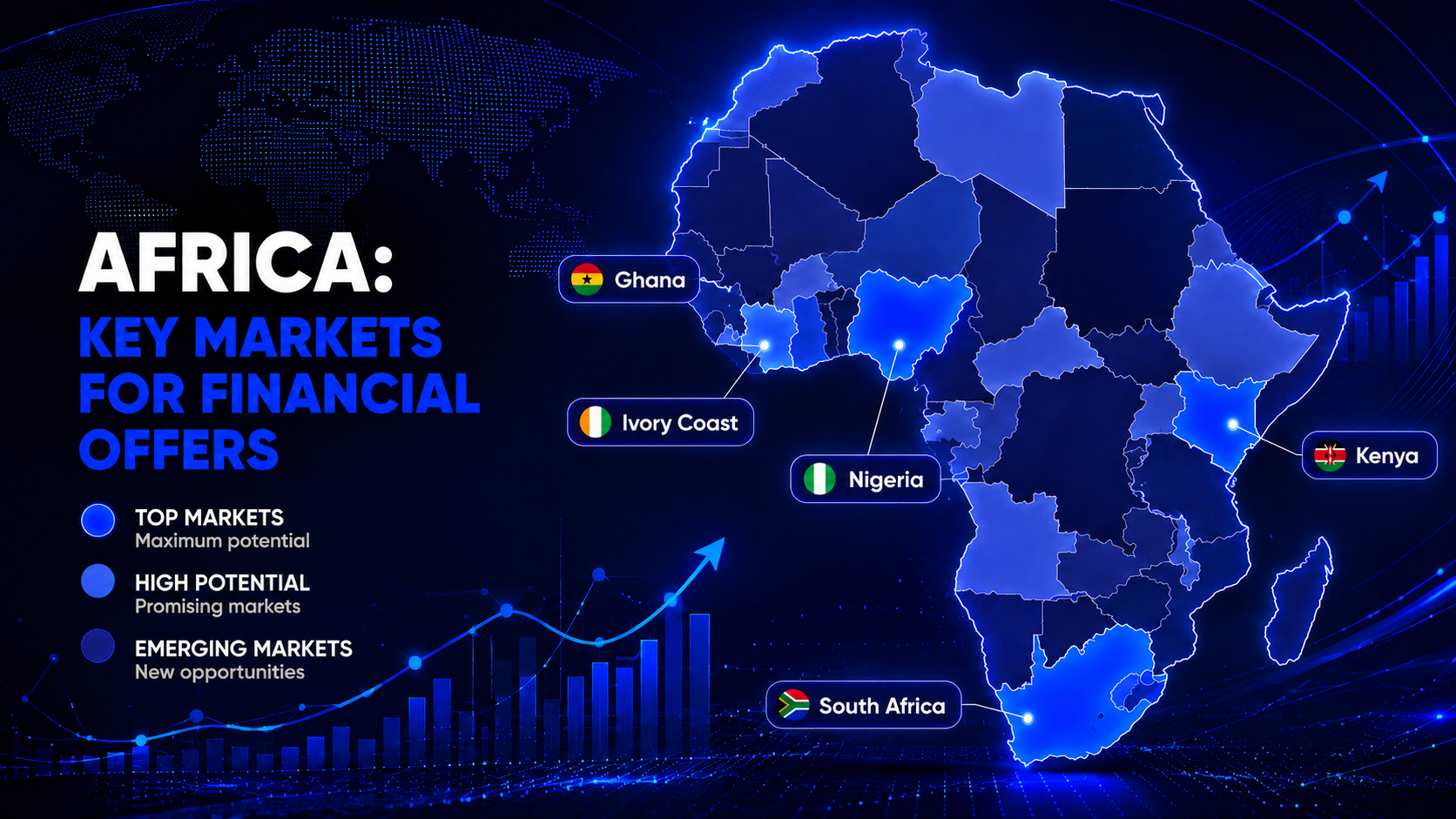
Nigeria
The continent's largest market and its second-biggest retail forex arena. English is the official language, the online audience has crossed 100 million, and young people are actively looking for alternative income. Strong verticals: finance, crypto, betting. The downside — the audience has seen certain angles many times over and competition is rising, so creatives need constant refreshing.
South Africa
The most developed, most mature market on the continent — closer to Tier-2 in its characteristics. It has the highest spending power, a developed banking system, and a legal, regulated market. South Africa is traditionally called Africa's premier trading hub; the South African rand is among the most-traded currencies in the world. The audience is more demanding, but the deposits are bigger.
Kenya
Home of M-Pesa and one of the most "mobile" markets on the planet: mobile money is used by over 90% of adults. A young audience (three-quarters under 35) and a very low entry barrier — you can open an account with as little as $10. An excellent GEO for testing messenger-warmup funnels.
Ghana and Côte d'Ivoire
Growing markets with cheap traffic and fast funnel payback. Ghana is English-speaking, Côte d'Ivoire is French-speaking — a distinction that matters when you prepare creatives. Competition is lower than in Nigeria or South Africa, but so is volume. These are GEOs for people hunting fresh markets without banner blindness.
Cameroon, Senegal, Tanzania, Uganda
The "second tier": less volume, but also less competition. Good for newcomers and for testing fresh angles on cheap traffic before scaling to the big GEOs.
North Africa (Egypt, Morocco, Algeria, Tunisia)
A separate cluster with Arabic- and French-speaking audiences and its own MENA-specific rules. Egypt has repeatedly appeared in high-ROI trading cases. Cultural and religious context is non-negotiable here: go easy on gambling-style framing, "easy money" hooks, and aggressive promises.
Audience profile and psychology
The typical African trader in 2026 is a man or woman aged 20–35, with a smartphone as their main (often only) device, limited mobile data, and strong motivation to find extra income. The key psychological triggers:
- Income and independence. Not "invest wisely," but "earn from your phone without quitting your studies or job."
- Ease of entry. "You don't need to be an expert" — especially for auto-trading and bots. It kills the fear of complexity.
- Social proof. Local success stories, payout screenshots, and WhatsApp/Telegram communities land harder than abstract promises.
- Trust over polish. Expensive animation and gloss can actually scare people off. Simple, "human," UGC-style creatives often convert better.
Regulation in 2026: what changed
Regulation across Africa has tightened noticeably, and that affects which offers and brokers you choose.
- Nigeria. The Investments and Securities Act (ISA 2025, signed March 2025) brought online forex platforms under SEC licensing for the first time, closing the previous regulatory vacuum.
- South Africa. The FSCA has intensified oversight: stricter AML, transparency, and customer-protection requirements.
- Kenya. The market is overseen by the CMA, but many brokers still operate unregistered — the regulatory framework is still forming.
- Ghana. The SEC now requires all online trading platforms to be licensed (a 2026 directive with a deadline of 31 August 2026) — the first licensing framework for this market.
What it means in practice: work with brokers that have local legitimacy and clear terms. Regulatory changes periodically shake up the offer landscape — keep your ear to the ground and don't build your whole business on a single offer.
Traffic sources for trading in Africa
The finance vertical is picky about sources: not every network accepts every kind of traffic, and many platforms restrict financial-product ads. The channels that work in 2026:
- Push and Pop. Cheap volume, good for testing and Tier-3 reach. They demand hard optimization and disciplined blacklisting.
- Native. Handles "editorial" prelanders for trading and crypto well (the "success story" or "news" format).
- In-app and mobile. Since the audience is almost entirely on smartphones, in-app networks deliver huge volume. Interactive formats (including playables) filter out junk traffic and lift Reg2FTD.
- Facebook / Meta. The classic for aggressive buying, but with a constant fight against moderation and the need to farm accounts.
- Telegram and messengers. One of the strongest channels for trading: private chats, warmup, auto-funnels. This is exactly where you close a lead down to a deposit.
- Financial-product showcases. Many networks offer ready-made showcases and landers for finance offers — handy for a fast start.
Funnels, angles, and creatives
Trading is a "warmup" vertical. A cold click rarely converts to a deposit on first touch, so the funnel is almost always multi-step.
Angles that work:
- Messenger warmup. Click → bot/channel on Telegram or WhatsApp → a sequence of messages with education, signals, and stories → registration → deposit. Auto-funnels and email/messenger sequences measurably lift conversion.
- Auto-trading and bots. The core message: "you don't need to understand the market — the bot trades for you." It removes the fear of complexity and lands well with an inexperienced audience.
- Education and info-products. Trading courses, "free signals," chart breakdowns. A soft entry that later routes to a broker.
- Editorial prelanders. Creatives and landers styled as a news site, blog, or media outlet with a local success story — this raises trust and clears moderation more easily.
On creatives:
- Lean into locality: local faces, local currency in the income figures, recognizable everyday details.
- For regions with weak internet, don't load heavy video — simple static creatives and lightweight formats perform.
- Pull ideas from spy tools (Adheart, AdSpy, Anstrex, BigSpy), but always adapt and uniqueify rather than copy verbatim.
- Be careful with specific income figures and "guaranteed returns" — that's both a moderation and a reputation issue.
Payments and withdrawals
Africa's decisive competitive edge is mobile wallets. Traders fund and withdraw through M-Pesa (Kenya), MTN MoMo (Ghana, Nigeria, and others), Airtel Money, and their equivalents. When choosing an offer, check whether the broker supports local payment methods in your GEO: if the only way to fund an account is a card or bank transfer, your deposit conversion will crater. Local payments are often the single factor between a funnel that runs and one that doesn't.
Language and localization
Africa is multilingual, and a "one creative for the whole continent" approach simply doesn't work.
- English — Nigeria, Kenya, Ghana, South Africa, Uganda, Tanzania (partly).
- French — Côte d'Ivoire, Senegal, Cameroon, the Maghreb.
- Arabic — North Africa.
- Swahili — East Africa (Kenya, Tanzania) as a secondary-reach language.
Always confirm the language of the specific country and region before launching. Localization isn't just translation — it's local currency in the figures, familiar payment brands, and cultural context.
Funnel economics and optimization
A few principles that separate a profitable campaign from a burned budget.
Budget determines your tier. Rough 2026 logic: up to $1,000 — test funnels on cheap Tier-3 traffic; $1,000–5,000 — Tier-2 with an economy you understand; $5,000+ — serious work and premium offers; $20,000+ — scaling. African GEOs are exactly the place you can enter the vertical on a modest budget.
Separate blacklists per GEO. A placement that prints money in Nigeria can easily run negative in Kenya. Build separate minus-placement pools for each country and each network.
Sub-ID analytics. Buy where live engagement and deposits are confirmed — not just clicks. This lowers CPA and pushes the funnel into the black.
Recon through spy tools. Before launch, see who's already running your vertical on the target GEO, how many active creatives there are, and how fresh they look. If hundreds of buyers are hitting the country with the same approach, find a fresh angle.
Don't rely on one offer. Regulatory shakeups, changed broker terms, creative fatigue — all reasons to run several funnels and offers in parallel.
Common mistakes
- Treating all of Africa as one package. Different countries mean different languages, payments, and spending power. Split into specific GEOs.
- Ignoring local payments. An offer without mobile wallets in a mobile-first GEO is a guaranteed weak converter.
- Cold buying with no warmup. Trading barely converts head-on — build a funnel that closes the lead.
- Heavy creatives on weak internet. Optimize weight and format for the region's real conditions.
- Copying others' creatives without adapting. They burn out fast and get cut by moderation.
- Betting on a single offer or source. One ban or one terms change and the funnel stalls.
The takeaway
In 2026, Africa isn't a "leftover Tier-3" — it's one of the most interesting regions for the trading vertical. Mobile money removed the payment barrier, a young audience is actively chasing income from their phones, retail trader counts are growing at double-digit rates, and competition is still lower than on overheated markets. The key to profit isn't "run traffic to Africa" — it's picking a specific GEO precisely, matching it with an offer that supports local payments, building a warmup funnel, and optimizing ruthlessly on data. Whoever learns the region's nuances now will skim the cream before the market overheats.
Share this article
Send it to your audience or copy an AI-ready prompt.