GLP-1 in 2026: How Media Buyers Are Cashing In on Nutra's Most Profitable Sub-Vertical
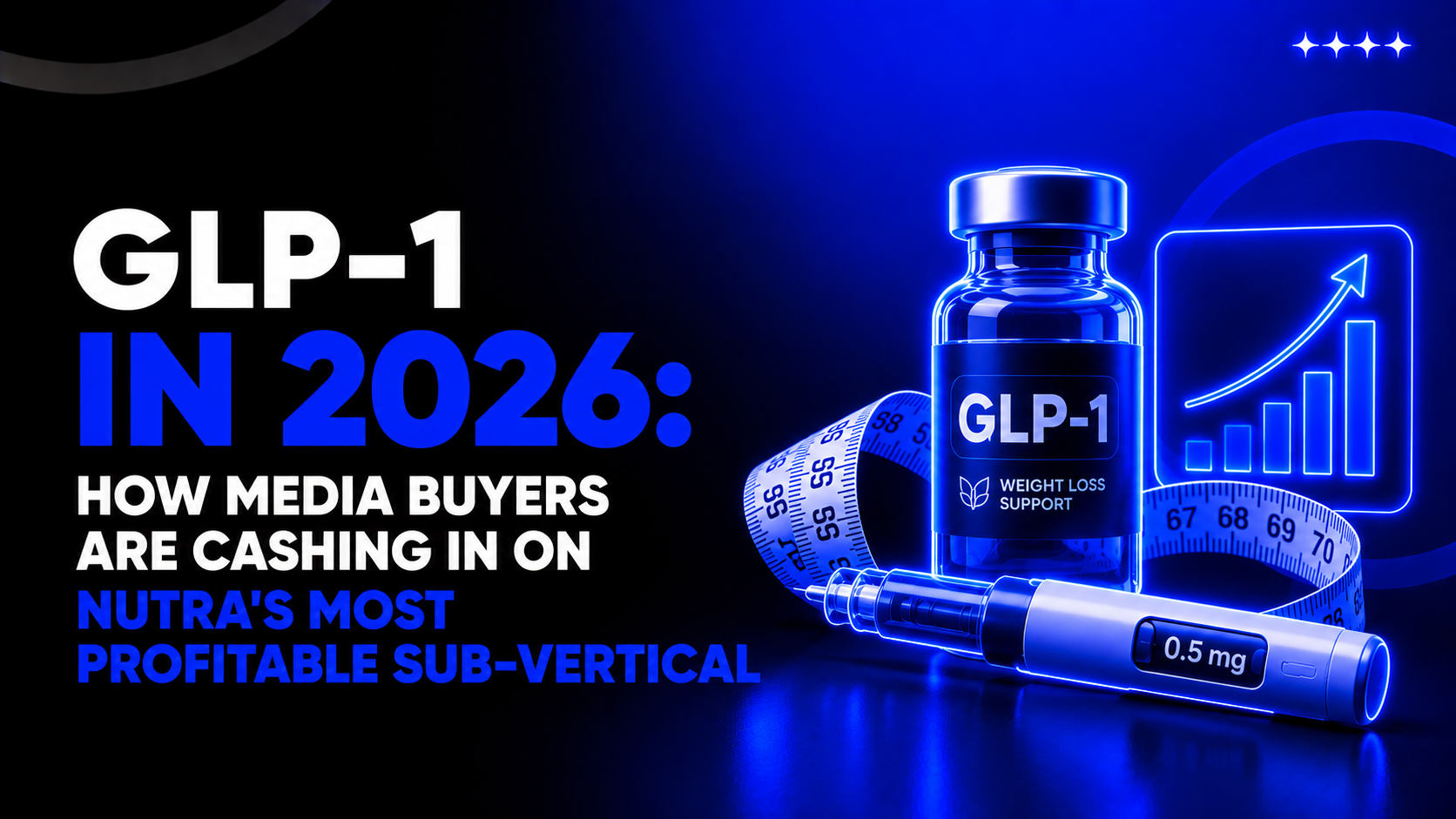
Every year someone declares nutra dead. And every year it finds a way to become a growth engine again. In 2026, that engine is the class of drugs built on the GLP-1 hormone — the ones behind Ozempic, Wegovy, Mounjaro and Zepbound. While part of the buying community complained about slashed payouts and paranoid ad moderation, a sub-vertical quietly grew inside health & beauty with a market worth tens of billions, a warm Tier-1 audience, and — for the first time in nutra — a product that clinically does what the creative promises. Here's why it works and how to run it in 2026.
What GLP-1 Actually Is, and Why It Isn't Another Fat Burner
GLP-1 (glucagon-like peptide-1) is a natural hormone released by the gut wall after eating. Its job is to tell the brain you're full and slow down how fast the stomach empties. In many people carrying extra weight, that signal is weak: the brain simply doesn't hear "stop," so hunger doesn't switch off even on a full stomach.
GLP-1 drugs mimic that hormone and amplify its effect several times over. That's the core difference from a classic weight-loss product. Ordinary fat burners try to rev up metabolism and promise magic. GLP-1 works from the other side — it turns off constant hunger. People eat less not because they're white-knuckling their willpower, but because they physically stop wanting to eat.
For a media buyer, that distinction is everything. For once in nutra, the product genuinely does what the ad says. Clinical trials show 13–20% body-weight reduction depending on the drug. That means you can build ads on facts instead of invented stories and fictional "doctors." Honest mechanics close the audience's biggest objection — distrust — and lower your moderation risk at the same time.
What Genuinely Changed by 2026
A couple of years ago, GLP-1 existed almost exclusively as a weekly injection. The pen scared off a huge slice of the audience that's afraid of needles. In 2026, that barrier started to crumble.
In December 2025 the FDA approved the world's first semaglutide pill — oral Wegovy 25 mg — and Novo Nordisk brought it to the US market in early January 2026. In the OASIS-4 trial it delivered roughly 13.6% average weight loss, and up to 16.6% in patients who stayed adherent — comparable to the injection. By April 2026 the pill had passed two million prescriptions, the fastest GLP-1 launch in US history, with self-pay pricing starting around $149 a month.
Then it kept accelerating. March 2026 brought approval of Wegovy HD (semaglutide 7.2 mg injectable) with about 20.7% weight loss — the highest available dose. And on April 1, 2026 the FDA approved Foundayo (orforglipron) from Eli Lilly — the first GLP-1 pill you can take with no food or water restrictions. Behind them, CagriSema, retatrutide and survodutide sit in late-stage trials, poised to reshape the market over the next couple of years.
At the same time, the indications keep widening: GLP-1 is increasingly positioned not as a "weight-loss pill" but as a metabolic therapy with benefits for the heart, liver, and even sleep apnea. For a buyer, that means fresh angles and audience segments that didn't exist yesterday.
The Market in Numbers
The scale of this sub-vertical is easiest to grasp through one figure: according to KFF, roughly one in eight American adults is currently taking or has taken a GLP-1 drug. This isn't a niche product for wellness geeks — it's a mass phenomenon millions already know about.
For affiliate marketing, that awareness cuts two ways. First, you don't have to convince the audience the product exists — they're already warm, and half the pre-selling has been done for you by the industry and the press. Second, nearly half of the people familiar with the drug complain about its price. A year on the original injectables in the US historically ran $12,000–$16,000. That gap between demand and the price of the original is exactly the gold seam for running traffic to affordable alternatives.
The market itself was valued at around $70 billion in 2025. Analysts project it will break $100–130 billion by 2030 and could approach $200 billion by the early 2030s. This sub-vertical isn't at its peak — it's only just reaching the plateau of mass consumption.
The End of the Monopoly: Generics and Collapsing Prices
The biggest 2026 event for a buyer is the expiry of semaglutide patent protection across several large markets: India, China, Brazil, Canada and Turkey. Together these countries account for roughly 40% of the world's population and about a third of adults living with obesity. The patent cliff opens the floodgates for generics.
In India, industry giant Sun Pharma has already secured clearance to launch its own drug in the Wegovy class. In Canada, protection lapsed back in early January 2026 and generics are in final registration. In China, several companies are lining up launches the moment the patent ends, and some biotechs are even developing a semaglutide nasal spray. By analyst estimates, a monthly course of a generic in these markets could cost as little as $40–50, against thousands for the original.
One caveat the hype guides tend to skip: in the US the semaglutide patent isn't expiring anytime soon — most estimates put it around 2031–2033. So cheap, legal semaglutide generics won't exist in the States for years. Understanding this geographic split directly shapes your choice of GEO, offer, and funnel: where the patent has fallen, price and access sell; where it still holds (Tier-1), form factor, legality, and convenient access sell.
White vs Grey and the Reality of 2026 Moderation
Before you build a funnel, be honest about which field you're playing on. The GLP-1 niche is split into two worlds.
The first is white: legitimate telehealth services, licensed pharmacies, and brand or aggregator affiliate programs like WeightWatchers or specialized health platforms. Payouts are clean, funnels last, and moderation is calmer — but the requirements are strict: PPC is often forbidden, you may be required to describe the product exactly as the advertiser presents it, and you have to keep everything medically accurate.
The second is grey: selling alternatives and generics through pre-landers, aggressive creatives, and COD or trial models. The payouts and volumes are higher, but so are the risks: bans, fines, clawed-back payouts, and regulatory attention that only intensified around weight loss in 2026.
The key moderation insight: a clinically proven product is your ally. Meta, TikTok and Google are extremely sensitive to weight-loss promises and before/after imagery. But precisely because GLP-1 actually works and is covered by legitimate medical sources, you can build pre-landers on real data — right down to Harvard Medical School material and clinical-trial results. The less fakery in the funnel, the longer it lives. This isn't ethics for its own sake — it's about account lifespan and cost per lead.
Three Audience Temperatures
Success with GLP-1 traffic rests on knowing exactly who you're talking to. The audience splits into three temperatures, and the pitch for each is fundamentally different.
The hot audience already knows GLP-1 and is ready to buy. The only question is where to get it at a reasonable price and in what form — injection or pill. No long stories or warm-up needed here. What works is a direct pitch built on availability, stock, and form factor. Headlines like "Finally — semaglutide now in pill form" or "A Mounjaro alternative without the markup" land straight on intent. The pre-lander is a short quiz to match dosage that routes immediately to a booking or order. The landing page is the simplest possible order form — price, payment, delivery — plus a visible block on contraindications.
The warm audience has heard of the drug but hesitates. They're held back by fears: hormones, side effects, dependency, the sense that "I'll start and won't be able to stop." Here the creative's job is to dissolve those fears. A casual UGC format works well: a person at home calmly explaining that they, too, were scared of the word "hormones" until they realized it's like vitamin D in winter — the body just produces the signal poorly, and the drug restores it. An expert breakdown also lands well, where a doctor factually explains the differences between drugs and speaks in weight-loss numbers. The pre-lander is best done in a Q&A format grounded in real medical sources, and the landing page should look like a legitimate medical service, mentioning licensed pharmacies and online medical review. For anyone afraid of needles, put the pill form up front: the barrier to entry drops sharply once a person sees a familiar "just like vitamins" format.
The cold audience has no idea what GLP-1 is. These people are simply exhausted by constant hunger, binges, and yo-yo weight, and they blame themselves. Your main task is to lift the blame off the person and place it on biology. Show the story of an ordinary person whose thoughts were consumed by food 24/7, and then it "let go." The core message: it's not about willpower, it's about a broken satiety signal, and today a drug can fix that. The pre-lander is a personal blog with a touch of investigative journalism: years of torturing themselves with diets and the gym until they discovered the problem was a hormone. The landing page for cold traffic should educate more than sell — explaining in plain language why every past attempt failed, how the satiety signal works, and why this is biology, not chemistry or magic.
The Funnel: Creative → Pre-Lander → Landing Page
The base scheme for these offers stays classic: the creative drives to a pre-lander, the pre-lander warms and dismantles objections, the landing page closes the order. The difference between segments isn't the structure — it's the length and emphasis of the warm-up.
The general principle for 2026: the more medical the funnel looks, the better it clears moderation and the higher the trust. Certification badges, mentions of licensed pharmacies and qualified doctors, blocks on contraindications (pregnancy, pancreatic conditions, a BMI of 27 or higher) — none of this is a formality. They're trust triggers that also reduce ban risk.
A visual "week-by-week plan" on the landing page works well: in the first one or two weeks the sugar cravings fade and the body adapts; across weeks three to eleven portions roughly halve and weight drops gradually by 5–7%; after week twelve the habit of eating less locks in at the metabolic level. That timeline gives people a realistic expectation instead of a "lose 20 kg in a week" promise that kills both trust and the account.
Traffic Sources and Formats That Land
Most GLP-1 traffic runs on Meta, TikTok and Google Ads, plus native networks and Telegram traffic for specific GEOs. Each source dictates its own pitch.
On Meta and TikTok, native UGC wins: a real person on camera, natural speech, a home setting, minimal "ad" feel. Direct before/afters and aggressive weight-loss promises still get banned fast, so the emphasis shifts to story, emotion, and dissolving fear, with the specifics moving to the pre-lander and landing page. On Google and native, the expert format performs well: a doctor in a coat, a pen injector or a blister pack on screen, a calm explanation of the mechanism. It looks official and safe, which is critical for white markets.
Three creative formats work reliably in 2026: live UGC with a real person and their story; an expert video with a doctor who speaks in numbers and defuses the fear of an unfamiliar drug; and a form-factor breakdown — pills vs injections — that answers the most common question from a new audience. The arrival of oral drugs handed the vertical a fresh angle all its own: "finally, now in pill form" is a news hook that lifts CTR by itself, because it's genuinely new.
Where to Find Offers and Which Model to Choose
The offer landscape in 2026 is split. On the white side in Tier-1, you have affiliate programs and aggregators: telehealth services, programs like WeightWatchers, health platforms listed in the big CPA networks. The models here are more often subscription or pay-per-qualified-action, payouts are stable, but there are source restrictions (frequently no PPC) and requirements on how you present the product.
On the grey side, product offers on alternatives and generics play out — mostly COD and trial — driven by volume in Tier-2 and Tier-3. An important 2026 nuance: in many Tier-2/Tier-3 GEOs, white GLP-1 offers through affiliate networks are barely available — those markets are dominated by online pharmacies and grey nutra, so competition and messaging are built differently.
When picking an offer, don't chase the pretty payout — read the bundle of "GEO + patent status + payment model + advertiser requirements." In countries where the patent has fallen, price and access sell. In Tier-1, where the original is still protected, form factor, convenience and legality sell. Match the payment model to traffic temperature: hot traffic converts well into direct orders and subscriptions, while cold traffic needs warming and lives better on trial models and longer pre-landers.
Unit Economics and Metrics
The niche is attractive, but it doesn't forgive blind buying. You have to count from the first dollar. The key benchmarks are cost per lead and approval rate on COD offers, subscription cost and retention on white offers, and the real payout after every advertiser deduction (some white programs clip commission for PPC traffic or for breaking presentation rules).
Keep the sales cycle length in mind separately. GLP-1 isn't a $20 impulse buy — it's a decision a person may reach over several touches. That's why retargeting, follow-up creatives and warming pre-landers pay off better here than in cheap physical-product nutra. Watch not just CPL but lead-to-payment conversion and returns: a high approval rate on a cheap lead matters more than a cheap click alone.
Mistakes That Burn Budget
The most common mistake is dragging old fake schemes into 2026. Invented "doctors," drawn-on before/afters, and "lose 30 kg in a month" promises on a genuinely medical product don't just get banned — they perform worse than honest messaging, because GLP-1 has real data that converts better than fiction.
The second mistake is ignoring patent geography. Running "cheap generic" angles in the US, where the patent holds into the early 2030s, means building an offer on something that doesn't exist legally — and inviting trouble with both moderation and advertiser. The third is mixing up audience temperatures: pushing cold traffic to a short landing page built for hot buyers, or, conversely, torturing a ready-to-buy person with a ten-minute story. The fourth is skimping on the contraindications block and trust triggers: on a health topic, that's the first thing to sink both conversion and moderation.
Where the Niche Is Heading
The direction is clear: more drugs, cheaper, and pill forms that remove the main barrier to entry — needle fear. The already-approved oral Wegovy and Foundayo will be joined over the next couple of years by a new generation of multi-hormone drugs. Patent cliffs in India, China, Brazil, Canada and Turkey are triggering a wave of affordable alternatives, and widening indications plus programs like the Medicare GLP-1 Bridge from mid-2026 keep pulling new segments into the space.
For a media buyer, that means the window of opportunity is open, but competition will only grow. The winners won't be whoever found a "juicy bundle" first — they'll be the ones who learned to work honestly with a product that actually works: hitting audience temperature precisely, building medically accurate funnels that don't die on moderation, and counting unit economics for the long game.
In Short
By 2026, GLP-1 has gone from hype to a durable nutra sub-vertical with a market in the tens of billions, a warm mass audience in Tier-1, and — for the first time — a product with proven efficacy. The arrival of pills removed the needle barrier, and patent expiry in major GEOs collapsed prices and opened new markets. Working here has become both easier (the product genuinely works, no fakery needed) and more demanding (harsh moderation of the weight-loss topic, the importance of unit economics and precise segment targeting). Whoever pairs honest medical messaging with a smart choice of GEO, offer, and payment model gets access to one of the most profitable nutra niches of the year.
Share this article
Send it to your audience or copy an AI-ready prompt.