Your New Site Has No Traffic in 2026: Sandbox, Penalty, or AI Overviews?
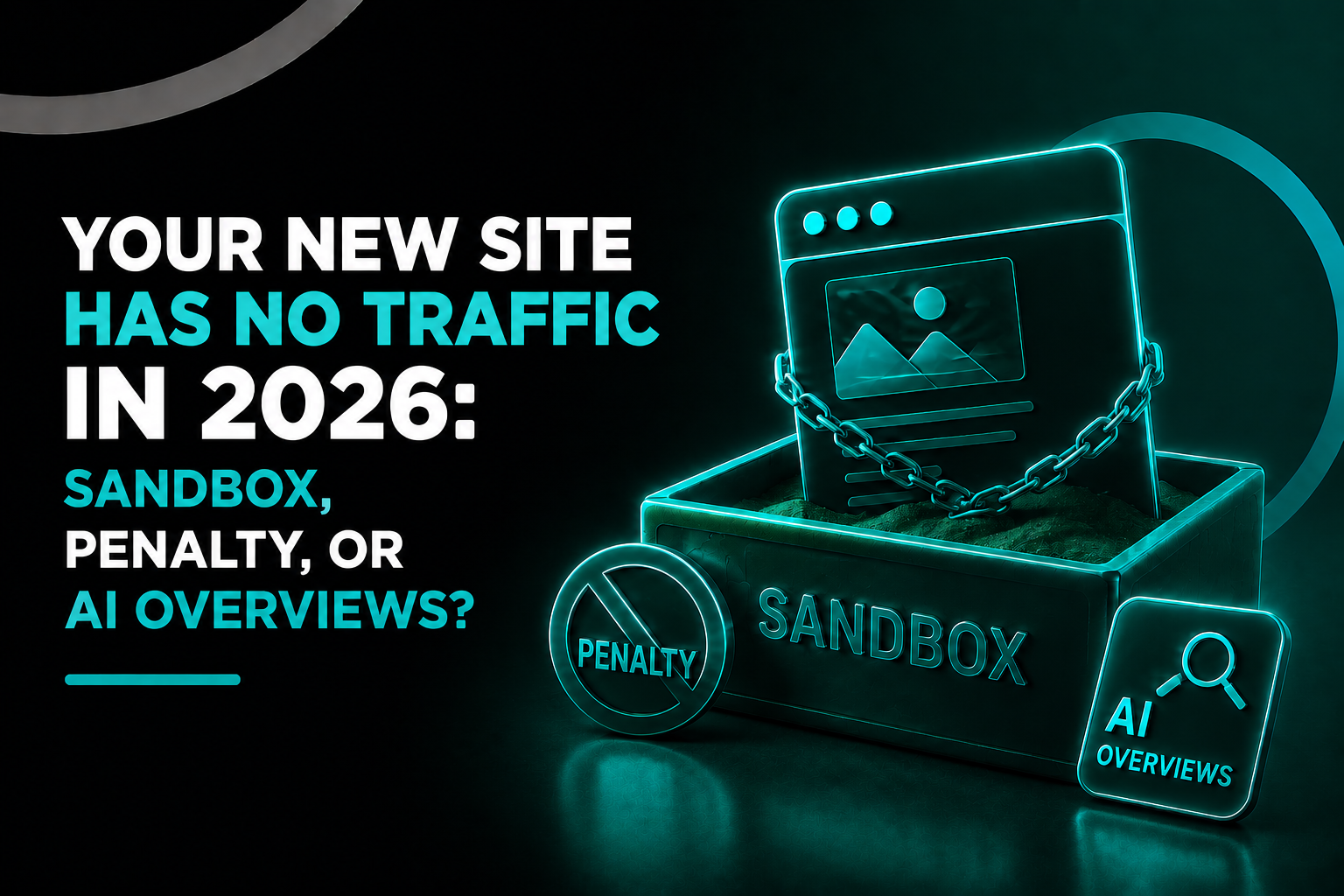
You launched a new site a few months ago. The content is up, the pages are live, and yet Google Analytics shows a flat line hovering just above zero. Search Console reports no manual action. Nothing is obviously broken — and that is exactly what makes the situation so frustrating. Four completely different problems can produce this same empty graph, and in 2026 there is one more possibility than there used to be. Each one demands a different response, and doing the wrong thing usually makes recovery slower, not faster.
This guide is about diagnosis before treatment. If you run sites for a living — and adult sites in particular, which sit under heavier scrutiny than almost any other niche — the discipline of correctly identifying why traffic is missing is worth more than any single tactic. The webmasters who lose money are rarely the ones who wait; they are the ones who panic, restructure a perfectly healthy site, and reset the clock they were already running down.
Does the "sandbox" actually exist?
Short answer: something real happens to new sites, but Google has never documented anything called a sandbox. The term is the SEO community's label for a repeatable pattern — new domains rank for almost nothing during their first several months, then gradually gain visibility once Google has accumulated enough signals to trust them. Google's own representatives have, over the years, acknowledged that fresh sites go through an "evaluation" or "understanding" period, while consistently declining to confirm any formal sandbox mechanism.
Whether you call it a sandbox, an evaluation phase, or a trust-building window, the behaviour is consistent enough across thousands of launches to be treated as predictable. For mainstream niches, meaningful organic growth usually begins somewhere between the fourth and eighth month, assuming the technical setup is clean, the content is legitimate, and the link profile is growing naturally. Adult sites routinely sit at the longer end of that range — six to nine months is normal, and sometimes longer — because they pass through additional content-safety and compliance evaluation layers before Google extends full ranking consideration.
The important reframe is this: the evaluation phase is not a punishment and not a bug. It is Google being cautious with a domain it has no history with. That caution scales with how much a category has been abused in the past, which is why adult, gambling, finance, health, and pharma domains all wait longer than a hobby blog. Adult content simply has one of the longest documented histories of spam, cloaking, thin affiliate pages, and link manipulation — so the caution is proportionally heavier. It is risk-adjusted trust building, not discrimination.
And the single most important operational takeaway follows directly from that: the evaluation phase is something you wait out correctly, not something you try to escape. Almost everything people do to "speed it up" — buying links, spamming social signals, hammering internal links, spinning up hundreds of programmatic pages — either extends the evaluation or converts it into a genuine penalty. The correct response is to keep building real quality signals and let the clock run.
The five things that produce a near-zero graph
Before 2026, the honest answer was "there are three possible causes." The rise of AI-driven search results has added a fourth, and it is now one of the most common — so this guide treats it as its own scenario. Here is the full set, described in plain terms rather than as a table, because the difference between them lives in the details.
The first is normal evaluation — the sandbox. Search Console shows impressions, even if they are tiny. Pages are indexed. There is no manual action. Position data exists but sits below the competitive threshold for most queries. Traffic is near zero because rankings are being suppressed while trust builds, not because anything is wrong. Time and quality are the only real levers.
The second is a technical problem. Search Console shows zero or near-zero impressions, URL inspection reports pages as "not indexed," a robots.txt rule is blocking crawlers, or a stray noindex tag is telling Google to stay away. The site is invisible not because it is untrusted but because a barrier is physically standing in the way. This is the good news scenario: it is usually trivial to fix and it recovers fast.
The third is an actual penalty. Either a manual action appears in Search Console, or impressions and rankings collapse sharply after a period of normal function — often lining up with the date of a confirmed core or spam update. Penalties do not respond to patience; they require specific remediation.
The fourth, and the new one, is AI Overviews and AI Mode absorbing your clicks. This is the trap of 2026. Your rankings can be perfectly healthy, your impressions can be stable or even rising, and your click-through rate still falls off a cliff — because Google is answering the query directly at the top of the results page and fewer people ever reach a blue link. It looks like a penalty in a clicks-only view. It is not one. Diagnosing it requires looking at impressions and clicks separately, which most people never do.
And there is a fifth state worth naming even though it isn't really a problem: a normal new site doing everything right. Impressions present, positions clustered below the competitive range, no clicks yet. Nothing to fix, nothing to panic about. Rankings below the top of the first page generate almost no clicks by design, and that resolves on its own as trust accumulates.
The single most valuable habit here is the diagnostic order. Rule out the technical problem first, always. A noindex tag or a robots.txt block looks identical to both the sandbox and a penalty in an analytics dashboard, and spending ten minutes in URL Inspection will resolve the majority of "I think I'm sandboxed" panics before they turn into expensive mistakes. Only after technical causes are cleared should you weigh evaluation against penalty against AI cannibalization.
Reading the sandbox in Search Console
A site in genuine evaluation produces a recognisable fingerprint, and it lives almost entirely in the impressions curve. Open Search Console, go to the Performance report, set the date range to six months, and look at the impressions line on its own. A site in evaluation shows a slowly climbing curve — even if the absolute numbers are laughably small, twenty or forty impressions a day. Growth, however sluggish, is the defining signature of the evaluation phase. A penalised site shows the opposite: a flat or declining line, frequently with a visible cliff on the exact date of an algorithm update or a manual action.
If your impressions have been trending upward for three months or more, even at trivial volume, you are almost certainly being evaluated rather than penalised, and the correct response is to keep publishing and leave the structure alone. This is worth internalising because the instinct to "do something" is precisely the instinct that resets the trust-building clock. Structural changes — new URL patterns, a rebuilt navigation, a migrated CMS — tell Google to start understanding the site from scratch.
Position data tells the same story from another angle. In the Performance report, switch on Average Position. A site in evaluation typically shows average positions somewhere in the twenties through the eighties across all queries — the pages are ranking, just not competitively. Filter down to the specific keywords you actually wrote content for; if those pages are surfacing anywhere in the results, even deep on the second or third page, you are indexed and under evaluation, not invisible and not penalised. The mere presence of ranking data during a young site's first year is a healthy sign. A page that never appears in position data at all is not being evaluated — it is either unindexed or in serious trouble, which points you back toward the technical or penalty scenarios.
What a real penalty looks like
Penalties come in two flavours, and only one of them announces itself.
Manual actions are the type Google formally documents and notifies you about. They appear in Search Console under Security & Manual Actions, and the notification specifies whether the action is site-wide, affecting the entire domain, or partial, affecting particular pages or sections. For adult sites, the recurring culprits are spammy or auto-generated content — the endless programmatic pages with no editorial value that the niche is notorious for — thin affiliate pages that exist only to funnel clicks to an offer without adding anything of their own, and deceptive practices like cloaking, hidden text, or misleading titles. Each has a defined remediation path, and each one is fixable if you are honest with yourself about what you actually built.
Algorithmic penalties are the harder case because nothing tells you they happened. There is no notification. A core update, a spam update, or a reviews update simply applies a downward adjustment to your domain or to specific pages, and the only evidence is the shape of the graph: a sudden, sharp drop in impressions and clicks starting on a particular date. The way to distinguish this from the sandbox is decisive — evaluation is gradual, while an algorithmic hit is a cliff. If a site was doing five hundred impressions a day and dropped to fifty overnight, that is an algorithmic event, full stop. The sandbox never produces a sudden drop from a higher baseline, because a sandboxed site never had the higher baseline to begin with.
This is where 2026 matters concretely. Google has already shipped two broad core updates this year — one rolling out from late March into early April, and a second from May 21 into early June — and both produced unusually large ranking swings. Industry analyses found that a substantial share of pages ranking in the top ten before these updates fell out of the top hundred entirely, with visibility shifting away from aggregators and thin intermediary sites toward stronger, more original destinations. If your collapse lines up with either of those windows, you are looking at an algorithmic event, not the sandbox, and the recovery path runs through genuine quality improvement rather than patience. Recovery from an algorithmic hit is generally only reflected at the next major update, which can be months away, so the work has to start immediately even though the reward is delayed.
The 2026 trap: when it's AI Overviews, not a penalty
This deserves its own section because it fools experienced operators. In 2026, AI Overviews and AI Mode are the default search experience for an enormous share of queries. Gemini-powered answers now sit at the top of the results page and resolve many questions before anyone clicks anything, and the search box itself was rebuilt to encourage the long, conversational queries these answers thrive on.
The consequence for your graph is specific and counterintuitive. Your impressions can hold steady or even grow while your clicks fall dramatically, because appearing inside an AI Overview, or ranking beneath one, does not convert to clicks the way a classic blue-link position did. Data reported in 2026 showed the click-through rate on the first organic result dropping from roughly a quarter of searches to around one in ten once an AI Overview occupies the top of the page. You can hold position one and still lose half your clicks — and none of that is a penalty. Nobody demoted you. The results page simply changed shape underneath you.
Diagnosing this is straightforward once you know to look. Compare impressions and clicks side by side over the same window. If impressions are stable or rising while clicks decline, the culprit is almost certainly AI cannibalization rather than a ranking loss. Google has helped here by adding Search Console reporting that breaks out impressions inside AI Overviews and AI Mode, so you can now see directly how much of your visibility lives on those surfaces. The strategic response is not a panicked site change; it is accepting that ranking and click-through have decoupled, that being the source an AI answer cites is now its own form of visibility, and that leaning entirely on Google for traffic has become measurably riskier than it was even a year ago.
Why adult sites wait longer
Three factors extend the evaluation window for adult domains specifically, and all three are worth engineering around from day one.
The first is content-safety classification. Google treats adult material as sensitive and runs additional evaluation before granting competitive visibility, which means a new adult site with a technical setup and content quality identical to a mainstream site will still typically take an extra two to three months to emerge. There is a practical lever here that too few operators use: building genuinely useful non-explicit editorial content alongside the adult content. Industry explainers, creator advice, regulatory breakdowns, and other safe-for-work editorial pages give Google's systems more material to evaluate in a lower-sensitivity context, and the domain-level trust that earns spills over onto the adult pages. In an AI-search era that rewards demonstrable expertise and original reporting, this kind of content also happens to be exactly what gets cited in AI answers, so it does double duty.
The second is legal-compliance signalling. A visible 2257 compliance statement, a genuine age gate, and a clear privacy policy are observable trust signals, and Google's human quality raters are instructed to check for exactly these when they assess adult sites. Their presence won't magically shorten the sandbox, but their absence is a documented reason for extended evaluation and lower quality scoring. A new adult site with no compliance statement, no privacy policy, and no age disclaimer is in the worst possible position during evaluation — it looks precisely like the low-effort, high-risk sites the extra scrutiny exists to catch. These elements cost almost nothing to add and should be live before you publish, not bolted on later.
The third is link-profile scrutiny. New adult sites are disproportionately targeted by spammy link sellers, for the simple reason that desperate webmasters make easy customers. This is a genuine trap: a young adult site that buys a batch of low-quality links in its first six months can flip its own evaluation phase into a real spam penalty almost overnight, and Google's spam detection for adult content is more aggressive than for mainstream sites precisely because the category earned that reputation. During evaluation, the only safe link building is editorial — links you earn because someone found your content genuinely worth referencing. No purchased placements, no reciprocal exchanges, no submissions to low-quality adult link farms. It is slower, and it is the only approach that builds trust instead of risking a penalty.
What to actually do, scenario by scenario
If you have diagnosed evaluation, the work is disciplined patience. Keep publishing at consistent quality on a steady cadence — a couple of new pages a week is a reasonable floor — and refresh existing pages when the information behind them goes stale. Add clear author attribution and structured data so your editorial credibility is legible to Google's systems, and earn a small number of genuine editorial links each month through real outreach rather than purchases. What you must not do is rebuild the site structure, change the domain, inject thin programmatic pages, buy links, or disavow links you never built. Every one of those resets the very signals you are waiting on. The most damaging mistake in this scenario is reading a quiet traffic graph as evidence that the site is broken and "fixing" a site that was only ever being evaluated.
If you have diagnosed a technical block, move immediately. Run URL Inspection on your homepage and your five strongest content pages and check whether each is indexed, whether crawl errors are present, whether robots.txt is blocking access, whether the rendered HTML actually matches the source — JavaScript-dependent content that fails to render is a classic culprit — and whether a noindex tag has slipped into the meta robots. Remove whatever you find and request re-indexing for each affected page. This is the fastest recovery of any scenario; blocks typically clear within one to three weeks as Googlebot recrawls, and it is the reason technical diagnosis comes first.
If you have diagnosed a penalty, the path depends on the type. For a manual action, read the specific reason Google gives, fix the actual problem — strip the thin content, clean unnatural links with a disavow file, remove cloaking — wait a couple of weeks for the fixes to settle, then submit a reconsideration request that is specific and factual about what you found and what you changed. Vague, defensive reconsideration requests get rejected. For an algorithmic hit, identify which update triggered the drop by cross-referencing the date against Google's published update history, research which quality signals that update targeted, and address them directly through better content, credible authorship, and a cleaner link profile. Recovery shows up at the next major update, which is typically months out, so the value comes from starting now.
If you have diagnosed AI cannibalization, resist the urge to treat it as a fault to repair. There is no page to fix, because nothing broke. The productive response is strategic: structure content so it is the kind of clear, original, genuinely authoritative material that AI systems cite rather than skip, build the topical depth and brand recognition that make you a preferred source, and deliberately reduce your dependence on organic clicks alone. In a monetised context, that means treating direct traffic, email, community, and other discovery surfaces as first-class channels rather than afterthoughts. Google sending fewer clicks per impression is not a temporary glitch to wait out; it is the new baseline to build around.
The 2026 reality webmasters are building on
A few structural truths now sit underneath all of this. Google has settled into a cadence of frequent, disruptive core updates, and each one raises the quality bar rather than targeting a single tactic — which means the durable strategy is being genuinely worth citing, not chasing whatever the latest update seemed to reward. Original, first-hand, credible content keeps gaining while thin, templated, mass-produced material — including the flood of low-effort AI writing that hit every niche including adult — keeps losing. That is not a temporary swing; it is the direction of travel.
At the same time, the line between "traditional SEO" and "optimising for AI" has essentially dissolved. Google's own guidance is blunt about it: optimising for its generative features is SEO, there is no separate scheme to chase, and no special file or markup makes you eligible for AI answers — a technically sound, indexable, high-quality site already qualifies. What has genuinely changed is the economics of a ranking. A top position is worth fewer clicks than it used to be, so authority that spans multiple discovery surfaces, and traffic that doesn't depend entirely on Google, are no longer nice-to-haves. For anyone whose income depends on these sites, that diversification is the real 2026 lesson hiding inside a diagnostic guide.
The rule that ties it together
Underneath every scenario is one principle: a quiet traffic graph is a signal to diagnose, not a signal to demolish. The sites that emerge from evaluation with strong positions are the ones that spent the waiting period building real quality — comprehensive content, credible authorship, clean links, solid technical foundations, and the compliance elements an adult site cannot skip. The sites that fail are almost always the ones that mistook slow traffic for a broken site and started tearing things up.
Give a new adult site six to nine months before drawing hard conclusions, and give any 2026 traffic drop the courtesy of separating impressions from clicks before you decide it's a penalty. A four-month-old adult site with slowly rising impressions is not failing. It is behaving exactly the way a new site in a scrutinised niche is supposed to behave — and the correct move is to keep building and let it.
Share this article
Send it to your audience or copy an AI-ready prompt.