Semantic Clusters for Monetization: Why a Single Page No Longer Makes Money and What to Build Instead
If your site was pulling in steady AdSense or affiliate revenue a couple of years ago, and then traffic tanked two or three times over after some Google update — you're not alone. After the Helpful Content Update, a string of core updates, and the rollout of AI Overviews, thousands of webmasters watched the same scene play out: rankings dropped, RPM cratered, and articles that had been parked in the top 10 for years got dumped past position 20.
It's not that Google decided to hate you. The rules of the game just changed. The search engine no longer scores pages one at a time — it looks at your site as a whole and decides whether you actually know the topic well enough to deserve visibility. One-off sites and content farms covering whatever's trending are the first to bleed. The ones that survive build topic clusters — connected groups of pages around a single theme.
Here's how it works, what a webmaster should actually do, and why cluster-based SEO hits your site's revenue directly, not just your rankings.
What Broke in Classic SEO
The old playbook was simple: gather keywords, write one article per keyword, sprinkle in the right density, pull in traffic, monetize with ads. That worked as long as Google read pages literally — counting words and measuring keyword density.
Then everything shifted. In 2015 came RankBrain — Google's first machine-learning algorithm. In 2018–2019, Neural Matching and BERT taught Google to understand context and the relationships between words. In 2021, MUM rolled out to handle complex queries. And starting in 2024, Gemini neural networks got baked into search, along with AI Overviews — a feature that builds a ready-made answer from multiple sources right inside the SERP.
For a webmaster, that means three nasty consequences.
First, thin articles built around single keywords stopped pulling traffic. Google now understands that ten pages about "how to take creatine," "creatine dosage," and "when to take creatine" are all the same intent. It ranks one of them and treats the rest as ballast. And ballast on your site signals low quality.
Second, AI Overviews steals your clicks. Where users used to have to visit a site to get an answer, now they often grab the summary right in the SERP and bounce. By various estimates, CTR on top positions has dropped 20–60%, especially for informational queries — exactly the kind of traffic AdSense sites live on.
Third, the Helpful Content System aims directly at monetized sites. Google officially targets content "created primarily for search engines rather than people." A site that looks like a stack of SEO articles built around ad blocks, with no real expertise behind it, risks taking a sitewide demotion — not just a hit on individual pages.
Why Google Now Scores Your Whole Site
The key term to remember is topical authority. It's Google's idea of how deeply you actually understand a topic. Not "do you have a page targeting this query," but "have you covered the topic thoroughly enough to be trusted on it."
A site with 200 scattered articles spanning weight loss, crypto, and everything in between looks like a farm to Google. A site with 40 pieces all in one topic, where every angle is covered, looks like an expert resource. And it ranks better, even with three times fewer articles.
Topical authority is tied directly to EEAT — Experience, Expertise, Authoritativeness, Trustworthiness. For YMYL niches (Your Money or Your Life — health, finance, legal), EEAT is non-negotiable. A site without visible expertise just doesn't get in.
For monetization, that translates directly to revenue:
• Quality traffic monetizes better. Ad networks pay more for users who stick around and read multiple pages.
• A warmed-up audience converts. Someone who's read three of your articles and decided you know what you're talking about is way more likely to click an affiliate link.
• The site survives updates more cleanly. A topically coherent resource gets demoted less often, because Google "understands" what it is.
What a Topic Cluster Is and What It's Made Of
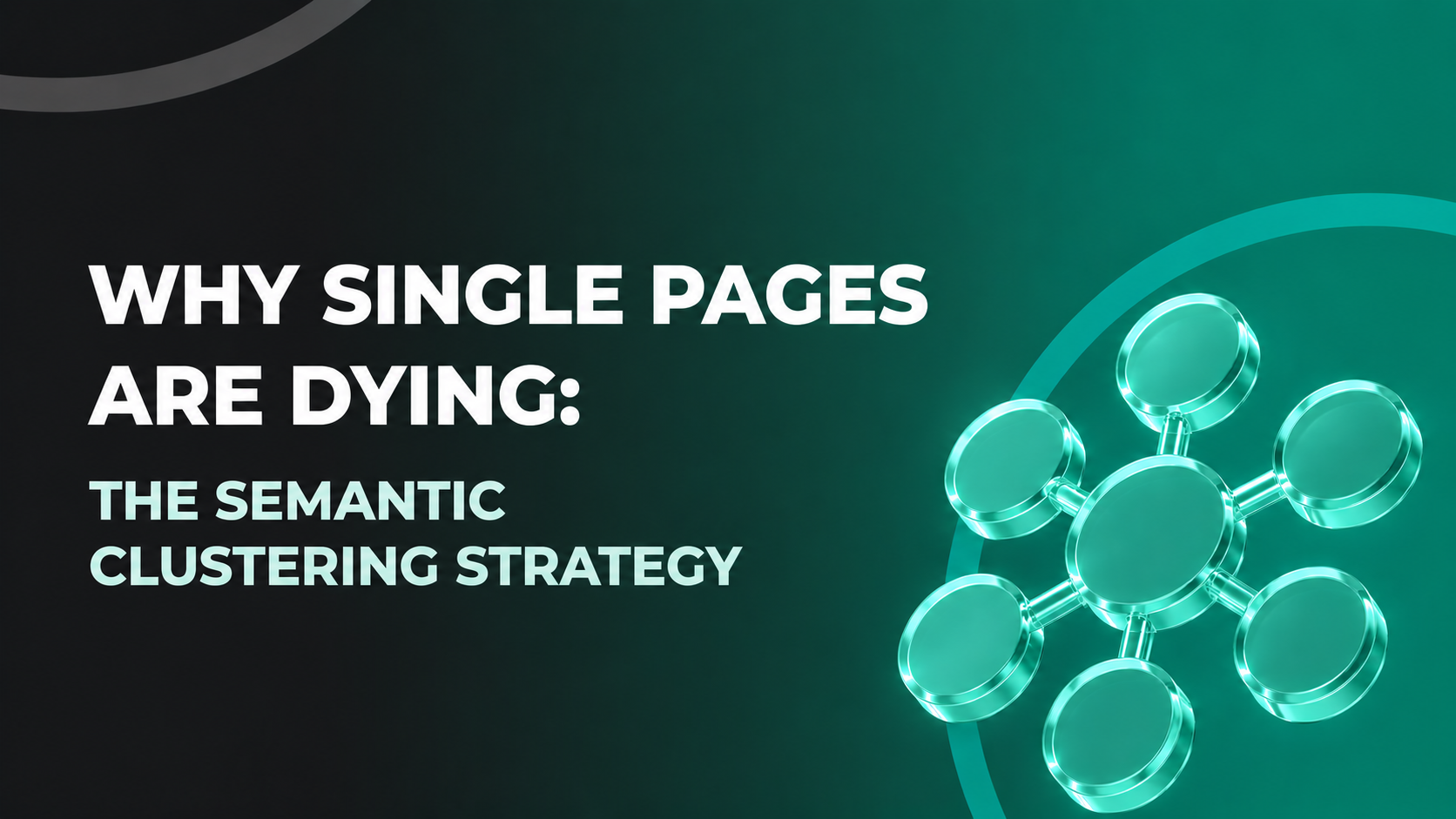
A topic cluster is a group of pages tied to a single theme and linked together internally. Structurally it looks like the sun with rays: in the center sits the pillar page (the hub), and around it sit supporting pages that cover individual angles of the topic and link back to the hub.
The hub is a broad page answering the main query for the topic. The supporting pages are narrower articles targeting specific subqueries. They're all stitched together with internal links so that Google sees this isn't a random pile of articles — it's a built-out system.
How is a cluster different from a regular blog category? A category is just a folder with tags. The articles in it don't have to be related, can overlap in intent, can duplicate and cannibalize each other. A cluster is a designed structure where every page covers its slice of the topic and links to its neighbors.
Let's take a supplements and nutraceuticals site as our example — we'll walk through the whole article using this niche.
A "magnesium" cluster might look like this. At the center: a hub called "Magnesium: How to Choose a Supplement, Forms, Dosages, and Contraindications." Around it sit the supporting articles: "Magnesium Citrate vs. Glycinate: Which Form Absorbs Better," "Symptoms of Magnesium Deficiency in Adults," "Magnesium for Insomnia: Dosages and Schedule," "Magnesium and Vitamin B6: Why People Take Them Together," "Top 7 iHerb Magnesium Supplements: Formula Comparison."
The hub captures the broad "magnesium" query, ranks in the top, and funnels visitors deeper into the site. The supporting articles catch the long tail and feed traffic back to the hub through internal linking. You end up with not one page on one topic, but an ecosystem that Google reads as an expert block.
Intent Is Google's Main Filter
Intent is the user's motivation behind the query. Why they're searching and what they want to get.
Google figures out the intent first, then picks pages that match it. If your page doesn't match the intent by format — no matter how perfectly optimized for keywords — it's not getting in the top.
There are four intents. Let's walk through them with our supplements topic.
Informational. The user wants to learn something. Queries: "why take magnesium," "vitamin D deficiency symptoms," "what is omega-3." Page format: a long-form guide, an explainer, a deep dive. This is the ideal material for AdSense — a long article, the user scrolls, ads load, RPM grows.
Commercial. The user is comparing options but hasn't bought yet. Queries: "best magnesium citrate," "which omega-3 to pick," "top 10 immune supplements." Page format: a roundup, a comparison, a ranking. This is the gold mine for affiliates: the user is ready to click out to a marketplace.
Navigational. The user is searching for a specific brand or product. Queries: "Solgar magnesium reviews," "Now Foods Vitamin D review." Page format: a product card or a detailed review of a specific supplement. Ranks well for branded queries and closes "hot" traffic.
Transactional. The user is ready to act right now: "buy magnesium citrate," "magnesium delivery." Page format: a product card or a direct link to the offer. On a content site this usually plays out through an affiliate redirect.
The main rule, the one worth tattooing on your hand: one intent, one page. If you spin up three articles for "which magnesium to choose," "best magnesium," and "top magnesium" — that's the same intent, and Google will decide the pages are competing with each other.
It's called cannibalization, and it kills the rankings of all three. The algorithm just doesn't know which one to surface, so it surfaces none.
Quick way to check for cannibalization: type into Google:
site:yoursite.com keyword phrase
If a single query pulls up three or four of your own pages — you're cannibalizing yourself.
How to Build a Cluster, Step by Step
Walking through it on the same niche — supplements.
Step 1. Pick a Topic for the Cluster
The topic has to hit three boxes at once: search demand, monetization potential, and at least some room to show expertise. Check three things:
• Search volume. If the main query is pulling fewer than 500–1,000 monthly searches, a cluster around it probably won't pay off. Check Keyword Planner, Google Trends, the free tiers of Ahrefs or Semrush.
• Monetization potential. Are there affiliate programs in the niche, marketplaces with referral commissions, AdSense demand. For supplements, that's iHerb, Amazon, marketplaces with CPA deals.
• Competition. If the top is locked up by clinics, government health sites, and major media — pushing in with your own site is brutal. Better to take a narrower angle: not "vitamins," but "vitamin D for women over 40."
Say we pick "magnesium" — stable demand, the topic is broad, there are plenty of affiliates and a solid AdSense payout.
Step 2. Gather the Cloud of Meanings
The cloud of meanings is every question, problem, and phrasing your audience cares about within the topic. There are several sources, and the play is to use all of them:
• Google Search Console, the Performance → Queries report. If your site already gets traffic, this is where you see the actual phrases that bring people to you but don't yet rank in the top. These are your obvious growth points.
• Google Trends. Shows dynamics and seasonality. Magnesium, for instance, climbs steadily through fall and winter. You also get related queries.
• SERP analysis. Type the main query into Google and look at what's in the top 10. What formats, what length, what subtopics they cover. Grab suggestions from the "Related searches" and "People also ask" blocks while you're at it.
• AlsoAsked and AnswerThePublic. Free tools that build question trees around a query — great for informational intents.
• Reddit and forums. On the English-speaking web that's Reddit, Quora, niche subreddits. People formulate their real pain points without SEO polish.
• ChatGPT or Claude. You can ask AI to brainstorm 50 subtopics for a "magnesium" cluster. Just verify everything through Trends or Keyword Planner afterwards — AI loves inventing queries nobody actually searches for.
For magnesium, the cloud might look like this:
• What forms of magnesium exist and which one is best
• Symptoms of magnesium deficiency
• Magnesium for insomnia
• Magnesium and leg cramps
• Magnesium for women
• Magnesium for anxiety
• Can you take magnesium every day
• Magnesium and alcohol
• Foods highest in magnesium
• Magnesium blood test — where to get it and how to read it
• Top iHerb magnesium supplements
Step 3. Group by Intent and Cut Cannibalization
Now sort the meanings by intent and check for duplicates.
For instance, "best magnesium," "top magnesium," and "which magnesium to choose" are one intent, one page. "Magnesium citrate vs. glycinate" is a different topic, its own article. "Symptoms of magnesium deficiency" and "how to tell if you're low on magnesium" are again one intent, one piece.
The most reliable way to verify: Google each query and check whether the top results are the same pages. If SERPs overlap by 70–80% — same intent. If they differ — two different intents.
Step 4. Map Each Meaning to a Page Type
Each meaning becomes a page of a specific type.
Pillar page (hub). A big piece on magnesium overall — forms, dosages, who needs it, contraindications. Length 3,000–5,000 words, with a table of contents, tables, and clear sections. This is the cluster's center, and everything else links to it.
Guides and explainers — for informational intents. "Symptoms of Magnesium Deficiency," "Magnesium for Insomnia: How to Take It," "Magnesium and B6: Why People Stack Them." These are the AdSense workhorses — long, with high time-on-page.
Roundups and comparisons — for commercial intents. "Top 7 iHerb Magnesium Supplements," "Magnesium Citrate vs. Glycinate: Which Wins." These are the pages built for affiliate traffic, with referral links and "buy" buttons.
Reviews of specific products — for navigational intents. "Solgar Magnesium Citrate: Formula, Reviews, How to Take It." These pages catch branded traffic and close the user at the moment they're almost ready to buy.
Step 5. Link It All Together
Without internal linking, the cluster doesn't function. Google has to see that the pages are connected.
The rules are simple:
• Every supporting page links to the hub via at least one anchor. The hub is the gravitational center — link equity flows toward it.
• Supporting pages link to each other within the cluster when topics are adjacent. The "Magnesium for Insomnia" article naturally links to "Magnesium and Anxiety."
• The hub links to every major supporting page — usually through a "Related" block or contextual links in the body.
• Each page carries 3–5 internal links to other cluster pieces. Fewer is a weak signal, more starts to look spammy.
• Anchors should be meaningful. Not "click here" or "read more," but "how to take magnesium for insomnia" or "forms of magnesium and their differences." The anchor is a hint to Google about what the target page is about.
Common Mistakes Webmasters Make
Plenty of people try to build clusters, and they all step on the same rakes. Top of the list:
Cannibalization. Two URLs targeting one intent. Usually happens when the site grew organically: there was one article, then someone wrote "an updated version," and the old one never got deleted. The fix — either merge them with a 301 redirect or rewrite one to hit a different intent.
A hub with no satellites. You built a massive "everything about magnesium" page, but no supporting articles around it. Google sees no topical depth — a single page doesn't make a cluster.
Satellites with no links to the hub. The reverse problem: you wrote ten articles but never wired them back to the central piece. Google can't tell they're part of a system, so they rank as orphans.
"Read here," "see this," "more" anchors. Useless for SEO — the algorithm gets no signal about what the target page is. That's a wasted hint.
A cluster with no commercial exit point. The most painful mistake. You pulled traffic to informational articles, the audience reads, AdSense spins — but no affiliate clicks, because the cluster has no roundup or comparison pages. Informational traffic has to land somewhere monetizable, otherwise you're pouring water into sand.
The hub buried deep in the site. If a user needs five clicks from the homepage to reach the hub — Google reads it as a secondary page. The hub should be one or two clicks from home, ideally with a direct link from the main menu or the front page.
How a Cluster Actually Moves the Revenue Needle
Now for the part that matters — what you get in dollars, not just in rankings.
Higher RPM on AdSense and display. A user landing on the hub usually keeps going — into the supporting articles. That bumps session duration and pages per visit. To ad networks, that signals quality traffic, and they start paying more per thousand impressions. Real-world cases show RPM jumping 30–80% after a cluster structure goes live.
Better affiliate conversion. A cold user who hits a commercial page straight from search clicks affiliates poorly. A warm one — who's already read two of your explainers, knows the topic, and trusts you — clicks dramatically better. A cluster essentially reproduces the classic funnel: top tier warms up, middle tier compares, bottom tier closes.
Resilience to Google updates. Sites with built-out clusters tend to take less damage from core updates and HCU. The logic is straightforward: the algorithm reads topical coherence and expertise, and has fewer reasons to demote a site like that. Content dumps, on the other hand, get cleared out first.
Long-tail compounding. Supporting pages on their own don't bring much — maybe 50–200 visits a month each. But if there are 20–30 of them in the cluster, that adds up to several thousand monthly visits, and the traffic is stable — low-frequency queries rarely crash hard.
Branded traffic grows. When you have full topic coverage, people start coming back directly and Googling "yoursite magnesium." That's the highest-quality traffic — it barely depends on Google's mood and monetizes the best.
The Bottom Line
The era of "crank out 500 SEO articles and collect AdSense" ended somewhere around 2023. Google now scores the whole site: how deeply the topic is covered, whether expertise is visible, whether the pages talk to each other. Standalone landing pages and thin keyword articles stopped working — they either don't get indexed or get torched on the next update.
Cluster SEO isn't a fashionable trick — it's the minimum viable model for a content site in 2026. Pick a topic where you can show expertise. Build the cloud of meanings from Search Console, Trends, SERPs, and forums. Sort by intent, cut cannibalization, map the page types. Wire it all together with internal linking so the hub is the center of gravity.
It's slower than the old "write whatever" approach. But it works, it makes money, and — more importantly — it survives the next update, when the sites around you go down.
Share this article
Send it to your audience or copy an AI-ready prompt.