How AI Overviews are Changing SEO and What to Do About It
At the end of 2024, search engine optimization faced a fundamental shift. It's not that AI replaced SEO specialists. Neural networks began breaking the very mechanics of search that had worked for years: optimize your site, rank in the top results, get traffic. Now users increasingly get ready-made answers directly in search results, without clicking through to any website. For users, this feature is an absolute blessing. But what should businesses do after years of investing in SEO?
This article will show how organic search has changed, how to adapt projects for AI answers, and what results this produces in practice.
What's Happening: The Short Version with Numbers
Major search engines are actively integrating neural networks into their results. A user enters a query, gets a text block with an answer, and leaves without clicking a single link.
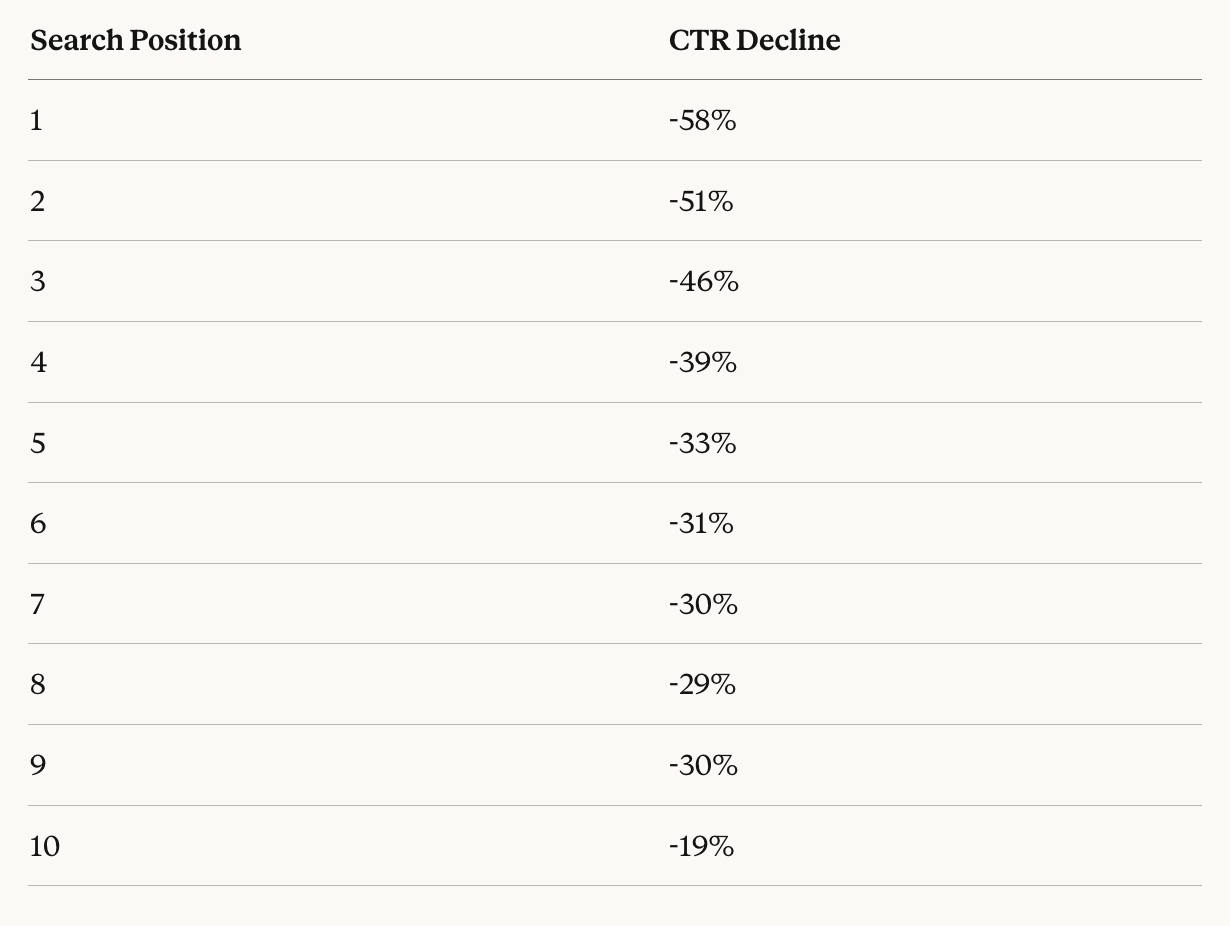
According to updated Ahrefs data from late 2025, when an AI answer appears in search results, the click-through rate for the first organic position drops by 58%. Looking at the global market, informational sites lost between 15% and 60% of organic traffic in 2025, depending on their niche.
Click-through rate decline after AI Overviews implementation (December 2025 data):
The share of queries with AI answers in major search engines reached 43% in the commercial segment and 68% in the informational segment. These figures are confirmed by industry expert research presented at major SEO conferences in 2025.
Search engines themselves confirm the trend: even before AI answers began appearing by default through search integration in May 2025, users started activating AI mode on their own one and a half times more frequently.
What does this mean in practice? If your site received traffic through content like "how to choose," "what's better," or "how much does it cost," you've already lost part of that traffic or will lose it in the coming months. Your rankings may remain in the top positions—people will just click on them significantly less often.
Query Types and Risk Levels
Not all queries are equally vulnerable to AI answers. Analysis of dozens of projects over the past year revealed a clear pattern: the degree of risk depends on the query type and the length of answer it requires.
High Risk
Informational queries with short answers: "What is the lifespan of a solar panel," "Difference between LLC and Corporation." For such questions, AI answers provide a compact block of two or three paragraphs, and users simply have no reason to click through to a site. This is where traffic drops most severely.
Medium Risk
Comparison queries: "Laminate vs engineered hardwood flooring," "Salesforce vs HubSpot for small business." AI answers provide a general summary, but the topic is complex enough that some users still want to dig deeper and click through to links. Traffic declines, but not as dramatically as with informational queries.
Low Risk
Commercial and local queries: "Kitchen remodeling contractor near me," "Buy custom furniture online," "Roller shutters installation cost." When users search for a specific contractor or product, they need company profiles, prices, reviews, and portfolios. AI answers don't fulfill this need, and this traffic remains relatively safe.
The Main Pattern
The shorter and more universal the answer to a query, the higher the probability that the search engine will fulfill the user's need directly in the results.
For businesses, this leads to a concrete conclusion. If you've spent years investing in informational content for traffic volume, now is the time to reconsider your priorities.
But there's good news: commercial queries that bring actual leads are still minimally affected. And you can redirect traffic through a new channel rather than just losing it.
GEO (Generative Engine Optimization): Optimization Principles
GEO (Generative Engine Optimization) is content optimization for generative search systems. Essentially, it's a set of principles by which neural networks choose which content to quote and which to ignore.
Language models (LLMs) break down your text into fragments and decide whether it's worthy of inclusion in an answer. Their logic is different, and if you don't account for it, you can have excellent content that the neural network simply won't see.
Use Specific Names
LLMs don't understand context the way humans do. If text says "this tool is great for business," the neural network won't always understand which tool is meant. It works with concrete entities, not pronouns.
Bad: "This system has a user-friendly interface and many useful features for professionals."
Good: "AquaDrill drills water wells from 65 to 500 feet deep in residential areas, completion time 1–3 days, 10-year warranty on steel casing."
Practical rule: Name the entity by name in each paragraph. One term means one concept throughout the text. Add modifiers: size, function, location, niche.
Entity → Attribute → Value Structure
Neural networks extract information best when it's presented in the "entity → property → value" format. This is similar to how data is stored in databases.
Bad: "The company offers great conditions and big discounts for first-time customers."
Good: "[Company] offers roller shutters starting at $45 per square foot with free measurement and installation within 3 business days across metropolitan area."
Checklist:
- Entity clearly named, without pronoun substitutions
- Specific properties, not "more" or "better"
- Context included in the paragraph
- Each thought is complete and doesn't require previous sentences for understanding
Each Paragraph Should Work as a Standalone Answer
This is perhaps the most important principle for GEO. LLMs use passage-level ranking: they take not entire articles, but separate fragments. If a paragraph can be pulled from context and still be clear and useful, chances of appearing in an AI answer increase dramatically.
Guidelines:
- 2–4 sentences per paragraph
- One sub-query per paragraph
- 150–400 words per H2 section
Superlatives only work with specific metrics: not just "best service," but "service with 99.8% uptime."
Answer Format Should Match Query Intent
Neural networks classify queries by intent type and expect a specific answer format. If the format doesn't match, the content gets passed over.
How this looks in practice:
- Transactional query ("best CRM for small business") — ranked list
- Informational query ("what is end-to-end analytics") — definition and mechanics description
- Comparison query ("Salesforce vs HubSpot") — comparison table
- Trust query ("is service X reliable") — trust signals: reviews, ratings, certifications
- Tactical query ("how to set up Google Ads") — step-by-step process
- Problem query ("why Google Ads not generating leads") — "problem–solution" format
Simple rule: one H2 section addresses one intent cluster. Don't mix.
Use Structured Formats
Tables are extracted by neural networks 3–4 times more often than regular text, especially for comparison queries. This doesn't mean you need to turn your entire site into tables, but where information fits into a "parameter–value" structure, tables beat paragraphs.
Which format for what:
- Characteristic comparison → comparison table
- Specifications and features → attribute table
- Plans and pricing → pricing table
- Process or steps → numbered list
- Selection criteria → bulleted list
- Pros and cons → two-column table
FAQ blocks also work excellently:
- Question mentioning the entity
- Direct answer in one sentence
- Additional data in two sentences
- Exceptions or caveats in three sentences
E-E-A-T Signals
E-E-A-T (Experience, Expertise, Authoritativeness, Trustworthiness) is Google's framework for evaluating content quality, and neural networks also orient to it. But it's not enough to write one disclaimer "article author is an expert with 10 years of experience" at the beginning of the text. Neural networks work with fragments and need at least one authority signal in each section.
Which signals work:
- Regulatory — links to licenses and certifications
- Expert — expert names with qualifications and quotes
- Data — statistics from authoritative sources
- Third-party — links to independent reviews and ratings
- Institutional — mentions of industry standards
- Temporal — publication and update dates
Prioritize: Not All Content Is Equally Important
You don't need to rewrite your entire site at once. Prioritize by content importance for neural networks:
- 40–50% of text — direct answer to query intent. This is the core that neural networks are most likely to quote.
- 30–35% — answers to related sub-queries. This increases chances of appearing in AI answers for several related queries.
- 10–15% — unique information: your own data, case studies, observations. What competitors don't have.
- 5–10% — supporting context: introductory words, transitions, connectors.
Place priority content at the beginning of the page. Comparison tables at the beginning of sections, and at the end—summaries with key formulations. For seasonal content, it's recommended to add the year to the heading.
Important: All these principles don't cancel classic SEO, they only supplement it. If your site has a poor technical foundation, slow loading, and content that doesn't rank in regular results, GEO optimization won't help. Neural networks primarily take information from sources that already rank well.
Working with High-Authority Platforms Strategy
Practice shows that in the overwhelming majority of cases, AI answers feature not company websites, but high-authority platforms: major media outlets, industry portals, authoritative blog platforms.
The logic is simple: these domains have an order of magnitude higher authority in the eyes of search engines than an ordinary company site. And this can be used.
An important caveat: appearing in AI answers doesn't guarantee users will click through to your site more often. Search engines don't yet share data about clicks from AI answers to analytics systems, so measuring direct effect is impossible.
But there's another effect that manifests clearly. The more often a company name appears in search results, the higher the brand awareness and the better the reputation. Today a user saw the name in an AI answer, tomorrow they stumbled upon an article in organic results. They'll make a decision later, but by that time they'll remember your company, and trust will be higher.
Examples of Successful Implementation
Industrial Equipment
A manufacturer of laser metal processing equipment. Narrow B2B niche where classic SEO is slow and competition for top rankings on industry queries is high.
Actions: 60 publications placed on authoritative business platforms and technology media: equipment rankings, expert reviews, technology comparisons.
Results:
- 41 of 60 articles entered top-10 of main search engine
- 30 articles in top-10 of alternative search engine
- Across 60 checked queries, AI assistants mentioned the company 12 times
- 26 times links to articles from platforms were provided in one system
- 27 brand mentions and 4 article links in another system
Key insight: Ranking articles with specific selections worked best, not general "how to choose" overviews. Neural networks more readily quote content with specific names, models, and numbers.
Tourism Services
A small tour operator with a strong product but weak search visibility. Competition in the niche is high, promoting your own site to the top for queries like "best mountain tours" is long and expensive.
Actions: A series of ranking articles published on major tourism platforms and lifestyle media.
Results:
- Within weeks, an article from an authoritative platform entered top-3 of search engine for target query
- AI answer began recommending the company first for the query "top mountain tour operators"
- Alternative search engine in AI mode followed
- ChatGPT started providing the company in recommendations
Five articles on external platforms made the brand visible at all main user touchpoints.
Car Inspection Services
Competitive niche where market leaders' advertising budgets are many times larger.
Actions: Series of publications with rankings created on high-authority platforms.
Results:
- For the query "best car inspection service [city]," AI answer provides a block with the company first
- Quotes description from ranking articles
- Essentially, the brand obtained a position impossible to buy through contextual advertising
Manufacturing Company
Security systems manufacturer with a long history of contextual advertising and SEO work.
Actions: Publications on external platforms added to standard strategy.
Results:
- For the query "best security systems installation companies," AI answer provides a block with the company first
- Authoritative business platforms and industry media cited as sources
- For a manufacturing company, appearing in AI recommendations proved easier and faster than reaching organic top-3 for the same query
Key Takeaway
Appearing in neural network answers is not an SEO replacement. It's a different tool with a different metric. It provides few direct clicks. But it solves a task that classic SEO solves slowly and expensively: making your brand visible whenever someone searches for your service.
Action Plan: Two Directions
Based on a year of working with AI answers on real projects, two directions emerge.
First — defense: minimize traffic losses where AI answers are already taking clicks.
Second — presence: ensure your brand appears in those very AI answers and in surrounding results.
Defense: Restructure Content Strategy
Check Where You're Already Losing Traffic
Open your analytics system and look at dynamics for informational pages over the past 6–12 months. If you see a decline with stable rankings, AI answers likely took the traffic.
Easy check: enter your key queries in a search engine in incognito mode and see if an AI block appears.
Reconsider Content Priorities
General informational articles in the "what is" and "how does it work" category are no longer worth the investment if your goal is traffic. Neural networks answer such questions better and faster.
Instead, focus on content that neural networks cannot replace:
- Cost calculation calculators
- Portfolios with photos
- Case studies with specific numbers
- Step-by-step service descriptions with prices
Everything that requires your unique expertise and data from real projects.
Strengthen Commercial Pages
Transactional queries are still minimally affected, and they're what bring leads. Service pages, product cards, landing pages for specific offerings—that's where resources should go now.
Add:
- Capture forms
- Detailed work process descriptions
- Real reviews
- Specific prices
The more specifics on the page, the harder for AI answers to replace it and the higher the conversion.
Presence: Become a Source for AI Answers
Publish on High-Authority Platforms
As real case studies showed, AI answers primarily take information from platforms with high domain authority. Major media, industry portals, authoritative blog platforms—all potential sources.
Effective formats:
- Ranking articles
- Expert reviews
- Product or service comparisons
Important to understand: this works for brand awareness, not direct traffic. Measure effectiveness through brand query growth and share of presence in results, not through clicks.
Structure Content for Neural Networks
Both on your own site and on external platforms. Neural networks better recognize information presented in "question—answer" format, as tables, lists with clear hierarchy.
What to add:
- FAQ blocks
- Schema.org microdata
- Comparison tables
- Structured lists
This doesn't guarantee appearing in AI answers, but increases chances.
Track New Metrics
Classic "rankings + traffic + leads" no longer gives the full picture.
Add to analytics:
- Monitoring presence in AI answers for key queries (still manual only, no automation tools exist)
- Brand query dynamics
- Number of positions on first page for target queries, including external platforms
- Appearances in search engine suggestions
If the brand starts appearing more frequently in suggestions and AI answers, the strategy is working, even if direct organic traffic isn't growing.
Comprehensive Approach
Best results are achieved when simultaneously:
- Commercial site pages are strengthened
- Expert content is published on external platforms
- All content is optimized under GEO principles
This creates synergy: external publications increase awareness and trust, while optimized commercial pages convert traffic into leads.
FAQ: Common Questions
Do Different AI Systems Take Information from the Same Sources?
Not exactly. Observations show different search engines have different preferences:
- One search engine relies more on authoritative local platforms in its region of operation
- Another search engine more readily quotes its own products, review platforms, and major industry resources
- ChatGPT may pick up information with a delay of several weeks, but holds it longer
Therefore, strategy differs slightly for each neural network.
Are AI Answers the Same for All Users?
No. Search engines consider region, query history, and device. Checking the same queries from different regions produces different AI answers with different sources.
This means for local businesses, it's important that publications on external platforms include geographic references.
Can a Competitor Displace Your Brand from AI Answers?
Yes, and it happens. AI answers aren't static; they update as new sources appear.
If a competitor starts actively publishing on high-authority platforms and their content proves more relevant, the neural network will start quoting them.
Therefore, a one-time publication doesn't work as a long-term strategy—regularity is needed.
Should You Block Your Site from Neural Networks via robots.txt?
Some sites try blocking AI crawlers by adding directives for specific user-agents in robots.txt: GPTBot, ClaudeBot, PerplexityBot, and others.
Technically this works—each crawler identifies itself, and the directive blocks it specifically.
But this approach is considered a mistake. You lose the chance to be a source for AI answers, and traffic leaves anyway because the neural network will simply take information from a competitor.
Conclusions
AI answers don't kill SEO. They kill a specific approach where businesses spent years driving informational traffic for volume and hoped some visitors would somehow convert. That traffic goes to AI answers, and getting it back won't work.
But commercial queries that bring actual leads are still minimally affected. And for those ready to adapt, a new tool has emerged.
What's changing:
- General informational content loses value as a traffic source
- Commercial and transactional queries remain effective
- A new influence channel emerges through presence in AI answers
- Focus shifts from number of clicks to awareness and trust
What to do:
- Reevaluate the role of informational content in your strategy
- Strengthen commercial pages with specific offers
- Optimize existing content under GEO principles
- Begin working with high-authority platforms to increase presence in AI answers
- Implement new effectiveness tracking metrics
SEO evolution continues. Those who adapt quickly gain an advantage. Those waiting for a return to "the good old days" will lose positions.
Neural networks don't replace SEO—they change the rules of the game. And in this new game, there are opportunities for those ready to use them.
Share this article
Send it to your audience or copy an AI-ready prompt.