Autonomous SEO in 2026: What Ahrefs Agent A Really Means for People Who Make Money From Websites
For most of the last decade, running a profitable website meant doing the unglamorous work by hand. You opened one SEO tool, exported a spreadsheet, cross-checked it against another tool, argued with yourself about which keyword was worth chasing, and then finally did something with the data three tabs and two coffees later. The data was never the bottleneck. Acting on it was.
That is the gap a new category of tool is trying to close in 2026: the autonomous SEO agent. Instead of handing you numbers and leaving the thinking-and-doing to you, an agent takes a goal, breaks it into steps, pulls its own data, reasons over it, and delivers a finished result — a report, an audit, a content brief, a draft ready in your CMS. Ahrefs shipped the most credible version of this idea at the end of May 2026, and it's called Agent A.
This is a practical look at what it actually is, how it fits into the work of someone who earns a living from websites, and — just as important — where the reality falls short of the marketing.
What Agent A actually is
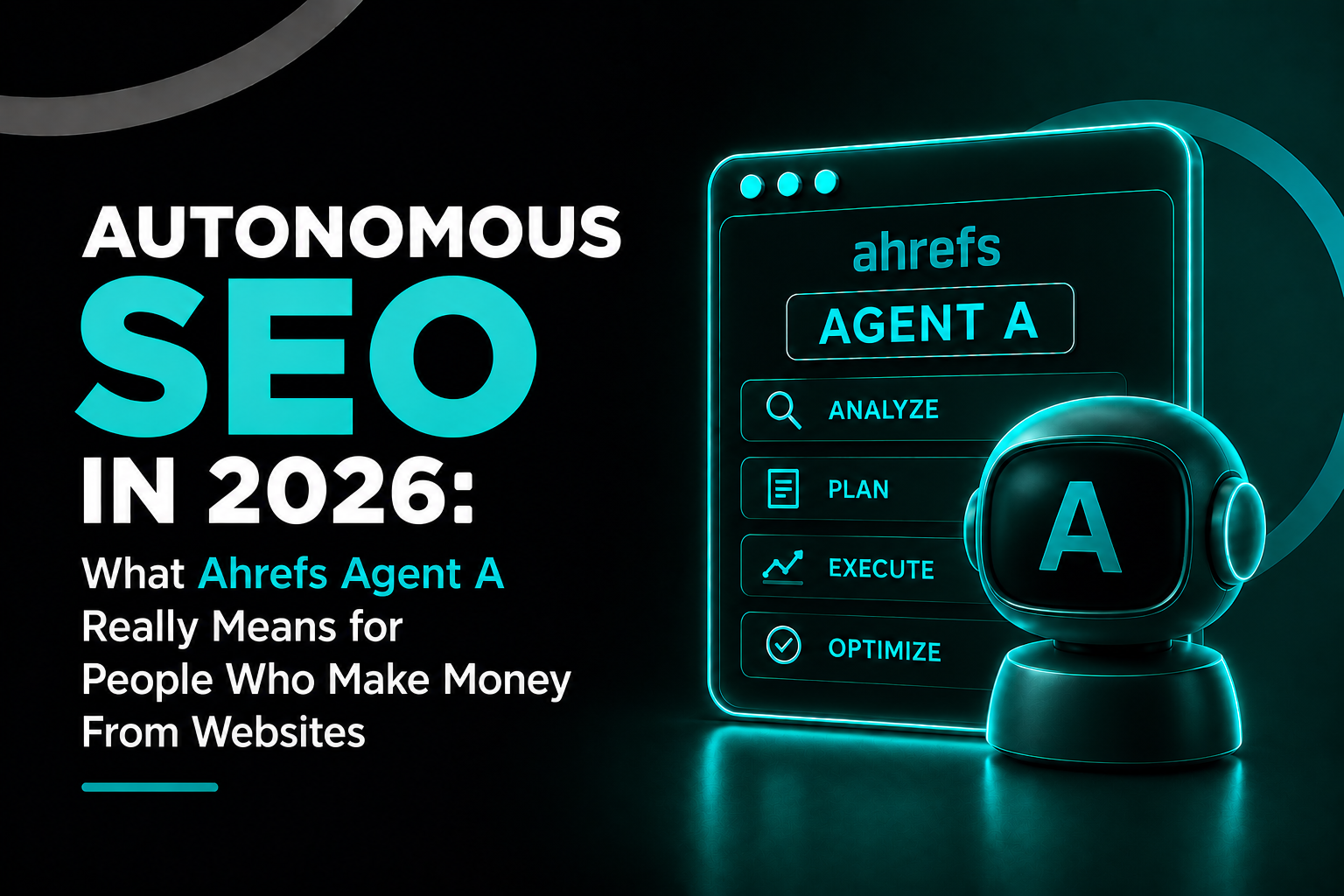
Agent A is an autonomous marketing agent built directly on top of Ahrefs' data. The distinction that matters is between an assistant and an agent. An assistant answers a question you ask. An agent accepts an objective and completes the whole job without you steering every keystroke. You tell it "find the topics my three biggest competitors rank for that I don't, and hand me back a prioritised content plan," and it runs the queries, evaluates the opportunities against your site's realistic chances, and returns the finished plan — not a dashboard you still have to interpret.
Under the hood it runs on always-on infrastructure (Ahrefs partnered with an agent-hosting platform called Letaido to make this work), which means it can operate on a schedule, unattended, and wake you up with a Slack message on Monday morning rather than waiting for you to log in. It costs $99 a month, and — unusually for this kind of product — the AI model usage is bundled into that price rather than billed as murky "credits" on top.
The reason this is different from just wiring a chatbot into a spreadsheet is the data underneath it. Agent A has direct, unrestricted access to Ahrefs' full index — on the order of 170 trillion indexed pages, tens of billions of tracked keywords, and trillions of mapped backlinks. Crucially, it can reach parts of that index that were never exposed through the public API, and it can cross-reference several data sources inside a single task. That combination — a genuine, current dataset plus an agent that can act on it — is the thing most competing "AI SEO agents" can't fake, because most of them are a language model bolted onto whatever they can scrape off the open web.
"Agentic" versus "AI-assisted": Agent A and Agent B
Ahrefs actually launched two things close together, and it's worth being clear about the difference because people conflate them. Agent B is the smaller one: an in-tool chat assistant that lives inside the Ahrefs panels and answers questions about whatever you're currently looking at — "why did this page lose traffic last month?" It's useful, but it's reactive. You have to be sitting there, looking at the data, asking.
Agent A is the ambitious one. You brief it on a task the way you'd brief a junior team member, then walk away and let it finish. The mental model that works best is this: Agent B is the analyst you interrupt with a question; Agent A is the teammate you hand a project to and check on tomorrow. For a small operation, that second model is the one that actually buys back your time.
The data moat is the whole point
It's worth dwelling on why the underlying data matters so much, because it's the single factor that separates this from the wave of forgettable AI SEO tools launched in the last two years. Anyone can plug a frontier model into a marketing prompt. What almost nobody has is a deep, current, proprietary index of the web's link graph and search behaviour. Ahrefs spent roughly fourteen years building exactly that. Agent A inherits it wholesale.
For a site owner, the practical consequence is coverage. Generic keyword tools routinely under-represent or filter out data in less mainstream niches; an agent querying the full index directly surfaces competitor terms, emerging categories, and link opportunities that thinner tools simply never show you. If your income depends on ranking in a niche the big consumer tools treat as an afterthought, that depth is not a nice-to-have — it's the difference between finding an opportunity and never knowing it existed.
It picks the right model for each step
One quietly clever design choice: Agent A isn't married to a single AI model. Depending on the subtask, it routes work to whichever model does that job best — a reasoning-heavy analysis might go to Claude, a piece of writing to a GPT model, a cheap bulk transformation to something faster and cheaper. You don't manage any of this, and you don't pay per model. From your seat it's a black box that quietly optimises quality against cost on every step. For work that touches sensitive or niche terminology, the routing also sidesteps a subtle problem: some models over-filter unusual industry vocabulary and quietly distort the analysis. Letting the agent choose the model that handles the context cleanly keeps the output honest.
Keyword research that ends in a plan, not a spreadsheet
This is where the time savings become obvious. Keyword research done by hand is a grind of filters and exports. Agent A takes a topic, a niche, or a competitor URL and runs the whole loop: it queries across multiple filters at once, reasons about which terms suit your site's authority and content model, and returns a ranked list with recommendations attached. The output is a decision, not homework.
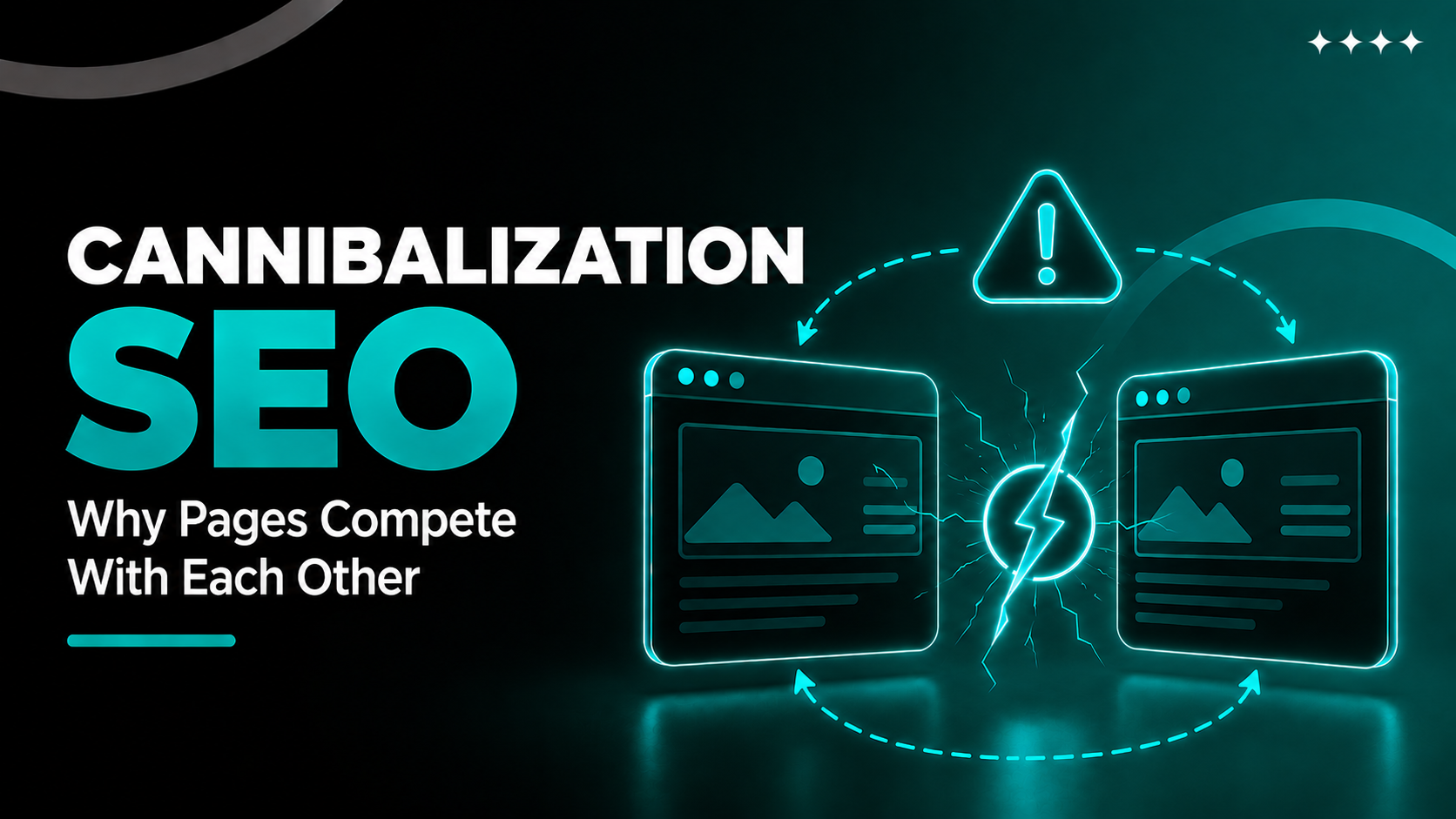
Three workflows earn their keep first. Content-gap analysis is the highest-ROI thing you can point it at: give it three to five real competitors and it tells you which keywords they rank for that you don't, sorted by traffic potential and your realistic chance of winning them. Most site owners never run this systematically; the ones who do, and who publish into those gaps consistently, quietly take organic market share. Trending keyword research does the opposite of a normal volume report — instead of showing you what's already big (and already saturated), it flags what's accelerating, so you can publish into a rising category before everyone else piles in. And keyword cannibalisation detection solves a problem that plagues any site with hundreds of similar pages: when multiple pages chase the same term, Google can't decide which is authoritative and suppresses all of them. Agent A finds the clusters, tells you which page should become the canonical, and — if it's connected to your WordPress — can implement the redirects and canonical tags itself.
Link building, scoped to what's actually reachable
Agent A sits on Ahrefs' full backlink graph, and link work is one of the clearest places automation pays. A few workflows stand out.
Link intersect finds the domains that already link to two or more of your competitors but not to you — in other words, the sites that are demonstrably willing to link to something like yours. That's your most realistic prospect list, and the agent cross-references it against quality metrics and hands you a ranked outreach sheet. Broken-link building hunts for dead links on relevant sites in your niche, then matches your existing pages as the replacement; it's one of the few link tactics that's genuinely value-adding rather than spammy, because you're fixing something for the other site. Unlinked brand mentions finds pages that name you but don't link to you — the easiest conversions there are, because the awareness already exists and a polite email often closes the loop. And a full competitor backlink audit maps the link landscape of your niche: who's linking to the people beating you, which of those sources are reachable, and how their anchor text is distributed.
That last detail matters more than it looks. Running an anchor-text analysis on your own incoming links is one of the smartest defensive uses of the tool, because an over-concentration of exact-match keyword anchors is exactly the pattern that trips spam filters. Catching it before Google does is worth more than most people realise.
Technical audits that scale to a network
If you run one site, technical SEO is annoying. If you run twenty, it's unmanageable by hand. Agent A connects to Ahrefs' Site Audit, and when the audit flags issues you can push them straight to the agent for diagnosis. The genuinely valuable layer here isn't the fixing — it's the prioritisation. A large site throws hundreds of technical flags at once, and most of them don't matter. The agent ranks them by estimated impact on rankings, so a broken redirect on a dead page with no traffic sinks to the bottom while the same issue on a page pulling ten thousand visits a month floats to the top. Your time goes where it moves the needle.
For anyone running a network of sites, the real unlock is scheduling. You can have the agent run sequential audits across every domain on a recurring basis, batch the routine maintenance into a monthly summary, and fire an immediate alert only when something crosses a severity threshold. What used to be a few hours of manual navigation per site becomes roughly half an hour of human review across the whole portfolio each month. That multiplier is the entire value proposition for lean teams managing a lot of domains.
The new frontier: being visible inside AI answers
Here's the part that didn't exist in a serious way a couple of years ago and now can't be ignored. A growing share of searches never reach a traditional results page at all — people ask a chatbot and read the synthesised answer. If your site is the source those answers cite, you win traffic and authority you'd never see in a rank tracker. If it isn't, you're invisible in a channel that keeps growing.
Agent A leans into this with a set of "GEO" workflows — generative engine optimisation, the AI-era cousin of SEO. It can map where competitors are being cited in AI responses and you aren't, so you can see the gaps. It can check whether your already-cited pages have gone stale, since AI systems drop outdated sources over time. And it can monitor how your brand is actually described inside chatbot answers, which is reputation intelligence you otherwise have no window into. For anyone whose income depends on being found, this is the most forward-looking reason to pay attention, precisely because most site owners haven't adapted to it yet.
Where it fits in a money-site stack
None of this is interesting in the abstract; it matters because of what it does to revenue. For an affiliate site, faster content-gap execution and trending-keyword capture translate directly into more pages ranking for commercial-intent terms before competitors saturate them. For a display-ad site living on volume, the multi-site audit automation and cannibalisation fixes protect the organic sessions that pay the bills. For a lead-generation site, the link and E-E-A-T workflows shore up the authority signals that decide whether you rank for the queries with real buyers behind them. The through-line is that Agent A shifts the constraint. Your ceiling stops being "how many hours can I spend in dashboards" and starts being "how good is my judgement about what to publish and pursue."
The honest limitations
Now the part the launch posts skip. Agent A is powerful, but it is not magic, and treating it as such is how people waste ninety-nine dollars a month.
First, its universe is Ahrefs data. It does not natively pull your GA4 sessions, your Search Console clicks, your CRM deals, or your CMS publishing pipeline. That means it can tell you a page should rank and is losing to a competitor, but it can't always see what your own analytics know about why that page converts or bounces. You still need to marry its output to your first-party data yourself.
Second, an agent that acts autonomously can act autonomously wrongly. It can misread a niche, propose a consolidation that flattens a page you needed, or draft content that reads plausible and is subtly off. The human job doesn't disappear — it moves upstream, to reviewing and approving. The operators who get burned are the ones who let it publish unattended and call it a day.
Third, and most important for anyone tempted to scale content generation with it: mass-produced pages are a liability, not an asset. Google has spent the last few update cycles getting better at demoting thin, templated, machine-assembled content. An agent that can spin up a thousand programmatic pages in an afternoon is a loaded weapon pointed at your own domain if the pages don't actually help a reader. The tool lowers the cost of doing the work; it does not lower the standard the work has to meet.
Who it's for, and who it isn't
Be honest with yourself about which side of the line you're on. If you're a solo operator running one modest site and already stretching to pay for a basic Ahrefs plan, an autonomous agent is overkill — you'll save a few hours a week and spend more time learning the tool than you get back. The value curve bends sharply upward with scale. If you're managing a portfolio, running an agency workflow, or spending a meaningful chunk of every week on reports and audits that a machine could grind through overnight, the ninety-nine dollars pays for itself almost immediately. The question isn't whether the tool is good; it's whether your workload is shaped like the problem it solves.
What a realistic first month looks like
Rather than treat it as a magic box, the operators who get value from it tend to ease in along a predictable path. The first week is usually a single content-gap analysis against the top few competitors, because that produces the most obviously useful output and builds trust in the tool fast. From there it's natural to point it at trending keywords in the core niche to find rising terms, then run link-intersect prospecting to build a realistic outreach list. Once those one-off tasks feel reliable, the schedule takes over: a recurring site-audit sweep across the whole portfolio, delivered to Slack, running quietly in the background. Somewhere in the second month the AI-visibility and brand-authority workflows come in, because by then you're thinking less about catching up and more about defending your position. Run monthly, that handful of workflows covers the highest-impact maintenance a site needs, for well under a couple of hours of actual human review — and the review, not the running, is where your attention belongs.
The bigger picture
The arrival of tools like Agent A doesn't make the site owner obsolete; it changes what the job is. The tedious middle — the exporting, the filtering, the cross-referencing, the copy-pasting between tabs — is exactly the part that machines do tirelessly and well, and it's the part most of us never enjoyed anyway. What's left is the part that actually decided who won all along: knowing your audience, choosing what's worth building, judging what's good enough to publish, and having the taste to tell a real opportunity from a shiny distraction. Automation raises the floor for everyone, which means the ceiling — the strategy and the judgement — is where the competition now lives. For people who make their living from websites, that's not a threat. It's the most leverage the work has ever offered, provided you keep your hands on the part that matters.
Share this article
Send it to your audience or copy an AI-ready prompt.