Ragebait in Affiliate Marketing: How Provocations Increase CTR Without Killing Your Accounts
Introduction: Emotions as Currency in Digital Marketing
Forget boring creatives and polite posts. In 2026, the winner is the one who knows how to hit a nerve. Social media algorithms figured out a simple truth long ago: emotional content holds attention 3-4 times longer than neutral content. And where there's attention, there's reach, clicks, and ultimately, money.
Does positive content work? Absolutely. But negative emotions—outrage, bewilderment, the desire to argue—trigger viral distribution mechanisms on a completely different level. People don't just like, they share, comment, tag friends to vent their emotions. And this is where ragebait enters the game.
What is Ragebait: Definition and Mechanics
Ragebait (from "rage bait") is content deliberately created to provoke a negative audience reaction. The goal is simple: cause outrage, provoke an argument, make a person stop and react.
The Psychology of Provocation
Why does this work? It's all about our evolutionary wiring. The brain perceives provocative content as a potential threat and activates "fight or flight" mode. In the digital environment, this translates into:
- Comments — people can't stay silent
- Shares with criticism — "Look at this nonsense I found!"
- Mentions — tagging friends to share the outrage
- Extended engagement — arguments in comments stretch for hours
All of this is pure gold for algorithms. Facebook, Instagram, TikTok perceive such activity as a signal: "This content is interesting, let's show it to more people."
Real-World Examples
Classic ragebait:
- A blogger claims that "morning coffee is for weaklings"
- A clothing brand launches a provocative campaign with the caption "Your ex was right"
- An influencer publishes an "unpopular opinion" about a popular trend
In each case, the result is the same: explosion of activity, thousands of comments, viral reach.
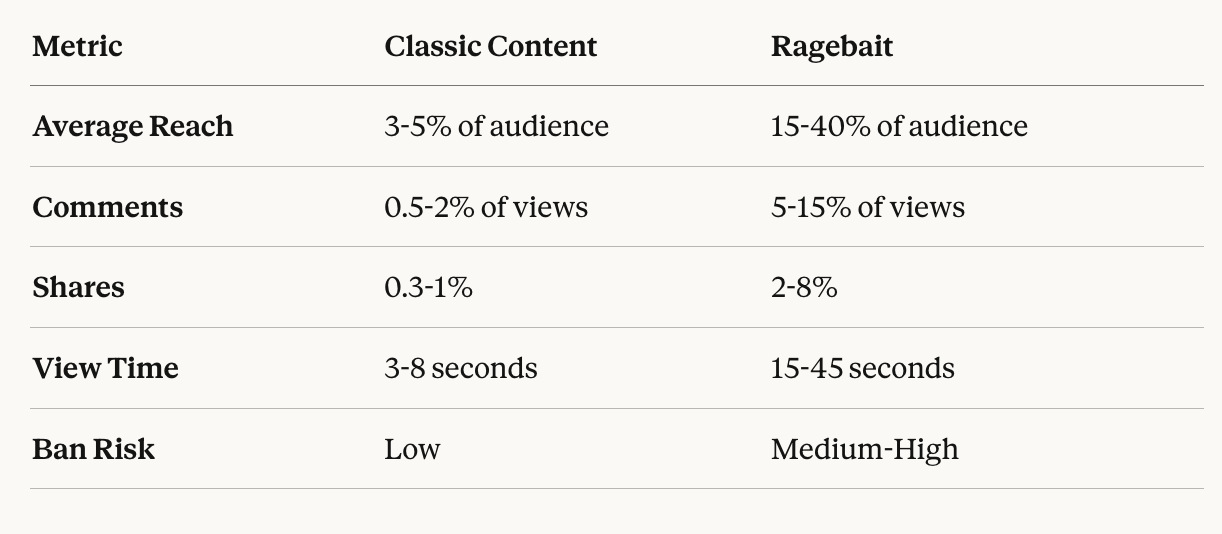
Ragebait vs. Classic Approaches
Let's honestly compare the numbers:
When ragebait works:
- Quick reach growth needed
- Warming up new accounts
- Reviving "dead" assets
- Testing audience reaction to edgy content
When it fails:
- Overly aggressive provocation (ban)
- Doesn't fit the niche/brand
- Lack of comment moderation (toxicity)
- Used as the only strategy
Applying Ragebait in Affiliate Marketing: Practical Guide
Theory is good, but how specifically do you use provocations to make money? Let's break down three main directions.
4.1. Warming Up Accounts for Cloaking
Problem: Fresh Facebook/Instagram accounts have zero Trust Score. Algorithms don't trust them, organic post reach approaches zero, and ad campaigns start with inflated CPC.
Solution: Ragebait for quick activity boost.
How it works:
- Choose a safe topic for provocation
- "iPhone in 2026 — overpaying for brand or real features?"
- "Food delivery: why couriers earn more than office workers"
- "Credit card purchases: financial literacy or normal practice?"
- Formulate a post with a hook
Unpopular opinion: people who buy iPhones on credit are
smarter than those who save up. And here's why... 👇
- Ignite discussion in comments
- Reply to the first 10-15 comments
- Ask counter-questions
- Disagree even with reasonable criticism (within limits)
Result: After 3-5 provocative posts, the account gains 500-2000 comments, dozens of shares. Trust Score grows, algorithms start trusting. After a week, you can launch main campaigns with normal CPC.
⚠️ How not to get banned:
- Avoid topics of politics, religion, nationality
- Don't use insults and profanity
- Don't provoke about health topics (especially children's)
- Monitor moderation: delete overly aggressive user comments
4.2. Creatives for Ad Campaigns
Provocative creatives deliver CTR 2-3 times higher than niche averages. But fine-tuning is critically important here.
Examples of provocative headlines:
Niche: betting
- ❌ "Earn with betting"
- ✅ "Bookmakers hate this trick. And here's why they ban it in 3 countries"
Niche: nutra (weight loss)
- ❌ "Effective weight loss product"
- ✅ "Nutritionists shocked: she ate THIS and lost 15 kg in a month"
Niche: cryptocurrency
- ❌ "Invest in crypto"
- ✅ "Banks hide the truth: why they fear this currency"
Important: Provocation should be in the headline and first 3 seconds of video. Then—specifics and real value, otherwise you'll get high bounce rate and budget drain.
Process of coordinating with advertiser:
- Prepare 2-3 creative variants: one classic, two provocative
- Show statistics: if you have experience, attach CTR screenshots of similar campaigns
- Explain risks: warn that moderation may reject or account may receive a warning
- Agree on boundaries: what's allowed, what's absolutely forbidden
Case from practice: An affiliate in betting niche launched two creatives:
- Creative A (classic): "Sports betting with high odds"
- CTR: 0.8%
- CPC: $0.45
- Creative B (ragebait): "Why bookmakers block winning accounts (and how to bypass it)"
- CTR: 2.3%
- CPC: $0.19
With the same budget, the second creative brought 4 times more registrations.
4.3. Personal Brand for Affiliates
If you're building a personal blog in the affiliate niche, ragebait is your tool for explosive growth.
Strategy for beginners (0-1000 followers):
Step 1: Publish a provocative post
"90% of affiliates drain budgets because of one mistake.
And team leads stay silent about it because it benefits them..."
Step 2: Heat up in comments, responding to every reaction
Step 3: After 24 hours, publish an analysis with real value
Result: Post gets 5-10 shares, you start getting discussed in affiliate chats, first wave of followers arrives.
Strategy for reviving a "dead" account:
If your blog went quiet, activity dropped—one provocation can bring you back to followers' feeds.
Example:
"I stayed silent for a year because I realized: you're not ready for the truth about affiliate marketing.
But today I'll tell you why 99% of courses are a scam..."
⚠️ The 80/20 Rule: Only 20% of content—provocations. The rest—useful, educational material. Otherwise the audience gets tired and unsubscribes.
Risks and Limitations
Ragebait is playing with fire. One wrong move, and you lose your account or reputation.
Social Media and Ad Platform Moderation
Facebook/Instagram:
- Automated systems react to mass complaints
- Provocations on health topics = instant ban
- Three strikes for "hate speech" = ad account lockout
TikTok:
- Strictest moderation of all platforms
- Even light provocations can reduce reach
- "Shadow ban" works more often than full blocking
Google Ads:
- Provocative headlines often don't pass moderation
- Alternative: neutral headline + provocation on landing page
Reputational Risks
History knows hundreds of examples when provocations destroyed brands:
- Case 1: An affiliate launched a creative with fake disease statistics. Post went viral, but audience uncovered the deception. Result: public exposure, loss of trust, client exodus.
- Case 2: A blogger used ragebait on family values topic. Got thousands of comments, but 80% of audience was aggressively negative. Had to close account due to harassment.
Where's the Line Between Provocation and Toxicity?
Safe provocation:
- Challenges accepted opinion, but with arguments
- Touches nerves but doesn't insult
- Triggers discussion, not harassment
- Example: "Dropshipping dead in 2026? Here are 3 niches that still work"
Toxic provocation:
- Uses insults, discrimination
- Speculates on others' misfortune
- Manipulates fears without offering solution
- Example: "Only idiots work for salary" (direct insult to most of audience)
Checklist: How to Use Ragebait Safely
✅ Before publishing, check:
- Topic not from forbidden list
- No politics, religion, nationality
- No medical diagnoses and deadly diseases
- No children, animals in violence context
- Provocation = discussion, not insult
- Can defend position with arguments
- No direct insults to groups of people
- Element of exaggeration present, but not lies
- Ready for moderation
- Have time to respond to comments first 2-3 hours
- Ready to delete toxic user replies
- Have backup account in case of ban
- Alternative variant at hand
- If provocation doesn't work, have plan B
- "Normal" creative prepared for testing
- Provocation = 20% of content, no more
- 80% useful, educational material in feed
- Ragebait used selectively, not constantly
🚩 Red Flags (stop immediately):
- Harassment of specific person started in comments
- Post being shared with threats and insults
- Platform moderation sent a warning
- Advertiser asks to remove campaign
- Intuition says: "This is too much"
Case Studies and Numbers
Case 1: Warming Farm Accounts for Gambling
Task: Warm up 50 Facebook accounts for launching online casino ads.
Strategy:
- 5 days of posts in finance groups
- Provocative posts like "Bank deposit in 2026—worst investment"
- Active work in comments
Results:
- Average activity per account: 180 comments, 25 shares
- Trust Score grew from 0 to 6-7 (out of 10) in a week
- When launching ads, CPC was 35% lower than "cold" accounts
- Account survival rate: 78% (versus usual 50-60%)
Case 2: Viral Creative in Nutra Niche
Task: Break through banner blindness in overheated weight loss niche.
Creative:
- Video: woman eating pizza
- Headline: "Doctors furious: she ate THIS every day and lost 12 kg"
- Twist: about special low-calorie pizza (advertiser's product)
Metrics (comparison with control group):
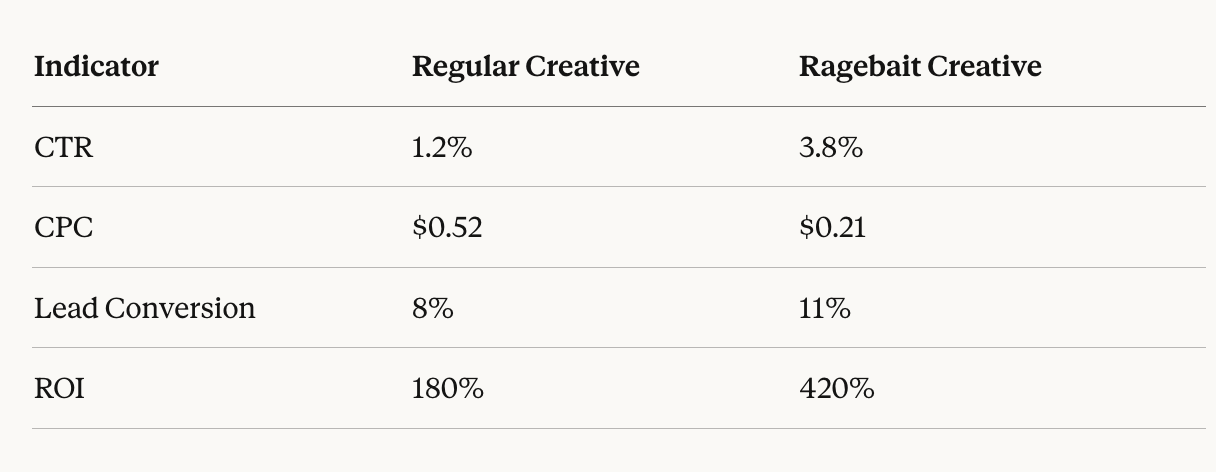
Result: With $5000 budget, provocative creative brought $8500 more profit.
Case 3: Personal Blog Growth from 300 to 5000 Followers
Affiliate: Blog about Facebook Ads, stuck at 300 followers.
Strategy:
- Post publication "99% of targetologists are charlatans. Here's proof"
- Detailed breakdown of typical mistakes with numbers
- Invitation to discussion in comments
Development:
- Post gained 450 comments in 48 hours
- 120 shares in niche groups
- Affiliate started being discussed in chats
- Wave of new followers: +1200 in a week
- After a month followers grew to 5000, engagement increased 4x
Key to success: After provocation, author released series of educational posts, securing new audience.
Conclusion: Balance Between Efficiency and Ethics
Ragebait is a powerful tool, but not a universal solution. Like a chainsaw: in skilled hands builds houses, in unskilled—cripples.
Main Takeaways:
- Ragebait works because it exploits evolutionary brain mechanisms. Social media algorithms amplify this effect.
- Dosing is critical. Provocations should constitute maximum 20% of content. The rest—real value.
- Risks are real. One unsuccessful post can cost an account, reputation, or partnership with advertiser.
- Ethics matter. Short-term gain from toxic provocations isn't worth long-term reputational losses.
- Test carefully. Start with soft provocations on safe topics. Track reaction. Scale only what works without negative consequences.
Your Action Plan:
This week:
- Analyze 10 viral posts in your niche
- Identify provocation patterns that worked
- Write 3 provocative headlines for your creatives
This month:
- Test one provocative post on personal account
- Launch A/B test: classic vs. ragebait creative
- Analyze results and adjust strategy
This year:
- Implement ragebait as one of the tools in arsenal (not the only one!)
- Build safety system: backup accounts, clear boundaries
- Scale what showed results
Remember: in affiliate marketing, the winner isn't who shouts loudest, but who knows how to manage audience attention. Ragebait is just one tool. Use it wisely, and it will multiply your results. Abuse it—and you'll lose trust forever.
The choice is yours. Take action.
Share this article
Send it to your audience or copy an AI-ready prompt.