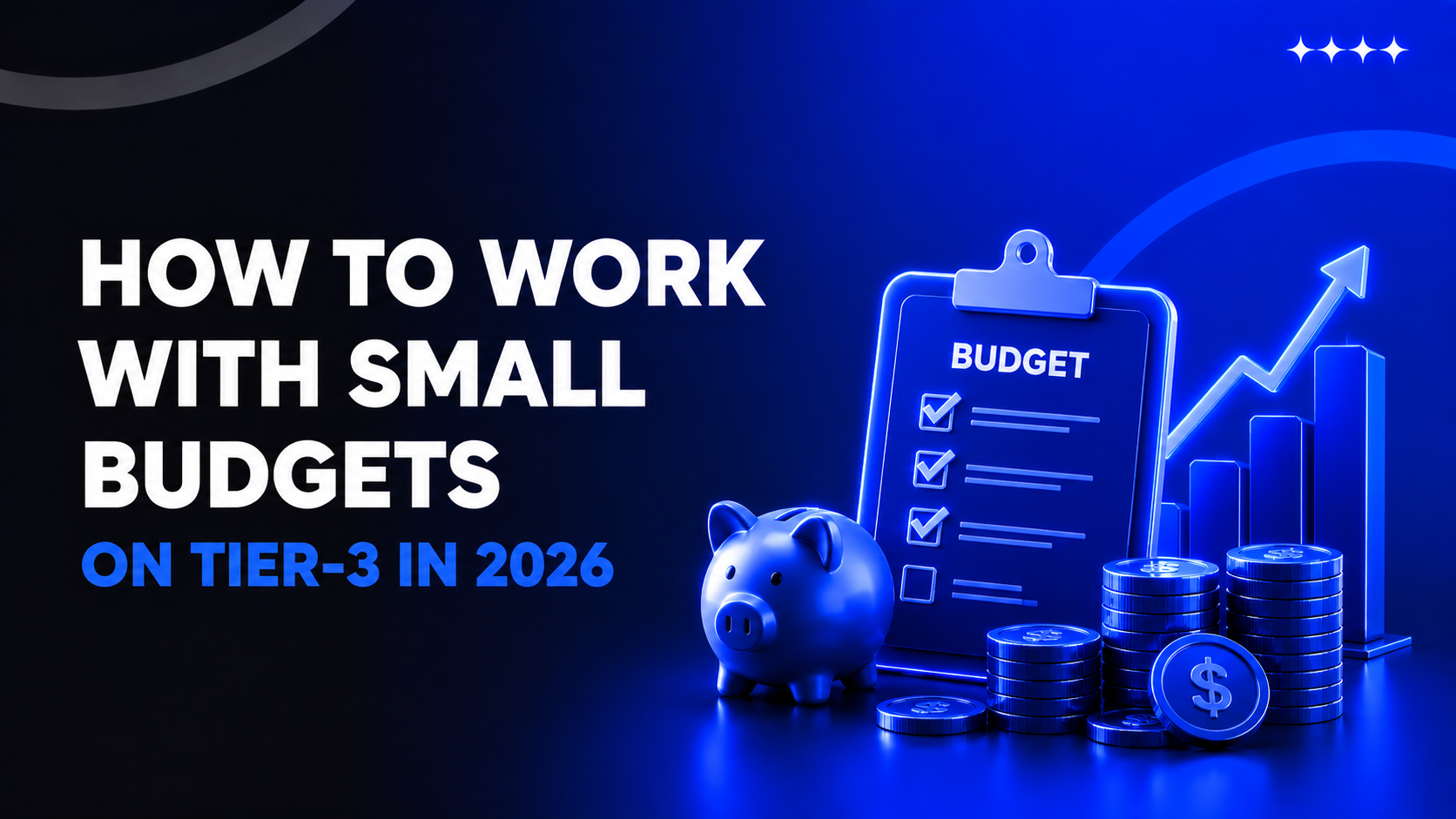
How to Work With Small Budgets on Tier-3 in 2026
Tier-3 is the market getting real attention in 2026 — and not by accident. Working with Tier-1 and Tier-2 countries sounds attractive, but the coin has two sides, and it's not as clear-cut as it looks.
Why does everyone seemingly rush toward Tier-3? Plenty of reasons, but the main one comes down to high prices and competition up top — more on that later.
The thing is, Tier-3 has its own advantages. The market lets you work with micro budgets, test profitably, and avoid diving into a deep minus every time you take one wrong step.
This article breaks down how to work with micro budgets on Tier-3 and what makes the approach different. Let's go.
Who actually wins across GEOs in 2026?
These days, only the buyers who think beyond budget and the other primitive parts of the job make it to the top of the arbitrage mountain. Get ready: now you need to feel your audience even better — to the point where you basically become part of it. It's the "you like my personality? don't worry, I have 20 more" energy.
Audiences should be analyzed more carefully everywhere, not just skimmed through a couple of basic metrics. On Tier-3 this matters even more. Income here is mostly unstable, and you'll often run into audiences with limited purchasing power. From that follows a set of logical conclusions about what's most likely to sell like hot cakes — an offer that reeks of "easy money," or anything that triggers emotion and presses on a pain point.
"No, I'm not short on cash — I just picked a different strategy"
Working with micro budgets really is different from simply running out of money. It's a strategy where you focus on saving on mistakes. A campaign can look like a sure win at first, but one wrong move — targeting too broad, a creative that wasn't picked carefully enough — and the budget evaporates as if it was never there.
So a micro budget isn't about "little money." It's about the extra nuances that both deliver results and make the work harder. The cost of a mistake goes up — which is exactly why the buyers who survive now are the ones who dig deep and build more complex funnels with precise math.
Here are the fundamentals you can't ignore when working with micro budgets:
- Pick fewer hypotheses and test them longer. Quality testing is just a matter of time. Time is what shows whether an offer works, whether something needs changing, and so on.
- Test cheaper. You don't want to burn the whole budget at the testing stage. Until you're sure the offer is relevant, don't pour too much into it. Start by collecting the first reactions from the audience — usually that's already enough to understand a lot.
- Treat a dead combo like the ex you should've left long ago. Sometimes one combination works for ages and quietly becomes your ideal. But you have to know when to accept reality: ideals burn out and stop performing miracles — especially if you're a buyer. The moment you see an approach stop working, cut it and bring in a new one.
- Don't price your tests by CPC. A common buyer mistake, and here's why: you really can find cheap clicks on Tier-3, but they almost always come with unpredictable audience behavior, uneven traffic quality, and so on. Calculate instead what the whole learning-and-validation stage actually costs.
- Log everything — even what seems trivial. Again, micro budgets are about more painstaking work, not "less money." A mistake is expensive. To avoid paying for it twice, track every detail, even the smallest.
Where to find traffic on Tier-3?
Now to the sources that work best on this market. One of the reasons people leave Tier-1 and Tier-2 for Tier-3 is the insane competition and expensive traffic at every turn. Tier-3 can offer relatively cheap sources, so there's plenty worth considering.
- Telegram. The messenger long ago outgrew the format of a simple chat app and built its own ecosystem of services and content. Ads in local channels, bot integrations, and simple mini-apps let you run targeted, predictable campaigns. The platform gives flexible control over spend, direct contact with channel owners, and fast feedback without complex technical setup.
- Local social networks. Tier-3 countries are full of local platforms where promoting offers is simpler. The auction isn't as overheated, and moderation is usually more forgiving.
- Push and in-page networks with manual bid management. People argue about how effective these are, but for Tier-3 markets they're a solid option. Their main advantage is control: you can set bids manually, exclude individual placements, manage frequency, and reallocate budget on the fly. Traffic quality can vary a lot, but on small budgets the ability to quickly test how the audience reacts to an offer matters more.
- Influencers. In Tier-3 countries, trust in local influencers with a few thousand followers runs high — sometimes higher than for big international brands or media personalities. Even on a limited budget you can run targeted integrations and check interest through small but engaged communities. You start with small sums, drop weak placements fast, and shift budget to more promising channels.
Wrapping up
If buyers used to ignore Tier-3 because of the smaller ceiling, in 2026 demand for these markets has clearly grown.
But the low expectations around how hard Tier-3 is create a false impression that it's actually easy. Yes, you can genuinely work with low budgets — but few admit upfront that a micro budget can quietly turn into wild spend.
Mistakes are expensive, so the smartest move is to save on them.
Share this article
Send it to your audience or copy an AI-ready prompt.