Brazil Pulls the Plug on Betting: What MP 1.394 Means for Media Buyers in 2026
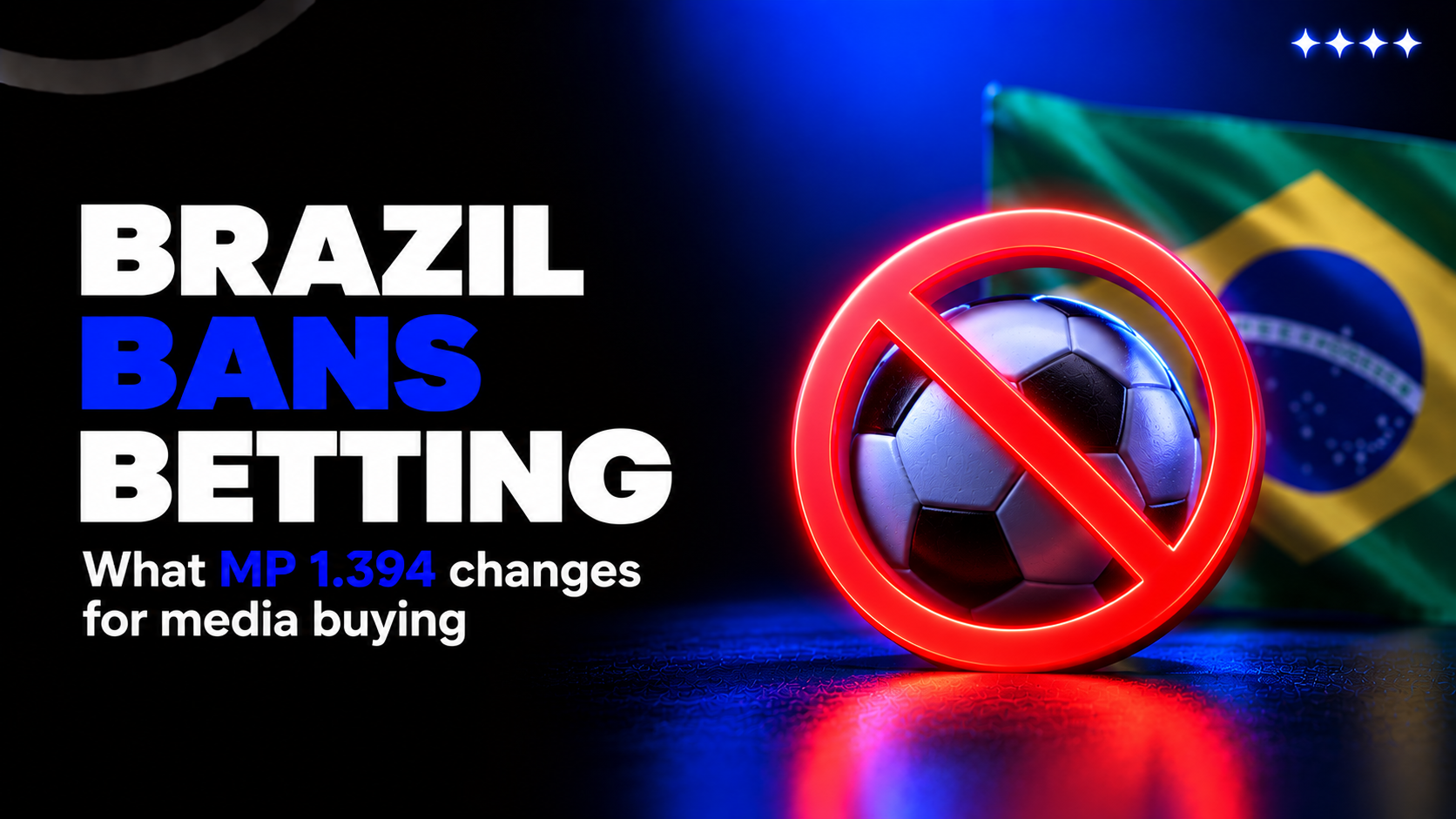
In January 2025 Brazil opened its federal licensed betting market, and within a year it ranked among the largest iGaming markets in the world. In September 2026 the country reversed course: legal sports betting and online casino are banned by presidential decree, licensed sites are going dark, and advertising is now unlawful.
For anyone who makes money on traffic, this is more than a regulatory headline. Latin America's biggest GEO has left the white market almost overnight. Below: what exactly was banned, where the grey areas are, what could happen after the election, and how to rebuild your budget allocation.
What was signed
On 25 September 2026, President Luiz Inácio Lula da Silva signed Provisional Measure (Medida Provisória) No. 1,394. It bans operating, offering, brokering and advertising fixed-odds betting (apostas de quota fixa), both online and in person.
The details that define its reach:
- The ban covers bets on real sporting events and online games driven by random number generators, meaning slots and casino, including the hugely popular "Tigrinho" (Fortune Tiger).
- Operators based abroad are explicitly included if they take bets from people located in Brazil. An offshore licence offers no cover.
- Licences issued by individual states are also extinguished.
- Other lottery products authorised by law are not affected.
A provisional measure is a presidential act with the force of law from the day it is published. Congress must approve it, amend it or let it lapse. The window is 60 days, extendable by another 60, and the clock pauses during the congressional recess. In practice, a final vote could slip into early 2027. Until then, the rules apply.
Timeline: the dates that matter
| Date | What happens |
|---|---|
| 25 September 2026 | Measure takes effect. New deposits and new advertising are banned |
| 5 October, 23:59 | Last day for players to withdraw. All ads and sponsor logos must be removed |
| 6 October | App stores, internet providers and CGI.br block sites and apps. Anatel relays orders to ISPs |
| 7–8 October | Operators send banks each player's balance by CPF (tax ID) |
| 9–14 October | Banks refund balances. State bank Caixa steps in where that fails |
| 25 October | Federal licences are formally extinguished. Same day: presidential runoff |
The licence fee of R30million(aboutUS5.8 million) for a five-year licence is not refunded, and the measure offers no compensation. Operators that fail to submit balance lists face a fine of R$200,000 per day.
The size of the market being shut
The 2025 numbers show how much demand is leaving the legal space:
| Metric | Value |
|---|---|
| Licensed companies | about 85 |
| Brands on .bet.br domains | nearly 190 |
| GGR (revenue after prizes) | R36.96billion(aboutUS7.1 billion) |
| Unique bettors | 25.2 million, roughly one adult in six |
| Online casino share of operator revenue | 70–80% by industry estimates |
| Federal taxes from the sector | about R$9.95 billion |
| Série A club sponsorship | over R$1 billion; more than half of the 20 clubs had a betting shirt sponsor |
One point stands out: casino, not football, generated most of the revenue. For media buyers, that means the most profitable product took the hardest hit — slots with fast FTDs and high LTV.
Why the government moved to a ban
The official rationale is household debt and gambling addiction. Central Bank data show debt payments took a record 28.9% of household income in June 2026, and a Central Bank director called betting a central element of that squeeze. Back in 2024, a Central Bank study found that people in Bolsa Família welfare households sent about R$3 billion to betting sites in a single month.
Public opinion backs the move: an Atlas/Bloomberg poll found 75% of Brazilians support banning online betting. The measure landed nine days before the first round of the presidential election, which matters for any forecast.
The ban caps a period of steady tightening. Earlier in 2026, betting ads were required to carry tobacco-style warnings, and the Supreme Court had already restricted advertising aimed at minors.
Ads, payments, platforms: what is actually prohibited
This is the section affiliates and buyers need most.
Advertising. All advertising, marketing and sponsorship of fixed-odds betting is banned. Existing materials and sponsor branding had to come down within ten days. The exception is previously published content where a brand appears incidentally, such as match coverage showing a logo on a shirt.
Platforms. Social networks and ad networks must stop serving betting ads, and app stores must remove betting apps. The Ministry of Justice can fine platforms up to 10% of their group's revenue in Brazil or, where there is none, R10toR1,000 per user, capped at R$50 million per infraction. With penalties like these, expect Meta, Google and TikTok moderation in Brazil to be as strict as it gets. Counting on creatives slipping through is pointless.
Payments. Banks and payment providers may no longer process betting transactions, including Pix, except to wind down operations and refund players. Pix was the dominant deposit method in Brazil, so the payment funnel for any Brazil offer is effectively broken.
Blocking. Sites are blocked through ISPs on Anatel's orders. The state was already fighting illegal sites: more than 25,000 domains were blocked between October 2024 and December 2025. The same machinery now points at everyone.
Criminal liability: a separate bill
Brazil's constitution does not allow crimes to be created by provisional measure, so the government sent a separate bill to Congress. The current draft proposes:
- four to six years in prison for operating fixed-odds betting, even under a foreign licence;
- two to four years for advertising betting, selling personal data to target bettors, and knowingly processing betting payments.
Journalistic, educational and critical content is exempt. The bill has not passed yet, but the direction is clear: advertising and player acquisition are moving from an administrative risk to a criminal one. The affiliate is named outright — whoever advertises and recruits.
Even before the bill passes, unlawful advertising can trigger liability under Brazil's Consumer Protection Code. It provides for administrative sanctions, civil claims and criminal provisions, and can reach not only the operator but also whoever creates and distributes the ad.
The grey areas
The measure leaves several questions open:
- What counts as content aimed at Brazilians. Portuguese language, a Brazilian domain, local influencers, the ability to register from Brazil? The measure sets no criteria. The safe assumption is the broadest reading.
- Legacy content. Reviews, rankings and SEO pages published before 25 September do not obviously qualify for the incidental-mention exception. If the brand is the point of the page, treat it as advertising.
- Court challenges. Constitutional challenges have been filed with the Supreme Court (STF): ADI 8024 by the Anseja association, ADI 8027 by ANJL, ADI 8028 by a mayors' association, plus a petition from broadcasters' association Abert. On 3 October, Flamengo asked Justice Luiz Fux to suspend the measure before 6 October. As of publication, no suspension has been granted, and the measure is in force.
- Compensation. Operators plan to sue to recover licence fees and investments. Industry estimates put potential claims as high as R$120 billion, though the figure is preliminary.
Politics as a traffic variable
In the 4 October first round, Senator Flávio Bolsonaro led with 47.04% to Lula's 45.15%. The runoff is on 25 October, the same day licences are extinguished.
The candidates' positions differ in a way that matters. Flávio called the ban populist and electioneering, yet pledged to ban online casino games like Tigrinho while signalling he would keep sports betting. Lula has framed it as a choice between ending betting and letting betting end Brazil.
That gives three baseline scenarios:
- Full ban holds. Congress approves the measure and the criminal bill passes. Brazil leaves the white iGaming market for the long term.
- Partial rollback. Congress or a new government brings back sports betting but keeps casino banned. The market restarts in a reduced form, without its most profitable product.
- Measure falls. The STF suspends it or Congress lets it lapse. Even then, recovery will be slow: licences, payment rails and player trust all have to be rebuilt.
In none of these scenarios does Brazil casino traffic return in its old form in the coming months. That is the key planning assumption.
Market reaction in numbers
Early data after the announcement show where demand is going:
- The Bet Legal monitoring system detected 377 unauthorised betting domains on 25 September and 981 on 28 September. That measures detected domains, not the size of the illegal market, but the trend is telling.
- According to analytics service Blask, offshore brands' share of iGaming demand rose from 3.4% on 24 September to 9.9% on 29 September — nearly tripling in five days.
- Affiliate coverage of the 20 most-promoted brands fell from 715 to 418 sites in a week, down 41.5%.
- Industry associations estimated that unlicensed sites already took 41% of all money wagered before the ban.
It is tempting to read this as "the demand is there, push offshore." The economics are worse than they look. Pix is blocked for betting, domains are short-lived, platform moderation is at its strictest, and advertising unlicensed operators is exactly what the bill makes a crime. The risk sits not only with the operator but with whoever brought the player in.
What media buyers should do now
- Audit live campaigns. Pause everything targeting Brazil in betting and casino, across push, native, in-app and influencer channels. Check retargeting and lookalike audiences built on Brazilian players.
- Clean up content. Reviews, rankings, landing pages and posts in Brazilian Portuguese featuring betting brands should be removed or reworked. Use the broadest reading of "content aimed at Brazilians."
- Revshare and holds. Brazilian revshare cohorts stop producing income. Check your partner terms: negative carryover, CPA holds, final payout dates. Get the affiliate program's position on closing Brazil deals in writing.
- Player data. Databases built on Brazilian traffic must not be sold or used to target bettors; the bill names this as a crime. Restrict access within your team.
- Accounts and pixels. Do not move Brazilian ad accounts with a betting history into other GEOs without checking them. A record of violations can follow them and trigger bans.
- Budget reallocation. Do not move freed-up budget in one block. Test new GEOs with small volumes and scale only on the CR, approval rate, EPC and ROI of each specific funnel.
- Brazil for other verticals. 213 million people, high mobile penetration and Pix are all still there. Brazil traffic expertise stays valuable in e-commerce, fintech, apps and other legal verticals.
Where to move volume: a LatAm overview
| GEO | Online gambling status in 2026 | What to adapt |
|---|---|---|
| Mexico | Runs on a 1947 law via SEGOB permits; reform under discussion | Second-largest market in the region. Different payment habits (SPEI, OXXO), creatives built around Liga MX. Risk of IEPS tax rising from 30% to 50% of GGR |
| Colombia | Most mature regulated market, supervised by Coljuegos | Strict compliance, licensed operators only, VAT changes in 2025–2026 |
| Peru | Federal licensing under MINCETUR since 2024 | Clear rules and a full first year of operation. A strong candidate for tests |
| Argentina | Regulated province by province; most have legalised online | Needs per-province adaptation; the operator's licence must cover the player's province |
| Chile | Bill approved in general terms by the Senate, not yet law. Supreme Court ordered ISPs to block unlicensed sites | High potential, but currently high risk. Watch the bill's progress |
The core rule: do not copy Brazil funnels one-to-one. Language (Spanish rather than Portuguese), payment methods, favourite leagues, attitudes to bonuses and even creative formats all differ. Each GEO is a fresh test.
There is a wider point too. Brazil may set a precedent: Argentina has debated advertising bans, and Mexico faces a tax hike. Diversifying your GEO portfolio is no longer optional; it is a condition for staying in business.
What to watch next
- The STF ruling on ADI 8024, 8027 and 8028.
- The 25 October runoff result and the winner's first statements on betting.
- The congressional committee on MP 1.394 and any amendments on sports betting.
- Progress of the criminal bill.
- Data on offshore domain blocking and payment enforcement after 6 October.
The bottom line
In under two years, Brazil went from Latin America's most promising licensed market to a full ban. Demand for betting has not disappeared, but legal access to it is closed, payment channels are cut, and advertising is on its way to becoming a criminal offence.
The winners will not be those who try to squeeze the last drops out of Brazil traffic. They will be those who rebuild their portfolio fastest: clearing out risk, closing Brazil deals on clear terms, and finding working economics in Mexico, Peru, Colombia and Argentina. The next two months will show whether the ban is final or whether Brazil comes back in a reduced form.
Share this article
Send it to your audience or copy an AI-ready prompt.