17 Years of Free Advertising — and Minecraft Finally Ships an Affiliate Program
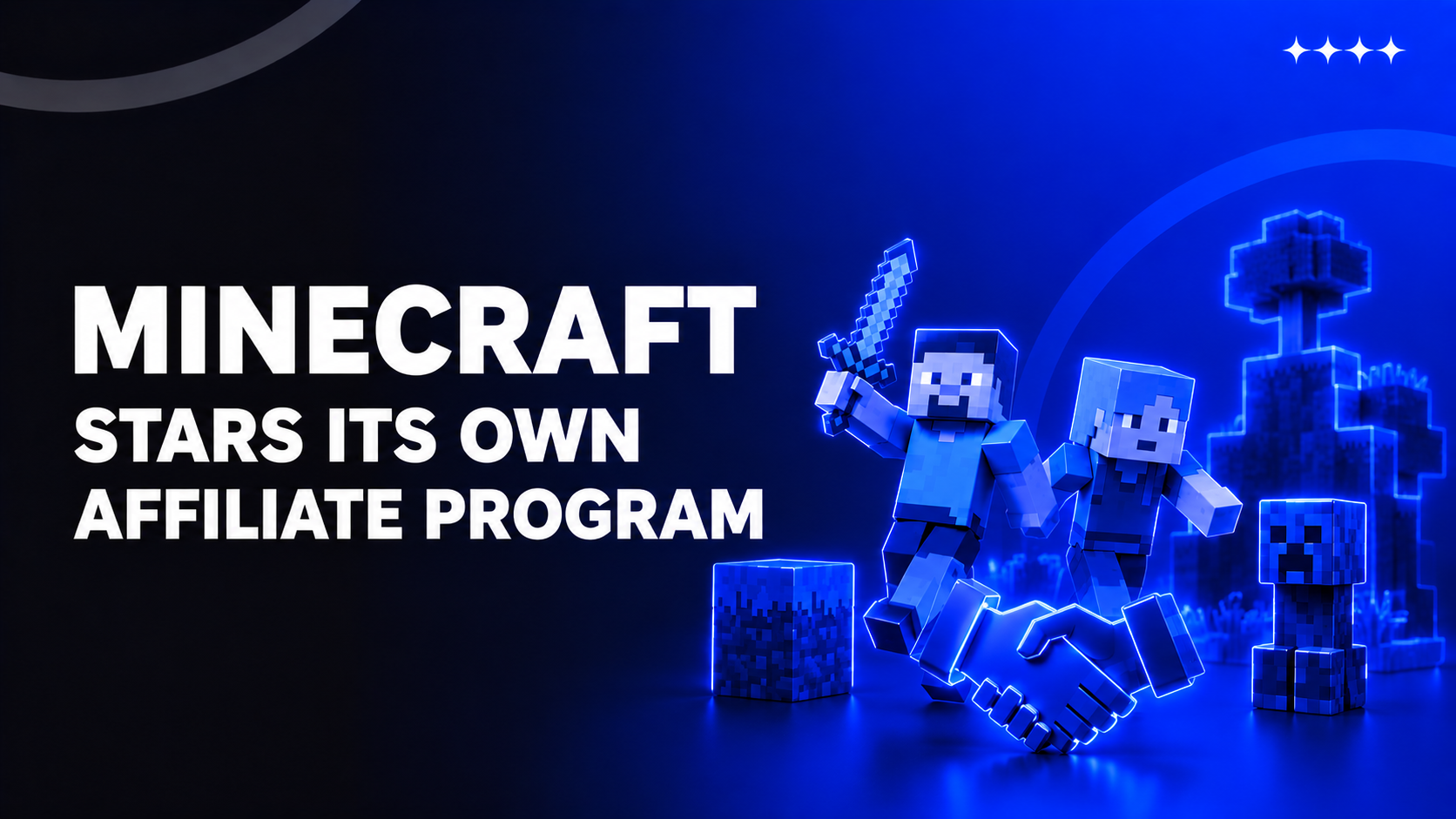
Minecraft turns 17 in 2026 and is still the best-selling video game in history, with more than 300 million copies sold and over 200 million monthly active users. For nearly two decades, millions of YouTubers, streamers, and content creators advertised the game for free. In June 2026 that finally changed: Minecraft launched its first-ever affiliate program.
Below is a breakdown of how the product works, what shifted in the approach to creator monetization, how much there is to earn, and why this launch points to a broader trend in gaming — one that opens a clean, white niche for affiliates and media buyers.
How the Minecraft affiliate model works
The model runs on automation from impact.com. Every partner receives a unique tracking link or QR code that can be dropped into videos, streams, bios, or social posts. When a user clicks through and buys something on the web version of the Minecraft Marketplace, the system records the action and credits a percentage.
The starting commission is 5%. It is paid on purchases of unique digital content — in-game add-ons, skin packs, texture packs, mash-up packs, adventure maps, custom mini-games, and survival spawns.
Commission is also credited when a buyer pays for an eligible product using the in-game currency, Minecoins. However, a standalone Minecoins purchase on its own is not monetized — only Minecoins applied toward a qualifying product count.
No commission is paid on the Minecraft game license itself, on basic character (persona) customization items, or on Minecraft Realms server subscriptions. In short, earnings are tied strictly to driving Marketplace content sales.
Who can join, and how onboarding works
The registration flow lists a wide range of partner categories, which signals that the program is not aimed only at large traditional influencers. Applicants include text and video reviewers, owners of deal, promo-code, and comparison sites for gamers, newsletter operators, and community managers. Applicants must be 18 or older.
After selecting an activity model, partners connect their promotion channels: websites, social profiles, mobile apps, or podcast platforms. Once sources are reviewed by moderators and the data is confirmed, the partner gets access to a personal dashboard with analytics. Because of expected application volume, approval can take up to a month.
Technical terms and traffic restrictions
This is where media buyers should read closely.
The program currently targets Tier-1 and large Tier-2 markets only. Commission is credited solely when the buyer is located in one of these countries: the United States, United Kingdom, Germany, Japan, Canada, France, Australia, Italy, Mexico, Brazil, South Korea, Poland, the Netherlands, or Spain. Purchases from any other geo generate no payout.
Attribution runs on a standard Last Click model: the conversion is credited to the partner whose link the user clicked last before buying. The attribution window is 14 days — if a user clicks but decides to purchase within two weeks, the partner still earns the percentage.
Earnings are held: actions lock roughly a month after the end of the month in which they were tracked, and approved transactions are paid in US dollars about 20 days after they lock. Budget your cash flow accordingly.
The biggest constraint for paid-traffic teams sits in the Media Partner Tracking Pixel clause of the program terms. Partners are explicitly forbidden from installing their own conversion-tracking pixels on the advertiser's side. In practice, that means you cannot pass purchase data into third-party trackers in real time — all analytics live inside the impact.com dashboard. As a direct consequence, it becomes difficult to set up automatic campaign optimization in Facebook or Google Ads against real conversions, since the platforms never receive the conversion signal. Anyone planning to scale with paid media needs to account for this from day one.
The brand has also fully insulated itself against refund risk. If a buyer cancels an order or the system flags suspected fraud, up to 100% of accrued commissions can be voided. And the terms are not fixed: the rules and payout rates can change with just one day's notice to partners.
Day-to-day operation is additionally governed by the public Affiliate Guidelines, which define how partner links may be used, content-disclosure requirements, and the exact list of actions that earn commission.
The tech backend and the franchise's media momentum
The chosen backend is impact.com, which automates partner discovery, link tracking, click attribution, and payouts through its Creator and Performance products. The platform supports several partner types at once — creators, publishers, educators, and Marketplace partners — under one roof.
The launch lands on the back of a franchise surge. The Minecraft Movie was a major box-office success, grossing well over $900 million worldwide, and a global brand tie-in further widened the franchise's reach. The gaming business has continued to be a strong revenue contributor for Microsoft.
The case cleanly illustrates how brands are changing their approach to marketing. Large companies are gradually moving away from classic pay-for-reach toward result- and ROI-linked models. Software like impact.com turns influencer marketing into a predictable business channel, where every payout is allocated automatically inside the platform.
That opens new ground for UGC creators. Marketplace add-on developers — who have collectively earned more than $500 million — can now generate their own affiliate links to their products and share them with streamers and media buyers for a cut of sales. A clear example of this approach is studios promoting custom maps by publishing gameplay trailers and driving traffic to the Marketplace. With the new affiliate layer, content creators can scale those sales and recruit outside bloggers or arbitrage teams for a share of the profit.
How creator commerce works in gaming
Minecraft holds its status as the best-selling game ever, with 300 million-plus copies and more than 200 million monthly active users. Previously, community activity on YouTube and Twitch grew organically and produced little beyond brand awareness. The new program lets the publisher convert that traffic into a managed sales channel — and the gaming audience leans heavily on creator recommendations when hunting for add-ons or maps through TikTok or Twitch.
The affiliate model closes that loop. A creator can route a user straight to a ready-made link, and the developer pays commission only on an actual purchase. Content and sales become a single system where the reward is tied exclusively to a confirmed result.
For media buyers and content media, this opens a fully white niche: traffic from reviews on TikTok or in Telegram channels can be monetized through affiliate links to Marketplace products. No grey verticals, no compliance landmines — a mainstream, brand-safe offer with measurable payouts.
Takeaways
Minecraft and impact.com have moved community monetization into a format where income depends directly on results. Streamers, gaming media, and mod developers can now earn a direct percentage on every in-game order.
The platform fully automates the process, so instead of getting paid for views, creators receive transparent earnings based strictly on real user purchases. For affiliates and media buyers, the offer is attractive on brand safety and scale — but the no-own-pixel rule, the held payouts, and the aggressive void clause mean the economics have to be planned, not assumed.
Share this article
Send it to your audience or copy an AI-ready prompt.